




Cased Scientific Gauge
These cased scientific gauge pieces are precision instruments housed in fitted boxes, prized by collectors for their blend of accurate measurement and fine Victorian or Georgian craftsmanship.
Cased Scientific Gauge
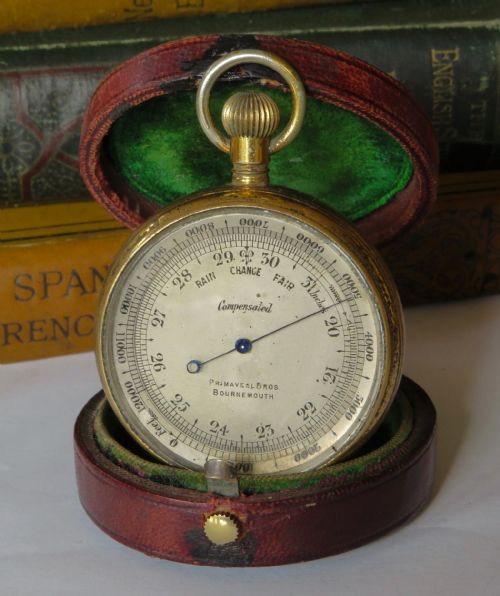
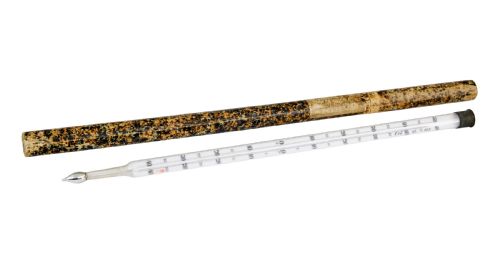
A cased scientific gauge brings together precision measurement and dedicated fitted housing, designed to protect delicate instruments during travel or storage. You will frequently encounter pocket barometers, travel thermometers, and barographs housed in mahogany, walnut, or leather cases.
The selections span from the eighteenth century through the Victorian era and into the early twentieth century. These instruments range from wall thermometers and barometer combinations to specialised devices like anemometers and galvanometers.
Makers housed these instruments carefully in fitted velvet or leather linings to ensure safety and longevity. Finding a cased scientific gauge in its original fitted box offers a direct connection to how these precision tools were utilised and stored.
How they were made
Craftsmen utilised brass and silvered metal for dials and internal mechanisms, combining durability with clear legibility. Cases were constructed from solid mahogany or walnut, often featuring fitted interiors lined with velvet or leather.
Specialist makers engraved scales and markings by hand onto metal plates to ensure accurate readings. The exterior woodwork received polish and fitted brass hardware to withstand regular handling.
Listings feature mahogany, walnut, brass, and silvered metal materials across Victorian and Georgian periods.
What varies in quality
The distinction between standard examples and superior pieces rests on the precision of the mechanics and the quality of the timber housing. Finer instruments feature signed silvered metal dials and bespoke mahogany cases built by recognised makers.
The integrity of the original fitted case significantly influences the standing of the piece. Matching original velvet or leather linings and undamaged glass covers indicate a higher tier of preservation.
Poulenc Freres of Paris·Alfred Apps·George Adams of Fleet Street·Alexander Wright·Short and Mason London·Cox of Plymouth Dock·Thomas Harris and Son·F. Robson Newcastle
The Cased Scientific Gauge Glossary
- Barograph
- A self-recording barometer that produces a continuous trace of atmospheric pressure on a paper chart. These instruments are frequently housed in mahogany or walnut cases featuring chart drawers.
- Hygrometer
- An instrument used for measuring humidity levels in the air. Saussure hair hygrometres utilise human hair to detect moisture changes.
- Galvanometer
- An instrument utilised for detecting and measuring electric current. Pocket versions were built into protective travel cases.
- Anemometer
- A device for measuring wind speed and direction. High-speed examples were cased for field use.
- Altimeter
- A gauge that measures altitude relative to a fixed level. Pocket barometer altimeters combined pressure reading with height measurement.
Cased Scientific Gauge: Frequently Asked Questions
What is a cased scientific gauge?
A cased scientific gauge is a measuring instrument, such as a barometer, thermometer, or anemometer, housed in a fitted protective box. These wooden or leather cases kept delicate mechanisms safe during transport or storage.
Such items represent the intersection of practical science and fine cabinetmaking from past centuries. Collectors value them for their mechanical ingenuity and original fitted presentation.
How were these instruments used?
These instruments served various domestic, navigational, and meteorological purposes, from recording daily air pressure to measuring wind speed. Owners placed them in studies, on ships, or carried them on travels.
Many devices were designed for specific professions, such as meteorology or engineering. Their portable nature meant that protective cases were essential for daily function.
How do I care for a cased gauge?
Cased scientific gauges require stable indoor humidity and protection from direct sunlight to preserve the wood and internal metal components. Keep the wooden exterior polished with appropriate wax and handle the glass covers with care.
Avoid attempting internal mechanical repairs unless handled by a professional specialist. Regular gentle dusting of the case and interior velvet will maintain the presentation.
How can I tell the period?
Dating relies on the style of the case woodwork, the typography on the metal dials, and the maker's signature or patent details. Georgian and Victorian pieces often feature hand-engraved brass plates and solid mahogany boxes.
Later Edwardian and early twentieth-century examples incorporate different numbering styles and modified materials. Comparing the maker's recorded active dates provides a reliable timeframe.