


Carved Wooden Room Partition
A carved wooden room partition divides a space with texture and craftsmanship, bringing architectural presence and rich decorative detail into a home.
Carved Wooden Room Partition
A carved wooden room partition creates flexible divisions within larger spaces using hinged panels that fold easily when needed. These pieces take the form of folding screens, room dividers, and fire screens originating from various global traditions.
The selections span distinct periods including the nineteenth century, Edwardian era, and the early twentieth century. Examples range from compact three-fold designs to substantial eight-fold panels.
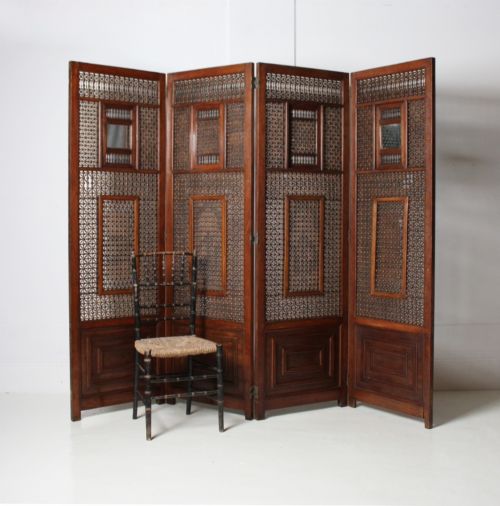
Origin styles include Chinese Republic Era and coromandel works, Japanese export pieces, Anglo-Indian and Burmese items, Islamic Revival mashrabiya panels, and European Art Nouveau and Edwardian interpretations.
How they were made
Construction relies on solid hardwoods such as mahogany, oak, padauk, and general hardwood frames built to support multiple folding sections. Joinery includes intricate fretwork and pierced lattice panels.
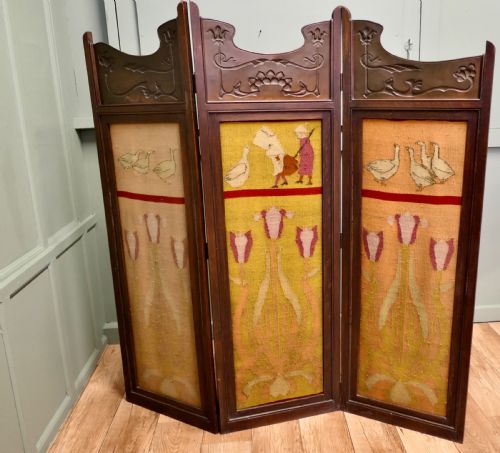
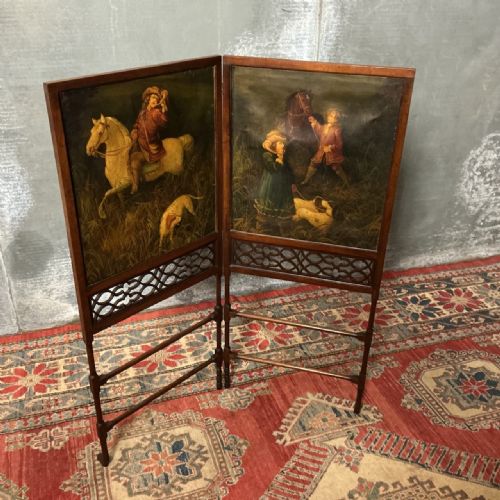
Surfaces receive elaborate treatments including black lacquer, coromandel lacquer, gilding, and applied brass or copper fittings. Some panels incorporate painted scenes, oil paintings, naive wool panels, or carved dragon motifs.
Some screens hide unexpected textures behind their formal woodwork, mixing carved dragons with naive wool panels.
What varies in quality
The depth and crispness of the hand-carving distinguish finer pieces from simpler productions, particularly on intricate mashrabiya work or dragon motifs. The quality of the underlying hardwood and the structural integrity of the hinges dictate longevity.
Surface artistry creates another major distinction, ranging from richly layered coromandel lacquer and detailed giltwood to simpler painted or textile inserts. The scale and number of folds also influence the architectural impact of the piece.
The Carved Wooden Room Partition Glossary
- Mashrabiya
- A traditional architectural element featuring turned wooden lattices used for windows and partitions. This technique allows air circulation while providing privacy.
- Coromandel
- A type of Chinese lacquered screen where the wooden base is coated in dark lacquer, incised with designs, and filled with colours and gold. It derives its European name from the Indian coast where trading ships stopped.
- Padauk
- A heavy, durable tropical hardwood prized for its rich reddish-brown colour and stability in fine furniture. It was frequently utilised in high-status carving.
- Fretwork
- Ornamental perforated or cutout woodwork created through piercing. This technique forms intricate geometric or organic patterns across panels.
Carved Wooden Room Partition: Frequently Asked Questions
How do you use a room divider?
These folding panels divide open-plan rooms, create private dressing areas, or conceal utilitarian zones within a living space.
Position them flat against a wall as decorative art or angle the folds to create a freestanding architectural barrier.
What is a coromandel screen?
A coromandel screen is a heavy Chinese folding panel coated in dark lacquer and intricately carved with figures, landscapes, or flora.
Master artisans incised the design into the hardened lacquer surface and filled the recesses with pigments or gold leaf.
How do you care for lacquered wood?
Maintain lacquered surfaces by dusting gently with a dry, soft cloth to prevent abrasive particles from scratching the delicate finish.
Keep these screens away from direct sunlight and fluctuating radiator heat to protect the wood and lacquer from cracking.
How many folds do these screens have?
The screens vary widely in width, appearing as compact three-fold arrangements or expansive structures containing four, eight, or more panels.
Heavier multi-fold panels require careful placement to ensure stability when angled across a floor.