
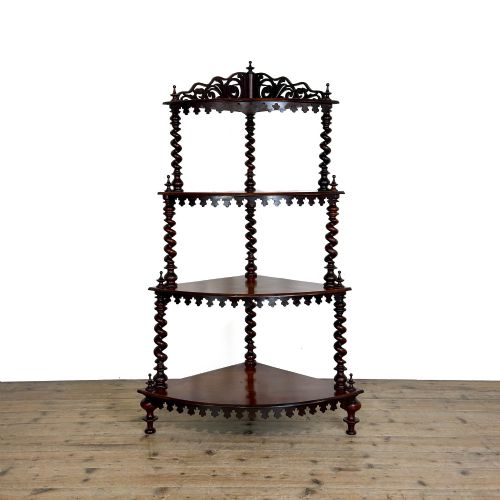




Carved Wooden Corner Shelf
These carved wooden corner shelf pieces bring practical tiers and rich timber to neglected angles, turning empty corners into display space.
Carved Wooden Corner Shelf
A carved wooden corner shelf puts unused room angles to work, utilising tiered tiers and brackets designed to fit tight junctions. Buyers find these configured as multi-tiered whatnots, wall-mounted display stands, and floor-standing corner cabinets.
Most examples belong to the Victorian era and the nineteenth century, running from mid-century burr walnut to later Edwardian and Anglo-Moorish interpretations. Formats range from open shelving units to mirrored cabinets and glazed cupboards.
The assortment includes regional variations such as Irish and West African padouk pieces alongside continental Sorrento inlaid olive wood. Alongside traditional corner shelves, related forms like occasional tables and tiered stands appear within the selection.
Materials and construction
Cabinetmakers built these pieces using dense hardwoods like mahogany, walnut, burr walnut, and kingwood, often enhanced by intricate marquetry and inlay. Olive wood and padouk bring varied grain patterns and tonal contrasts to specific regional works.
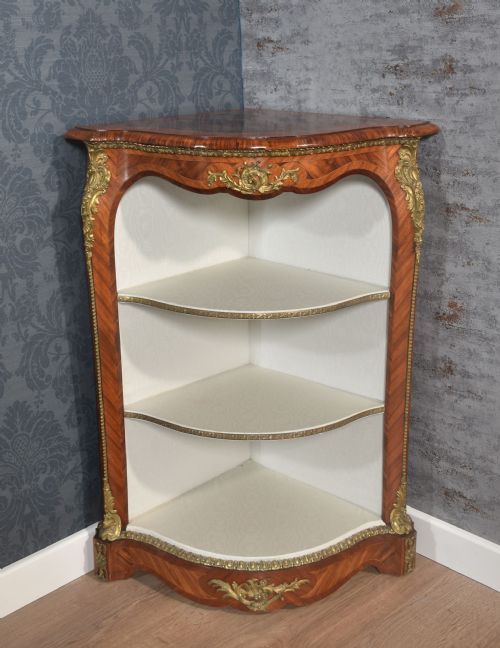
Structural embellishments rely on brass fittings, ormolu mounts, and carved pine elements, supported by barley twist turnings and mirror glass panels. Surfaces feature detailed hand-carving alongside precise joint work designed to bear weight at ninety-degree angles.
Design styles represented include Victorian Rococo Revival, French Rococo, Georgian, Colonial, and Anglo-Moorish.
Judging quality and execution
Quality rests in the selection of timber figures, such as highly figured burr walnut or exotic kingwood veneers, matched with crispness in the hand-carved details. Strong architectural proportions and secure joints distinguish finer examples from standard production pieces.
The refinement of secondary decorative elements, including ormolu mounts, inlaid marquetry, and turned barley twist supports, elevates an object. Original surfaces and integrated hardware preserve the integrity of the piece far better than later alterations.
Liberty & Co.
The Carved Wooden Corner Shelf Glossary
- Whatnot
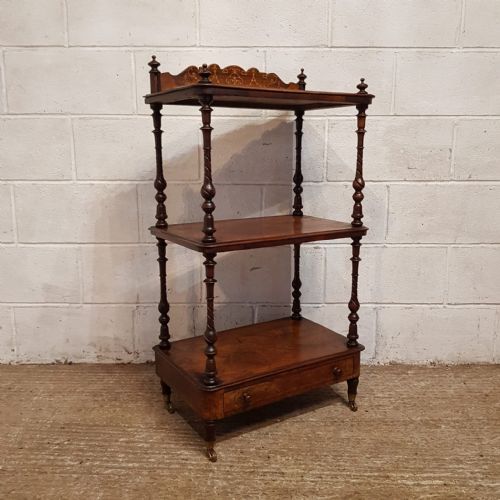
- A piece of furniture consisting of a set of open shelves for displaying small objects. These tiered stands developed during the nineteenth century to hold ornaments and books.
- Marquetry
- Decorative veneer work formed by small pieces of wood fitted together to create pictorial or geometric patterns. This technique decorates surfaces on nineteenth-century examples.
- Ormolu
- Gilded bronze ornamentation applied to furniture mounts and corners. Makers used these metal accents to highlight the contours of fine cabinets.
- Padouk
- A heavy, durable tropical hardwood with reddish tones. Craftsmen utilised this timber for colonial and regional shelving units.
- Barley Twist
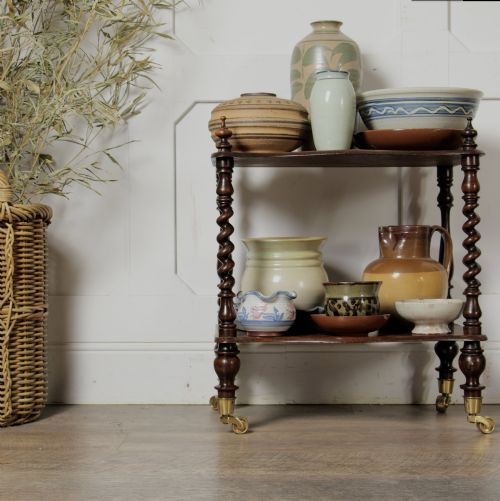
- A turned wooden column carved in a spiral shape resembling twisted barley. This decorative support appears frequently on Victorian stands and whatnots.
Carved Wooden Corner Shelf: Frequently Asked Questions
How do I hang a corner shelf safely?
Most wall-hung units rely on secure fixing brackets screwed directly into timber studs or masonry behind the plaster. Ensure the weight rests evenly across the upper and lower support points.
For heavier Victorian whatnots or cabinets, additional floor support prevents the bracket fixings from pulling loose under sustained loads.
How do I care for walnut and mahogany shelves?
Dust regularly with a soft, dry cloth to prevent grit from settling into the carved details and wood grain. Avoid placing pieces in direct sunlight or near heat sources that cause timber to dry and split.
Apply a microcrystalline wax periodically to nourish the surface polish without building up greasy residues.
How can I tell a Victorian piece from an Edwardian one?
Victorian items often display heavier carving, darker walnut or mahogany timbers, and elaborate details like mirrored backs or barley twist supports. They lean towards rich, dense ornamentation.
Edwardian examples tend to feature lighter woods, simpler structural lines, and more restrained decorative carving reflecting changing domestic tastes at the turn of the twentieth century.