
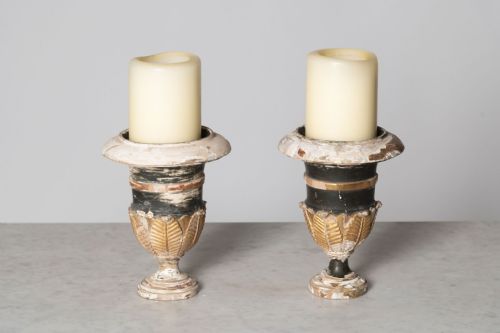


Carved Wooden Candleholders
These carved wooden candleholders bring architectural weight and rich surface texture to a room, ranging from grand Italian altar pieces to sturdy English oak pairs.
Carved Wooden Candleholders
When you search for carved wooden candleholders, you encounter a diverse range of forms spanning centuries of craftsmanship, from domestic table candlesticks to monumental church altar pieces. The selection includes pairs shaped as barley twists in oak, folk art figures, and grand giltwood creations designed for country houses.
Most pieces date from the eighteenth and nineteenth centuries, drawing on styles such as Italian Neoclassical, Baroque, and Jacobean Revival. You will frequently find pairs featuring brass sconces, polychrome paint, or silvered mecca finishes alongside traditional turned timber.
How they were made
The foundation of these objects relies on hardwoods like oak and mahogany, shaped through manual turning or intricate hand carving. Artisans applied finishes such as gesso, gold leaf, and polychrome paint directly onto the timber base.
Many items incorporate functional metal elements, attaching brass candle tops or sconces to protect the wooden structure from heat and wax. Silvering techniques, including mecca finishes, were utilised on Italian altar-type sticks to mimic more expensive metals.
The listings span from seventeen-fifty to nineteen-twenty, incorporating materials such as gesso, giltwood, brass, and hardwood across multiple European and Anglo-Indian styles.
What varies in quality
The distinction between standard domestic items and superior examples lies in the depth and precision of the hand carving. Pieces featuring figural work, such as folk art poachers or Blackamoor figures, demand a higher level of sculptural skill than simple turned columns.
Surface treatment also dictates distinction, where layered giltwood, genuine gold leaf, and preserved polychrome paint elevate an object above plain stained or polished timber.
The Carved Wooden Candleholders Glossary
- Giltwood
- Wood that has been coated with gold leaf or gold paint. This technique was widely used in Baroque and Neoclassical lighting to create a reflective, luxurious surface.
- Barley Twist
- A turning style resembling a spiralling rope column. It became popular in English oak furnishings during the Jacobean Revival.
- Mecca
- A transparent golden varnish applied over silver leaf or silvered surfaces. It creates the warm illusion of gold on Italian altar-type candlesticks.
- Polychrome
- Decoration employing several colours applied to the surface. It often appears on folk art or continental pieces to highlight carved details.
- Torchere
- A tall decorative stand or candlestick designed to hold a light. These monumental pieces often stood on the floor rather than a table.
Carved Wooden Candleholders: Frequently Asked Questions
How do I clean wooden candleholders?
Dust the carved surfaces gently with a dry, soft brush to prevent dirt accumulation in the recesses of the timber.
Avoid using liquid cleaners or polishes, particularly on pieces with giltwood, silvered mecca, or polychrome paint finishes.
How do I identify Italian altar sticks?
Italian altar-type candlesticks often display impressive proportions, intricate giltwood decoration, and silvered mecca surfaces.
They frequently draw on Baroque or Venetian styles, reflecting their origins in ecclesiastical or grand domestic settings.
What is the difference between a candlestick and a torchere?
Candlesticks are typically smaller objects designed to sit on tables, mantelpieces, or sideboards.
Torcheres are monumental, tall stands built to hold lights at a higher level from the floor.