
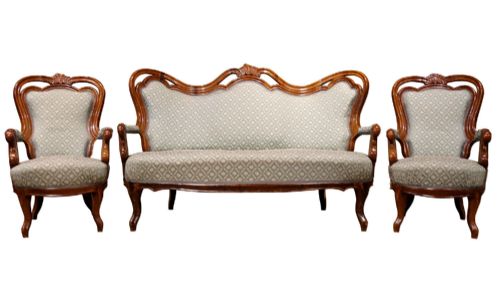
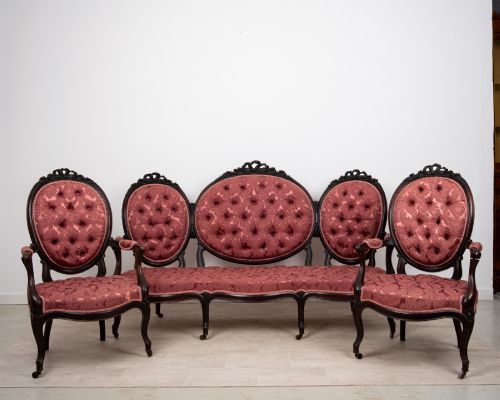


Carved Wood Sofa Suite
A carved wood sofa suite brings dramatic historic seating into a room, offering matched sets of settees and armchairs built to impress.
Carved Wood Sofa Suite
A carved wood sofa suite comprises matched sets of seating, typically pairing a central settee or sofa with complementary armchairs designed for formal reception rooms. These suites emerge primarily from the nineteenth century, alongside earlier eighteenth century examples, spanning diverse stylistic revivals. Buyers encounter salon suites, lounge suites, and drawing room suites configured for grand interiors.
The configurations vary from three-piece settings to larger drawing room suites numbering up to seven pieces. Frames feature elaborate carved woodwork executed in walnut, mahogany, padauk wood, or giltwood, often upholstered in deep buttoned fabrics, damask, or leather. These groupings reflect the formal entertaining habits of Victorian and continental households.
Materials and construction methods
Cabinet makers utilised dense hardwoods including walnut, mahogany, and padauk wood to construct the load-bearing frames and carved ornamental details. Artisans shaped these timbers by hand, applying deep relief carving to crest rails, cabriole legs, and arm supports. Giltwood finishes provided an alternative opulent surface treatment for French revival pieces.
Upholstery techniques involved traditional stuffing methods paired with horsehair or springs, secured beneath layers of fabric, damask, or leather. Deep buttoning secured the padding while creating distinct geometric patterns across backs and seats. Brass elements occasionally reinforced structural joints or decorated foot terminals.
Lion hand-carved details stare out from wooden armrests, keeping a silent, watchful guard over the parlour.
Distinctions in craftsmanship and design
The depth and crispness of the hand carving separate standard production frames from exceptional examples. Superior suites exhibit sharp, undercut details in the wood foliage and figures, whereas lesser pieces display softer, shallower ornamentation. The choice of primary timber also dictates quality, with finely figured walnut and padauk commanding greater attention than plain secondary woods.
Cohesion across the suite determines its overall integrity. The finest suites maintain strict uniformity in timber selection, carving motifs, and upholstery finishing across every chair and settee. Altered frames or mismatched pieces assembled at later dates lack the visual harmony intended by the original maker.
The Carved Wood Sofa Suite Glossary
- Salon suite
- A coordinated set of seating furniture designed for formal entertaining in a Victorian drawing room or parlour. It typically includes one settee and a pair of matching armchairs.
- Giltwood
- Timber that has been coated with a thin layer of gold leaf or gold paint. This technique creates a brilliant reflective surface popular in French revival furniture.
- Damask
- A reversible figured fabric woven on a jacquard loom, featuring patterns formed by contrasting warp and weft threads. It frequently upholsters formal nineteenth century seat furniture.
- Cameo back
- An upholstered chair back shaped in an oval or medallion outline resembling a carved cameo gemstone. This design is characteristic of mid-nineteenth century Victorian seating.
- Padauk wood
- A heavy, durable tropical timber known for its rich reddish-brown colour and fine grain. It appears frequently in colonial furniture imported from India.
Carved Wood Sofa Suite: Frequently Asked Questions
What is a salon suite?
A salon suite is a matched collection of upholstered seating designed to furnish a formal reception room. These sets usually comprise a settee paired with matching armchairs.
Such suites allowed nineteenth-century hosts to provide uniform, elegant seating for guests during social calls and gatherings.
How were these suites used?
These seating groups served as the focal point for formal entertaining in Victorian and continental drawing rooms. They furnished spaces dedicated to receiving visitors and displaying household status.
The matching chairs and settees created a cohesive decorative scheme within the principal rooms of grand houses.
How do I care for leather upholstery?
Leather upholstery on antique suites requires gentle cleaning with a soft, dry cloth to remove dust. Conditioning treatments help maintain the suppleness of older hides.
Keep these pieces away from direct sunlight and heat sources to prevent the leather from drying out or cracking over time.
How do I identify French revival styles?
French revival suites feature characteristic Louis XV or Louis XVI elements such as cabriole legs, carved floral crests, and exposed giltwood frames. The ornamentation mimics the curves and symmetry of eighteenth-century court furniture.
Craftsmen revived these classical motifs during the nineteenth century for fashionable European and British interiors.