


Carved Walnut Weather Instrument
These carved walnut weather instrument pieces combine practical barometers with rich timber work, giving any wall useful science and fine Victorian design.

Carved Walnut Weather Instrument
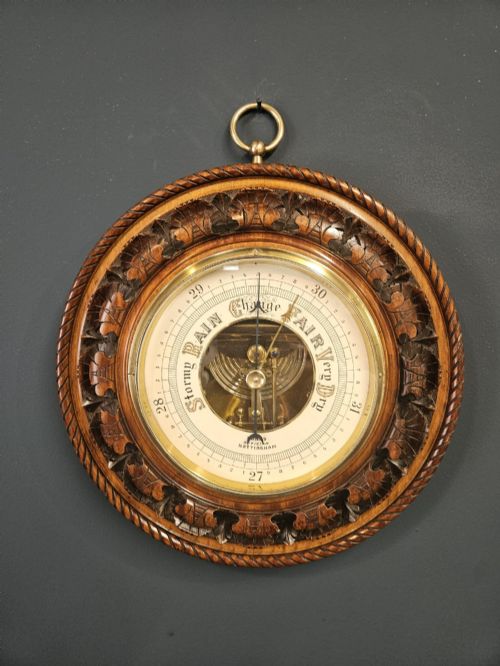
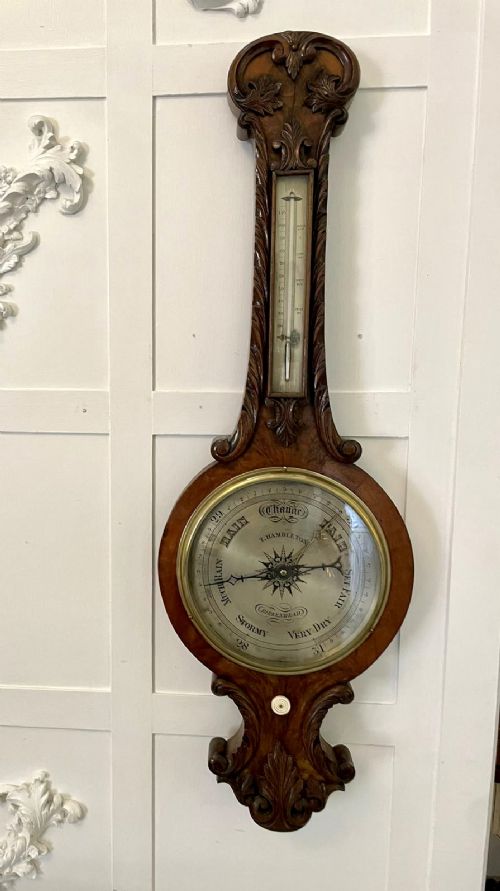
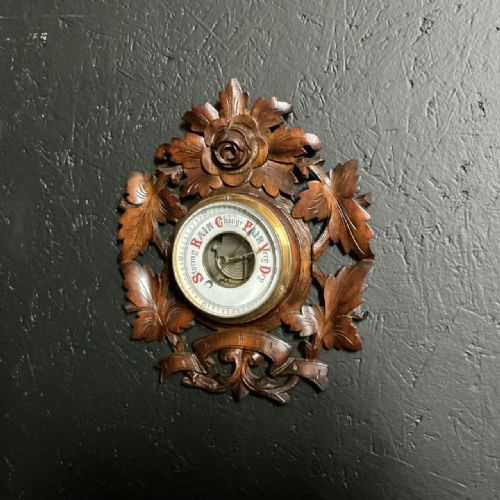
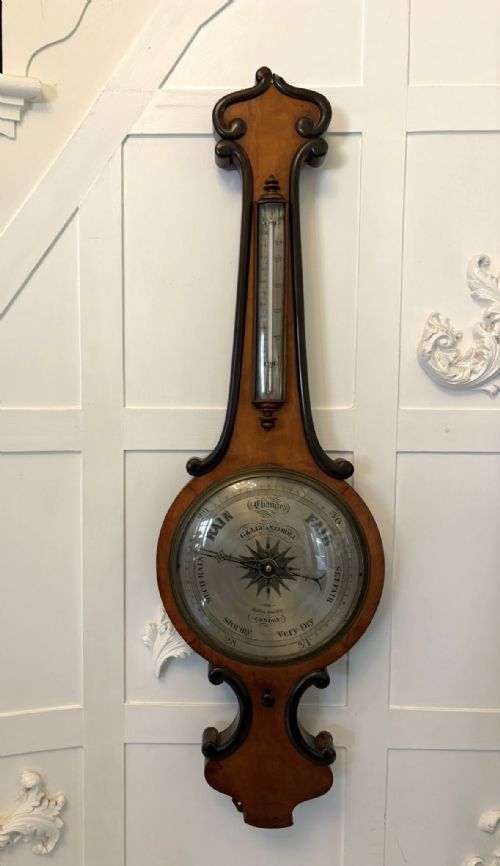
A carved walnut weather instrument brings together domestic recording tools and ornate woodwork, spanning wall barometers, stick barometers, banjo barometers, and combined clock barometers. You are looking at pieces primarily from the nineteenth century, including Victorian, Edwardian, and specific regional aesthetics like Black Forest styles.
The most common examples you will meet on this page are aneroid and mercurial barometers housed in heavily carved timber cases. These range from banjo and wheel formats to stick barometers, often incorporating ceramic dials and thermometer scales alongside the main weather glass.
Makers from London such as G & L Guanziroli and Negretti & Zambra appear alongside continental European and Scandinavian workshops. This variety means you encounter domestic British wheel models as well as deeply sculpted Swiss or German Black Forest carvings.
How they were made
The primary material is solid walnut or burr walnut, sometimes complemented by lindenwood for intricate sculptural elements. Artisans selected timber with deep grain patterns, then shaped the cases using traditional cabinet-making and relief-carving techniques.
Functional instrumentation was integrated directly into the timber housing, combining brass bezels, glass dials, and porcelain scales. Mercurial tubes or aneroid metal bellows were carefully mounted inside the carved frames to register atmospheric pressure accurately.
The selection includes specialised scientific stick barometers alongside decorative Black Forest wall pieces and combined clock units.
What varies in quality
The depth and crispness of the timber carving set different examples apart, particularly in styles like Black Forest work where foliage and rocaille motifs demand high sculptural skill. Finely figured burr walnut or golden walnut cases show superior timber selection compared to plain grain.
The reputation of the maker and the complexity of the dial layout also define the upper tier. Signed instruments from established London scientific makers demonstrate greater precision in both the internal mechanism and the exterior brass and ceramic fittings.
G & L Guanziroli·Negretti & Zambra
The Carved Walnut Weather Instrument Glossary
- Aneroid barometer
- A barometric instrument that measures atmospheric pressure through the expansion and contraction of a sealed metal capsule, avoiding liquid mercury. This design allowed makers to create compact and varied wall cases.
- Banjo barometer
- A wall barometer shaped roughly like a banjo, typically featuring a circular dial at the base and a long vertical thermometer stem above. It became a staple domestic form during the Victorian period.
- Stick barometer
- A tall, narrow barometer where the mercurial tube is exposed against a wooden backboard, often with a vernier scale. These instruments prioritise scientific precision over ornate mass decoration.
- Skeletonised barometer
- An instrument design where the dial plate is open or removed to reveal the internal mechanical levers and linkages. This format highlights the precision engineering of the aneroid movement.
- Rocaille
- An asymmetrical ornamental style inspired by shellwork, scrolls, and natural rock forms, frequently seen on continental carved frames. It provides the fluid, organic border characteristic of mid nineteenth-century carving.
Carved Walnut Weather Instrument: Frequently Asked Questions
How do I read a mercurial barometer?
Mercurial barometers measure atmospheric pressure by balancing the weight of mercury in a glass tube against the outside air. Rising mercury generally indicates fair weather, while falling levels suggest approaching rain or storm.
You read the current pressure by aligning the adjustable indicator needle with the top of the mercury column. Comparing these daily shifts allows you to track local meteorological changes over time.
Where should I hang a wall barometer?
Wall barometers require stable interior locations away from direct sunlight, central heating radiators, and damp external walls. Sudden temperature shifts can affect the sensitive internal mechanics and alter timber housings.
Hang the instrument securely from a solid wall fixing at eye level so you can easily view the dial and read the thermometer scales. Proper placement protects both the antique wood and the delicate glass components.
How do I tell Victorian from Edwardian barometers?
Victorian barometers often feature heavier, highly detailed relief carvings, deep walnut tones, and elaborate banjo or wheel layouts. The decoration leans towards naturalistic foliage, architectural pediments, and robust proportions.
Edwardian pieces generally present slightly lighter woodwork and more restrained decorative carving. By 1900, designs shifted towards cleaner lines while retaining traditional timber cases and combination thermometer displays.
What is the difference between aneroid and stick barometers?
Aneroid barometers use an internal sealed metal vacuum chamber to drive the pointer on a circular dial, making them compact and suitable for diverse decorative wall cases. Stick barometers use an open vertical glass column filled with mercury.
Stick barometers focus primarily on scientific utility and linear scale readings, whereas aneroid versions allow for complex banjo, clock, and heavily carved wall formats.