



Carved Trestle End Table
A carved trestle end table brings solidity and architectural character to a room, offering sturdy supports connected by a stretcher.
Carved Trestle End Table
A carved trestle end table is a sturdy form defined by upright supports joined to a base or stretcher, appearing across the nineteenth century and the Edwardian era. You will most frequently encounter side tables and occasional pieces fashioned from timbers such as mahogany, rosewood, and oak.
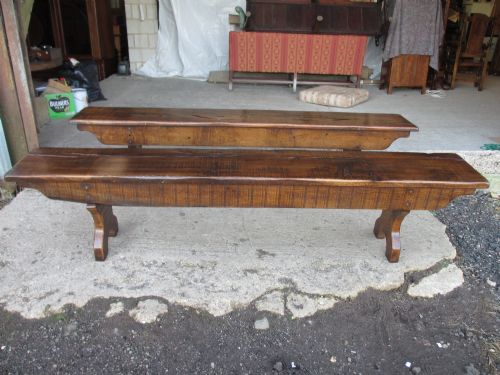
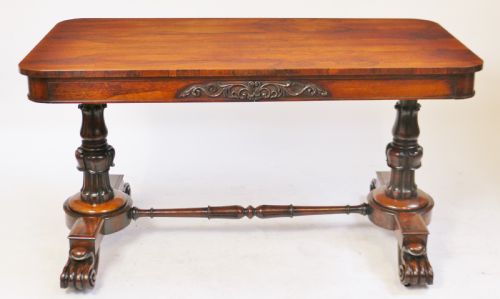
The selection ranges from compact Edwardian oak benches with shaped trestle ends to elaborate Victorian and Regency designs in rich rosewood. Makers and workshops adapted the trestle form for library desks, writing tables, and sewing cabinets alongside simpler lamp tables.
The origins span British periods including George IV and William IV, alongside continental revivals such as Italian Renaissance Revival and Spanish style. Pieces utilise distinctive support structures, from simple end supports to richly carved wooden pillars.
How they were made
Cabinetmakers constructed these tables using dense hardwoods including mahogany, walnut, rosewood, and oak, often selecting figured timbers for visible surfaces. Structural stability relied on traditional joinery within the trestle ends and central stretchers.
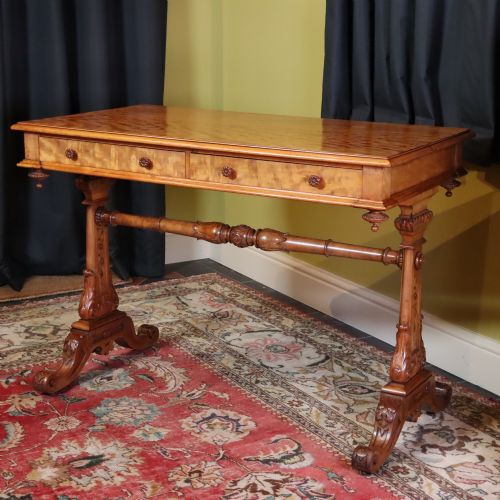
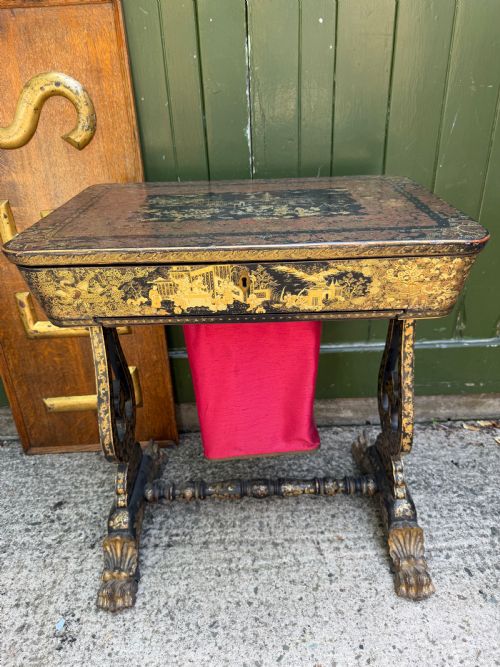
Decoration involved hand carving applied to the uprights, alongside specialised finishes such as gold leaf gilding and Chinese export lacquer work. Finer examples integrated secondary timbers like satinwood and incorporated fitted drawers with mahogany linings.
Listings feature woods such as rosewood, oak, mahogany, walnut, and satinwood alongside gold leaf and lacquer.
What varies in quality
Quality rests upon the selection of timber and the depth and crispness of the hand carving on the trestle supports. Dense, well-figured rosewood or mahogany indicates a superior piece compared to plainer utility woods.
Proportion and structural integrity define the better examples, where the weight of the timber balances the span of the base and stretcher. Finer workshops ensured precise joinery and sophisticated secondary details such as gilded decoration or satinwood interiors.
Whytock and Reid
The Carved Trestle End Table Glossary
- Trestle end
- A support structure consisting of upright feet connected by a horizontal beam or stretcher. It provides robust stability for heavier tables and desks.
- Side table
- A small functional table designed to stand against a wall or beside seating. These items frequently feature drawers or shaped supports.
- Rosewood
- A dense, heavily figured tropical hardwood prized for rich dark grain patterns. It appears frequently on nineteenth-century tables.
- Gilded decoration
- The application of fine gold leaf or powder to highlight carved details and surfaces. This technique adds ornamental brilliance to revival pieces.
- George IV period
- A stylistic era spanning the early nineteenth century characterised by classical influences. Furniture from this time often utilises rich mahogany.
Carved Trestle End Table: Frequently Asked Questions
Where do I place a carved trestle end table?
These tables suit hallways, living rooms, and studies where their solid trestle ends can be viewed from the side. They function effectively as lamp tables or writing surfaces.
Position them against walls or beside seating to showcase the carved supports and timber grain.
How do I care for nineteenth-century wood?
Maintain timber surfaces by dusting with a dry cloth and avoiding direct sunlight or excessive heat. Natural waxes help nourish older polishes.
Protect the finish from moisture by using coasters and mats beneath any objects placed on the top.
What is the difference between an end table and a centre table?
An end table is typically designed to sit beside larger furniture or against a wall, while a centre table is finished on all sides to stand freely in a room.
Both forms utilise trestle supports in the evidence, but centre tables often feature access from multiple directions.
How do I identify a Victorian Gothic piece?
Victorian Gothic furniture often incorporates architectural motifs inspired by medieval design, executed in timbers like pitch pine or oak.
Look for pointed arches, chamfered edges, and heavy structural forms characteristic of mid-nineteenth-century revivals.