
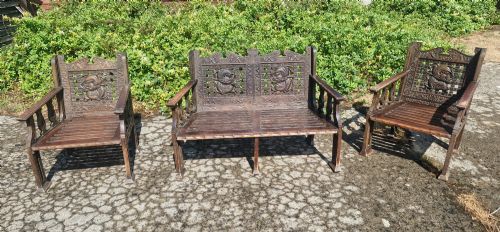


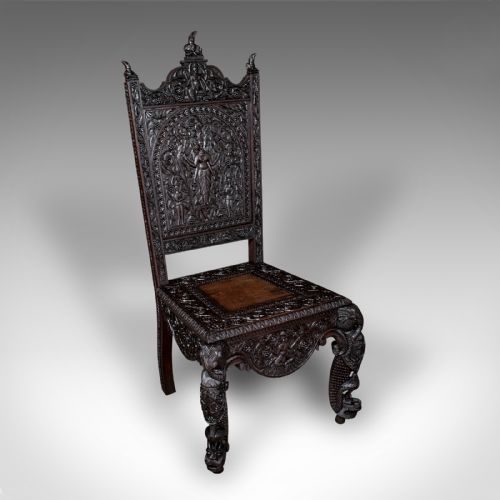


Carved Teak Chairs
These carved teak chairs bring deep colonial history and elaborate artisan detail into a room, offering robust seating with striking sculptural presence.
Carved Teak Chairs
When you search for carved teak chairs, you encounter heavy seating originating from colonial trade and Eastern craftsmanship during the nineteenth century. These pieces encompass diverse forms such as imposing armchairs, dining chairs, and folding campaign seats, often reflecting Anglo-Indian, Burmese, and Chinese export traditions.
The versions most commonly met on this page span the Victorian era up to the nineteen-twenties, frequently exhibiting dense floral motifs, peacock designs, or architectural elements. They serve equally as functional furniture and decorative statements, carrying the unmistakable weight and grain of dense tropical timber.
How they were made
These chairs rely primarily on dense teak and related hardwoods, selected for their durability and capacity to hold intricate, deep-relief carving. Artisans utilised hand tools to chisel elaborate scrolls, figures, and foliage directly into the solid timber.
Construction frequently incorporated secondary materials like brass inlay, cane panels, or leather upholstery to complement the carved wooden frames. Folding campaign designs and throne chairs required precise joinery to balance heavy ornamentation with structural integrity.
Periods represented span the Victorian era, the William IV period, and the early twentieth century up to nineteen-twenty.
What varies in quality
Quality in these chairs rests upon the depth, sharpness, and symmetry of the hand carving across the frame. Superior examples display crisp undercut details and harmonious proportions, whereas lesser pieces exhibit shallow, hasty incisions that lack definition.
The integrity of the underlying timber and the retention of original structural elements, such as brass fittings or cane work, further dictate the standing of a piece. Original surfaces and patination elevate the work, distinguishing master artisan production from simpler regional outputs.
The Carved Teak Chairs Glossary
- Anglo-Indian
- Describing furniture made in India during British rule, combining British form with local craftsmanship and materials. This style often merges European seat designs with dense Eastern carving.
- Savonarola chair
- A folding chair formed of multiple curved wooden slats intersecting to create a basket-like frame. The design originates in the Italian Renaissance but found adoption in Indian colonial workshops.
- Teak
- A dense, durable tropical hardwood known for its high oil content and resistance to decay. It provides the heavy, stable foundation required for deep-relief carving.
- Plantation chair
- A reclining armchair featuring exceptionally wide armrests designed for resting legs in warm climates. They frequently incorporate cane or leather seats for ventilation.
- Throne chair
- An imposing, high-backed armchair designed with symbolic or ceremonial ornamentation. These pieces usually feature prominent crests and heavy structural carving.
Carved Teak Chairs: Frequently Asked Questions
How do I identify an Anglo-Indian chair?
Anglo-Indian chairs combine standard nineteenth-century European seat forms with traditional Indian motifs and carving techniques. Look for dense floral relief work executed in heavy tropical hardwoods.
They often display regional variations, such as pierced fretwork or animal figures integrated into the wooden frame, reflecting the specific workshop traditions of the presidency where they were made.
Where were these chairs used originally?
These chairs furnished colonial bungalows, hill station residences, official offices, and grand country houses across the British Empire. Many served specific functions in verandas, halls, or formal dining rooms.
Folding campaign versions were built for travel and military expeditions, whilst ornate peacock or throne chairs functioned as statement pieces in principal reception spaces.
How should I care for carved teak?
Maintain teak furniture by dusting regularly with a dry, soft cloth to prevent particulate buildup within the deep recesses of the carving. Avoid placing the timber near direct heat sources or rapid temperature shifts.
Applying occasional natural wax helps nourish the wood surface and preserves the historical patination without altering the original finish of the carved details.
Are folding campaign chairs sturdy?
Nineteenth-century folding campaign chairs utilise interlocking wooden frames designed to collapse for transport while maintaining load-bearing strength. The joints rely on precise artisan alignment rather than modern fixings.
While functional for seating, they require careful handling when moving to protect the pivoting wooden mechanisms and historical hinges from undue strain.