






Carved Teak Centre Table
A carved teak centre table brings rich colonial-era craftsmanship and dense floral or figural relief into a modern room.
Carved Teak Centre Table
When you search for a carved teak centre table, you encounter nineteenth-century circular, hexagonal, and tilt-top occasional and dining forms created during the British colonial period. These pieces originate primarily from Indian and Burmese workshops, often designated as Anglo-Indian or Anglo-Burmese in style.
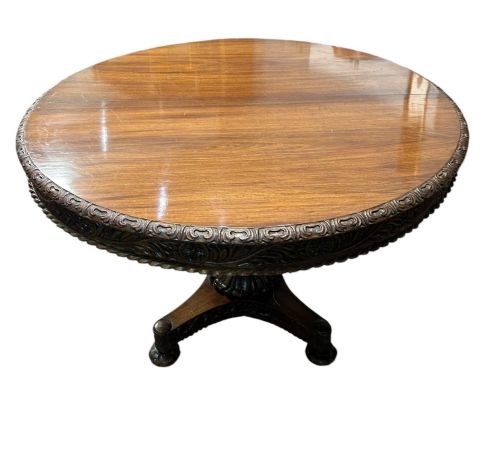
The version you are most likely to meet on this page is a nineteenth-century circular occasional or centre table, typically featuring heavy surface carving in dense tropical hardwoods. Alongside standard centre tables, the selection includes coffee tables adapted from traditional takhats or bullock carts, as well as occasional and tilt-top forms.
The construction spans the Victorian era and the year nineteen hundred, drawing upon regional vernaculars that combine British furniture typologies with indigenous carving traditions. These tables function equally well as standalone centrepieces or robust coffee tables within contemporary interiors.
How they were made
Maker-joiners utilised solid teak, padouk, and rosewood for the primary frames, selecting dense tropical hardwoods capable of holding intricate, deep-relief carving without splintering. Secondary materials such as iron, brass, and bone appear in structural fixings, decorative inlays, and structural enhancements.
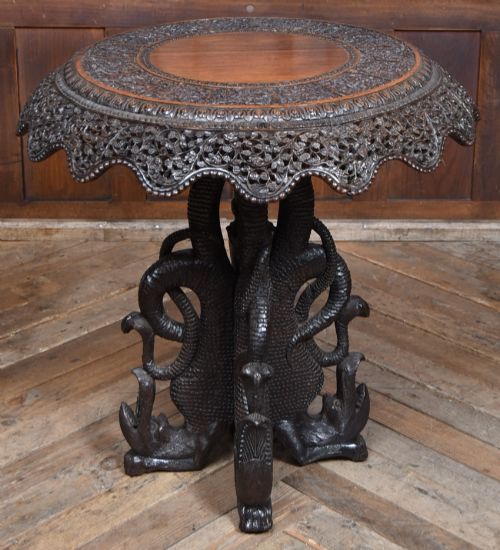
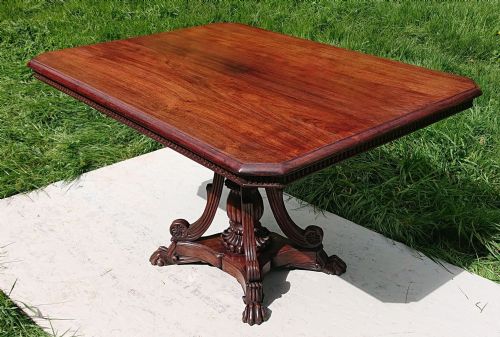
The surface decoration relies entirely upon hand-chiselling, producing layered foliage, animal figures, and geometric borders across the tops and aprons. Tilt-top mechanisms and pedestal bases utilise traditional joinery, turning, and heavy central pillars to support the substantial weight of the carved hardwood tops.
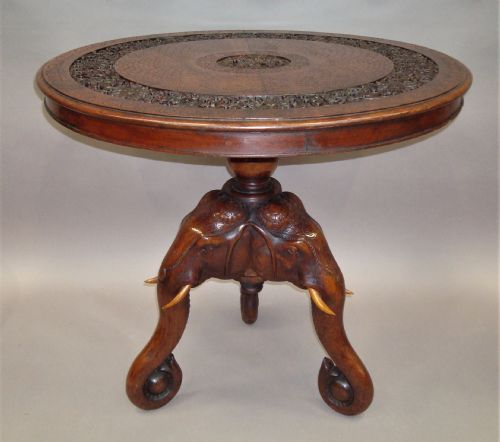
Several examples incorporate carved elephants into their structural pedestals, turning domestic support into a menagerie.
What varies in quality
The depth and crispness of the chisel work dictate the visual distinction between standard production and superior examples. Master carvers achieved deep undercutting and sharp definition in foliage and figures, whereas lesser pieces display shallow, uniform stamping and softer contours.
The choice of primary timber and the structural integrity of the base determine long-term durability. Tables fashioned from well-seasoned teak or padouk with stable pedestal supports maintain their alignment, while inferior timber selection or poorly joined tilt-top mechanisms lead to warping and wobble over time.
The Carved Teak Centre Table Glossary
- Anglo-Indian
- Furniture produced in India during the British colonial period, combining European forms with local carving styles. These pieces often utilise indigenous hardwoods like teak and padouk.
- Tilt-top table
- A table with a hinged top that pivots to a vertical position when not in use. This mechanism allowed the furniture to be stored against a wall in smaller spaces.
- Padouk
- A heavy, durable tropical hardwood with a reddish-brown hue, utilised by colonial makers for high-end occasional and centre tables. It takes fine detail during carving.
- Takhat
- A low, heavy wooden platform or table traditionally used in Indian domestic interiors. In modern contexts, these are frequently utilised as coffee tables.
- Occasional table
- A small table designed for intermittent use in a living space or bedroom, encompassing various pedestal and four-legged forms seen in nineteenth-century rooms.
Carved Teak Centre Table: Frequently Asked Questions
How do I style a carved table?
Position the piece as a central focal point in a room with neutral walls to let the heavy woodwork stand out without visual competition.
Keep surface accessories minimal, perhaps placing a simple ceramic bowl or a stack of art books on the carved top.
Are these tables sturdy enough for daily use?
Nineteenth-century hardwood tables were built from dense timbers like teak and padouk, making them exceptionally solid and heavy for everyday placement.
Ensure the central pedestal or leg junctions remain tight, and avoid dragging the table across rough flooring.
How do I date a carved wooden table?
Examine the timber species, construction joinery, and the style of the carving relative to nineteenth-century colonial design patterns.
Victorian and nineteenth-century pieces typically exhibit hand-cut joints, heavy patination on the tropical hardwoods, and distinct regional motifs from India or Burma.
What is the difference between an occasional and centre table?
Centre tables are traditionally proportioned to stand freestanding in the middle of a room, often featuring decorative work visible from all angles.
Occasional tables tend to be smaller movable pieces intended for specific side positions or specific tasks within a living space.