
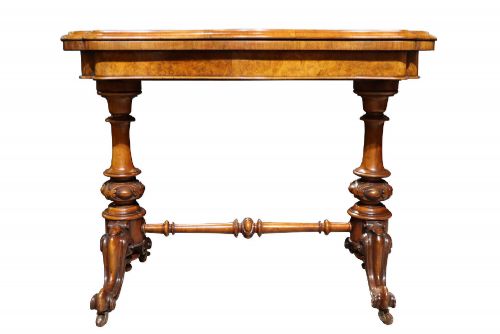


Carved Support Console Table
A carved support console table anchors a room with structural weight and detailed woodwork, offering a surface for display that relies on substantial pedestals or legs rather than four plain posts.
Carved Support Console Table
When you search for a carved support console table, you enter a field defined by tables relying on sculptural pedestals, lyre bases, stretcher frames, or figural supports rather than standard legs. These pieces emerge predominantly from nineteenth-century workshops, spanning Victorian, George IV, Regency, and Italian Baroque Revival styles. The forms range from fold-over card and tea tables to monumental wall consoles topped with marble.
The evidence on this page shows walnut, burr walnut, and burr oak sitting alongside heavily gilded surfaces and figured mahogany. You will encounter tables featuring specific figural motifs, such as carved elephants, swans, and lion's paw feet, alongside simpler pillar end and stretcher designs. Each version brings a distinct architectural presence tailored to hallways, principal reception rooms, or libraries.
How they were made
Cabinetmakers constructed these tables using dense timbers like mahogany and oak, frequently applying highly figured burr walnut veneers to tabletops to create striking grain patterns. The structural supports often required deep hand-carving from solid blocks of wood, allowing artisans to shape complex forms like lyres, animal paws, or mythological creatures.
Giltwood consoles combined carved softwood carcasses with layers of gesso and gold leaf to achieve a brilliant metallic finish beneath heavy stone surfaces such as breccia marble. Joinery relied on sturdy stretchers and robust pillar ends to bear the considerable weight of marble slabs and cantilevered tops without losing stability.
Listings span the nineteenth century, featuring walnut, mahogany, and giltwood alongside marble and brass.
What varies in quality
The distinction between ordinary and exceptional examples rests in the depth and crispness of the carving on the supports. Tables featuring master-carved elements like lions, swans, or complex foliage display a fluidity and anatomical accuracy that lesser workshops simply missed.
Material selection and timber matching also dictate the standing of a piece. The use of premium burr walnut veneer with symmetrical grain patterns, paired with heavy, well-figured marble tops or solid brass mounts, elevates a table above standard production items from the period.
The Carved Support Console Table Glossary
- Console table
- A table designed to stand against a wall, frequently secured to it for stability because the front supports carry the primary weight.
- Breccia marble
- A decorative stone composed of angular fragments embedded in a fine-grained matrix, commonly used for tabletops in revival pieces.
- Giltwood
- Timber coated with gold leaf over a prepared gesso ground, creating a bright metallic decorative surface popular in formal nineteenth-century interiors.
- Lyre base
- A structural support shaped like an ancient Greek lyre, often utilised beneath the leaves of nineteenth-century pembroke and tea tables.
- Burr walnut
- Timber harvested from walnut tree growths that produces intricate, swirling grain patterns highly prized by cabinetmakers for veneering.
Carved Support Console Table: Frequently Asked Questions
Where should I place a console table?
These tables find their traditional home against a flat wall in a hallway, drawing room, or dining space where they provide a surface for lamps, mirrors, or decorative objects without blocking foot traffic.
Because many nineteenth-century versions feature finished backs or rely on wall fixings for stability, placement directly against a structural wall ensures both safety and proper visual proportion in the room.
How do I identify a Victorian table?
Victorian examples often display dense timbers like walnut and burr walnut, combined with robust machine-assisted joinery tempered by detailed hand-carving on pedestals and stretchers.
Look for characteristics such as fold-over tops designed for card playing, heavy stretcher bases, and proportions suited to nineteenth-century domestic architecture.
What is a fold-over top?
A fold-over top consists of a hinged tabletop that doubles in surface area when opened out, revealing a concealed well or a baize-lined playing surface beneath.
Cabinetmakers utilised this mechanism on card and tea tables to save space in smaller rooms while providing a full-sized surface when entertaining guests.
How do I care for marble tops?
Marble surfaces require gentle cleaning with a damp cloth and mild soap, avoiding acidic substances like lemon juice or vinegar that can etch the polished stone.
Using coasters and placing felt pads beneath heavy decorative objects protects the soft surface from scratches and staining over time.