
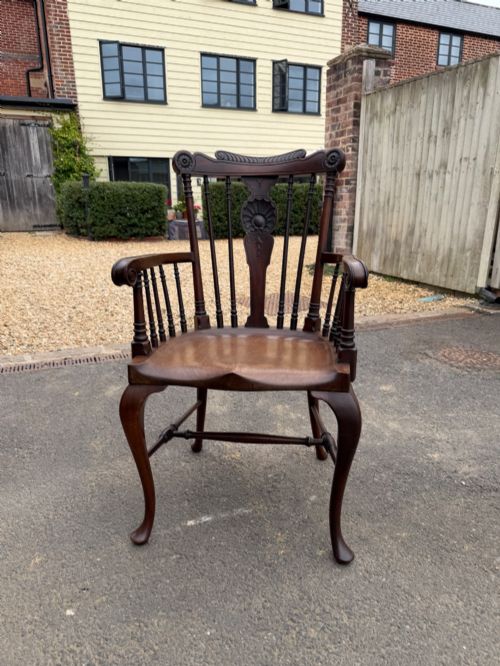
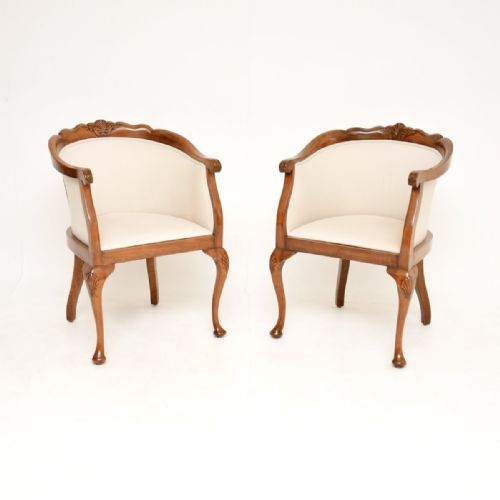


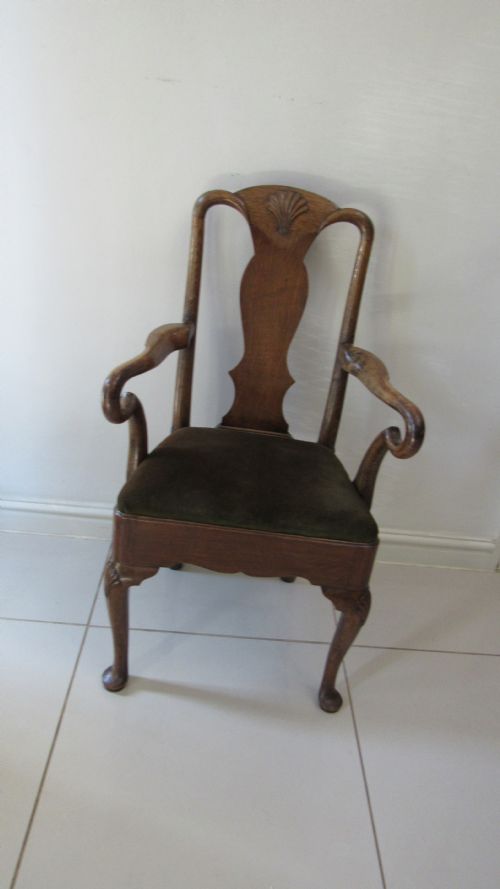


Carved Shell Back Armchair
A carved shell back armchair brings sculptural timber work and distinct upholstery into a room.
Carved Shell Back Armchair
A carved shell back armchair gathers examples spanning the Georgian era through to the Edwardian period and the nineteen-twenties. These seats appear in forms such as barrel backed armchairs, desk chairs, dining chairs, and occasional chairs.
The evidence shows timber frames built from mahogany, walnut, ebonised mahogany, and hardwood, often paired with textile, fabric, tapestry upholstery, and wood inlay. Styles range from Queen Anne and Chippendale to Art Nouveau and Victorian.
Buyers are most likely to encounter Victorian and nineteen-twenty walnut or mahogany pieces on this page. These seating options combine carved wooden backs with upholstered seats for everyday interior use.
Materials and construction
Frames rely on solid hardwoods like mahogany and walnut, shaped to support the carved shell motif on the backrest. Cabinetmakers utilised wood inlay for decorative surface detailing on specific occasional and desk chairs.
Upholstery techniques involve textiles, fabric, and tapestry applied over internal padding within wooden showwood frames. Tub and barrel backed designs require precise curved woodwork to form the enclosed seating shell.
Object types on this page include armchairs, dining chairs, desk chairs, occasional chairs, and a childs armchair.
Judging quality and execution
The depth and crispness of the timber carving separate standard production from superior craftsmanship. Sharp relief work on the shell motif and well-executed wood inlay indicate a higher grade of manufacture.
The integrity of the timber frame and the quality of the joining define the structure. Solid mahogany or walnut construction with tight joints distinguishes better examples from simpler hardwood frames.
The Carved Shell Back Armchair Glossary
- Armchair
- A chair equipped with side supports for the arms. These pieces range from desk chairs to heavy library seating.
- Barrel backed armchair
- A seat featuring a semicircular upholstered back that curves continuously around the user. This form provides enclosed support.
- Wood inlay
- Pieces of contrasting timber fitted into a recessed surface to form a pattern. This technique decorates cabinet work and chair frames.
- Showwood
- Timber frame construction left visible around the upholstered sections of a chair. This exposes the polished grain of walnut or mahogany.
Carved Shell Back Armchair: Frequently Asked Questions
How do I date an antique armchair?
Dating relies on stylistic markers, timber choice, and construction methods. Pieces from the Georgian era show distinct proportions compared to Victorian or Edwardian revivals.
Makers often adopted earlier styles like Queen Anne or Chippendale during later revival periods, which requires close examination of the wood.
Where should I place a barrel backed chair?
Barrel backed chairs suit corners, studies, or living spaces where the curved silhouette can be seen from multiple angles. Their enclosed design offers a comfortable seating position.
They function well alongside desks or as standalone reading seats in a traditional interior.
What woods were used for these chairs?
Mahogany and walnut form the primary timbers for these seating options, supplemented by general hardwoods and ebonised finishes. Walnut appears frequently in nineteenth-century and nineteen-twenty pieces.
Wood inlay adds decorative contrast to the primary timber on specific revival and Art Nouveau items.