

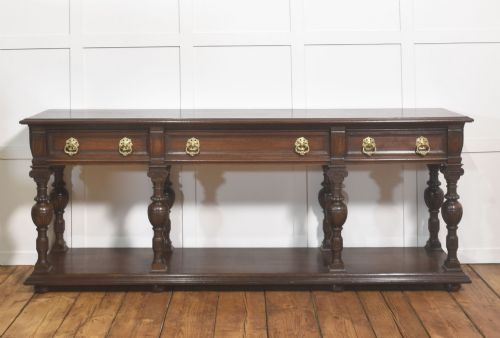


Carved Oak Potboard Buffet
A carved oak potboard buffet brings robust timber and open lower storage into a room, offering both practical utility and centuries of English craft.
Carved Oak Potboard Buffet
A carved oak potboard buffet represents a sturdy tradition of storage furniture, appearing in forms such as dresser bases, sideboards, court cupboards, and hall cupboards. These items originate from periods ranging from the seventeenth century through to the 1920s, encompassing Georgian, Victorian, and Jacobean Revival styles.
Buyers searching for this phrase will most frequently encounter nineteenth and early twentieth-century interpretations, particularly Jacobean style oak dresser bases and carved bleached oak variants. These pieces combine lower potboards with upper surfaces and cupboards, providing substantial presence and functional shelving.
The range also includes genuine seventeenth-century Lancashire buffets alongside eighteenth-century dressers featuring geometric carvings. Each example displays the heavy timber construction and carved detail characteristic of traditional English country cabinet-making.
How they were made
Construction relies heavily upon solid oak, selected for its durability and strength. Cabinet-makers shaped this primary timber using traditional joinery methods to build the substantial frames required for heavy dressers and sideboards.
Decorative work on these pieces frequently incorporates fruitwood marquetry inlay and detailed hand carving. Brass hardware, including hinges and handles, often finishes the woodwork on Victorian and later iterations.
Listings span from the 17th century through the Victorian period to the 1930s, utilising oak, brass, and fruitwood marquetry inlay.
What varies in quality
The distinction between standard and superior pieces rests upon the depth and crispness of the hand carving, alongside the proportion of the timber frame. Pieces executed with sharp geometric carvings and well-balanced small proportions demonstrate higher levels of initial workshop skill.
Material selection also dictates overall quality, particularly the choice between dense, finely figured solid oak and more utilitarian construction. The integration of decorative details such as fruitwood marquetry inlay further separates standard regional items from finer examples.
The Carved Oak Potboard Buffet Glossary
- Potboard
- An open lower shelf beneath a dresser or buffet, historically used for storing pots and pans. This lower tier provides stability to the entire framework.
- Court cupboard
- A heavy enclosed piece of storage furniture featuring upper and lower sections, often supported by turned columns. These cupboards date from the seventeenth century and later revival periods.
- Jacobean style
- A design aesthetic reflecting the early seventeenth-century English Renaissance, characterised by dark oak, geometric mouldings, and strapwork carving. Revival versions appeared frequently during the Victorian and Edwardian eras.
- Marquetry
- A decorative technique of applying thin pieces of wood veneer, such as fruitwood, to form geometric or pictorial patterns on a surface. This technique adds visual contrast to the dark oak background.
Carved Oak Potboard Buffet: Frequently Asked Questions
What is a potboard buffet?
A potboard buffet is a heavy wooden storage piece featuring an open bottom shelf known as a potboard. It combines the utility of a sideboard with display or enclosed storage above.
These items were traditionally used in kitchens and dining rooms to store heavy cookware and tableware. Today, they serve as substantial sideboards in living spaces.
How do I date an oak buffet?
Dating requires examining the construction marks, timber characteristics, and style markers such as geometric carvings or turned supports. Seventeenth-century examples display hand-split boards and archaic joinery.
Later revival pieces from the Victorian era or the 1920s show machine assistance and softer patination. Comparing the hardware and inlay styles helps confirm the period of manufacture.
Where were these pieces used?
They originated as utilitarian furniture for large country houses and farmhouses, placed in kitchens or dining halls for food preparation and storage. The open potboard kept heavy ceramic and metal pots within easy reach.
In modern homes, they function well in dining rooms, large hallways, or kitchens as serving surfaces. Their deep storage accommodates modern tableware and linens easily.
Are these pieces made of solid oak?
Most traditional examples utilise solid oak throughout their primary framework, doors, and tops. This heavy timber gives the furniture its exceptional weight and structural longevity.
Some later revival pieces incorporate secondary woods or veneers for decorative panels, such as fruitwood marquetry inlay. The core structure, however, remains built around sturdy oak.