

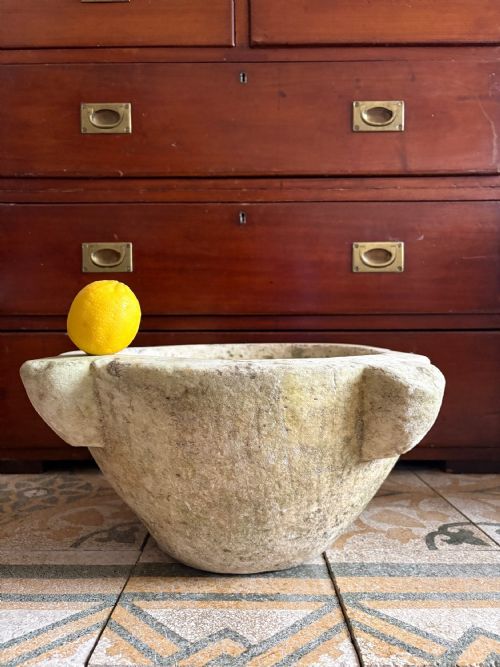


Carved Marble Bowl
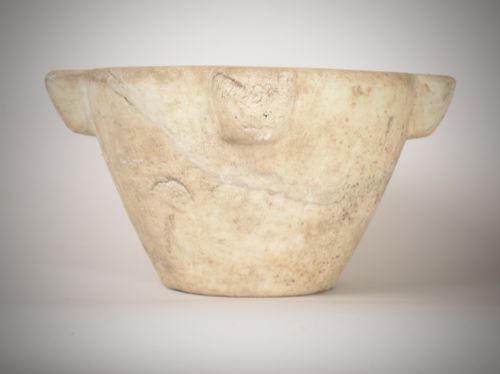
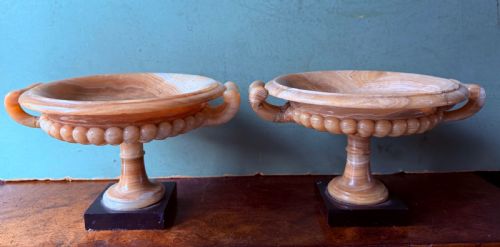
These carved marble bowl examples range from substantial eighteenth century kitchen mortars to decorative nineteenth century Grand Tour tazzas.
Carved Marble Bowl
A carved marble bowl brings solid mineral weight and classical form into an interior, functioning as a centrepiece or display vessel. The selection draws heavily on nineteenth century Grand Tour souvenirs and eighteenth century utilitarian forms.
Buyers encounter pedestal tazzas, campana urn bases, and heavy kitchen mortars shaped from diverse stones. These objects bridge classical sculpture and domestic utility through turned and carved profiles.
How they were made
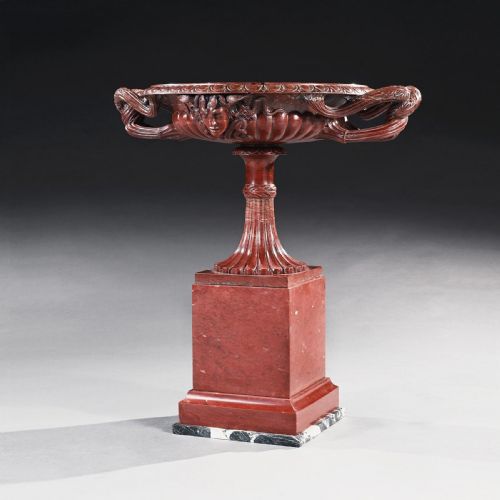
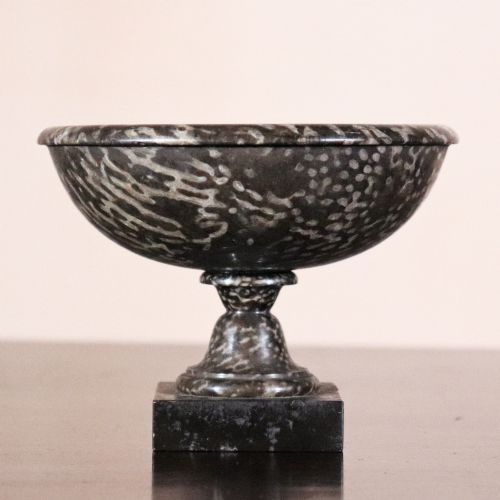
Masons shaped these vessels from blocks of marble, alabaster, limestone, and specialised stones like Rosso Antico and Ashford Coral. Lathe turning and hand chiselling produced the smooth hollows and profiled rims characteristic of the form.
Many nineteenth century souvenir pieces combine marble or alabaster bowls with contrasting black marble bases or metal mounts. Eighteenth century mortars rely on simple, robust mass for their stability and function.
What varies in quality
Quality rests in the choice of stone, the crispness of the turning, and the integration of any pedestal or base. Highly figured marbles and rich mineral colours elevate a piece beyond basic utilitarian work.
Proportion and scale dictate visual success, particularly in Grand Tour copies modelled after antique precedents. Finer examples display careful finishing that respects the natural veining of the material.
Benedetto Boschetti·Ferdinand Preiss
The Carved Marble Bowl Glossary
- Tazza
- A shallow bowl or cup mounted on a stem and foot, often used for display on a table or pedestal. The form derives from ancient drinking vessels adapted as decorative works.
- Grand Tour
- A traditional trip through Europe undertaken by upper class travellers in the eighteenth and nineteenth centuries. Souvenirs included miniature bronzes and carved marble architectural models.
- Rosso Antico
- A deep red marble prized by classical sculptors and later nineteenth century Italian lapidaries. It mimics the ancient red marbles of Greece and Egypt.
- Mortar
- A heavy bowl used with a pestle for crushing and grinding substances in kitchens or apothecary shops. Earlier examples prioritized thick walls and durable stone over ornamentation.
Carved Marble Bowl: Frequently Asked Questions
What is a tazza?
A tazza is a shallow ornamental bowl raised on a pedestal foot, designed primarily for visual display rather than dining. These pieces frequently draw on classical antiquities.
In nineteenth century collections, they served as centrepieces on tables and consoles to showcase fine stonework.
Where were Grand Tour items made?
Grand Tour souvenirs were produced predominantly in Italian workshops during the eighteenth and nineteenth centuries to supply travelling collectors. Rome and Florence served as major centres for lapidary work.
Artisans copied ancient sculptures and architectural fragments in miniature scale using local marbles and alabaster.
How old is my stone bowl?
Dating relies on tool marks, the choice of stone, and the stylistic context of the pedestal or base. Eighteenth century utilitarian mortars show heavier tool work and simpler, thicker profiles.
Nineteenth century decorative pieces often feature sophisticated mineral varieties like Rosso Antico or Ashford Coral.