
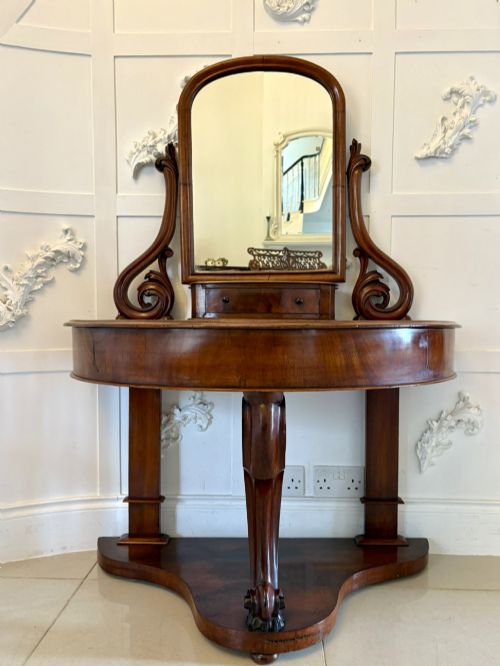
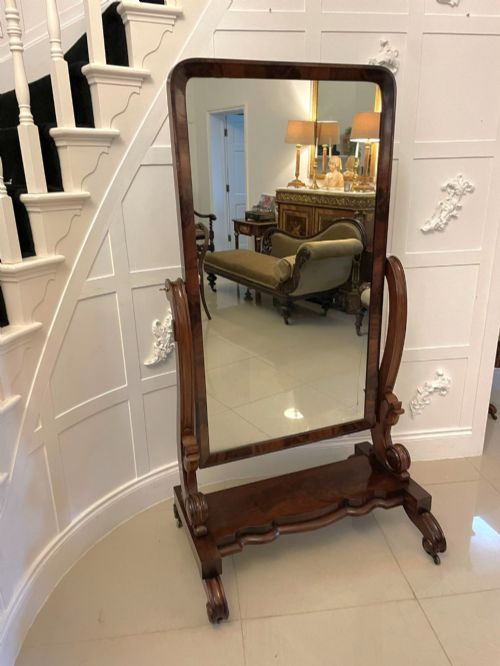


Carved Mahogany Swivel Mirror
A carved mahogany swivel mirror brings warmth and practicality to a dressing space, offering adjustable reflection framed in rich timber.
Carved Mahogany Swivel Mirror
A carved mahogany swivel mirror is a functional piece of antique furniture designed for grooming, typically featuring a pivoting glass plate set within a supportive wooden frame. These mirrors appear in various formats across this selection, ranging from compact toilet mirrors meant for tabletop placement to large freestanding cheval mirrors.
The pieces on this page span several eras and styles, with Victorian examples appearing most frequently alongside Edwardian, Regency, and Georgian interpretations. Makers constructed these mirrors to sit atop dressing tables or to stand independently on the floor, utilising the adjustable pivot mechanism to tilt the glass as needed.
How they were made
Craftsmen built these mirrors primarily using solid mahogany, frequently incorporating flame mahogany veneer, burr walnut, or walnut to add decorative grain patterns to the frames and base structures. Structural stability relied on sturdy upright supports, sometimes enhanced with turned columns or intricate carvings.
Makers integrated brass hardware, including pivoting screws, hinges, and candle sconces on certain designs, allowing the glass frame to tilt smoothly. Mirror glass itself is fitted within the wooden rebate, and select examples incorporate marble tops into the supporting base structure for added weight and presence.
An unusual boot maker's mirror appears among the collection, offering a specialised workshop perspective alongside domestic dressing pieces.
What varies in quality
Quality in a carved mahogany swivel mirror rests on the depth and crispness of the timber carving, the choice of figured wood veneers, and the overall heft of the construction. Superior examples exhibit harmonious proportions between the glass frame and the supporting base, utilising dense mahogany that has aged to a deep, resonant colour.
The refinement of the brass pivot mechanism and the clarity of the original mirror glass further distinguish finer pieces from simpler utilitarian versions. Attention to detail in the joinery of the support scrolls and the stability of the swing action mark the difference between standard production and exceptional workshop output.
Gillows
The Carved Mahogany Swivel Mirror Glossary
- Cheval mirror
- A large freestanding mirror supported by a frame with four legs, allowing the user to view their entire outfit. These tall glasses pivot on vertical side pivots.
- Toilet mirror
- A smaller dressing mirror designed to sit on top of a table, chest of drawers, or washstand. They frequently incorporate small drawer bases.
- Swing mirror
- An alternative term for a swivel mirror, denoting a glass plate mounted on horizontal pivots between two upright posts. This allows the angle of reflection to change.
- Flame mahogany veneer
- A decorative wood slicing chosen for its distinctive, flickering grain pattern resembling flames. Cabinet makers applied this thin layer over secondary timbers on the mirror base.
- Turned columns
- Cylindrical wooden supports shaped on a lathe, commonly found flanking the uprights of Victorian dressing mirrors. They add architectural detail to the frame.
Carved Mahogany Swivel Mirror: Frequently Asked Questions
Where should I place a swivel mirror?
These mirrors suit dressing tables, chest tops, or dedicated console surfaces where their pivoting action allows easy adjustment for height and light.
Larger cheval versions stand directly on the floor in bedrooms or dressing rooms, functioning as full-length mirrors.
How do I adjust the mirror angle?
Most pieces utilise brass thumbscrews or pivot pins set into the upright support arms. Tightening or loosening these fittings controls the tension on the swing frame.
Careful adjustment prevents the heavy glass from slipping while maintaining smooth movement.
What periods do these mirrors cover?
The selection spans from Georgian and Regency eras through the Victorian and Edwardian periods. Victorian examples form the largest group on this page.
Earlier pieces often feature walnut or red mahogany, while later Victorian and Edwardian items show heavier carved detail.
Can I store items in the base?
Many tabletop toilet mirrors include a small box base fitted with one or more small drawers. These compartments historically held jewellery, cosmetics, or small grooming accessories.
Freestanding cheval mirrors and simple swing frames lack storage compartments, focusing entirely on the reflection.