


Carved Mahogany Parlour Bench
A carved mahogany parlour bench offers seating built in mahogany, uniting Victorian and Edwardian craftsmanship for formal rooms.
Carved Mahogany Parlour Bench
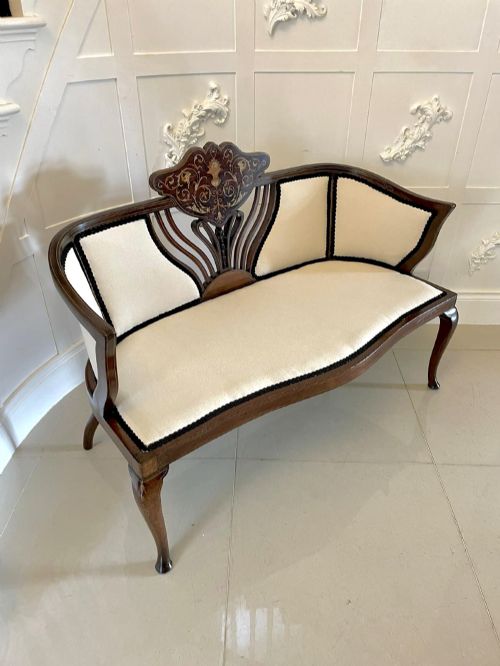
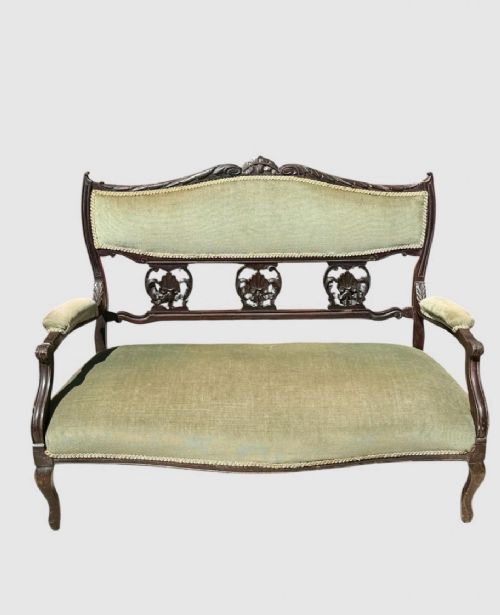
A carved mahogany parlour bench appears as a settee, sofa, or two-seater designed for the home, typically arriving from the Victorian, Late Victorian, or Edwardian periods. These seating pieces combine substantial timber frames with upholstery, serving as formal furniture for reception spaces.
The versions most commonly met on this page date around 1880, 1900, or into the 1930s, reflecting late nineteenth and early twentieth-century tastes. They manifest in styles such as Chippendale alongside plain Edwardian and Victorian forms.
Buyers examining these items find settees and sofas engineered for two occupants, frequently enhanced with decorative woodwork. The scale suits drawing rooms, parlours, and salons where guests gathered.
Materials and construction
Makers built these pieces primarily from solid mahogany, frequently incorporating satinwood and boxwood inlay for visual contrast on the timber surfaces. Frameworks often feature carved and turned wooden elements.
Upholstery forms an integral part of the construction, utilising fabrics, cream upholstery fabric, and cord braid alongside brass details. Certain examples arrive ready for re-upholstery by the buyer.
Listings span the Victorian, Late Victorian, Edwardian, and 1930 periods, utilising mahogany, satinwood, boxwood inlay, fabric, and brass.
Assessing quality in mahogany seating
Quality reveals itself in the crispness of the timber carving and the precision of the satinwood or boxwood inlay work. Superior examples demonstrate careful attention to joinery and turned woodwork details.
The execution of the frame design distinguishes standard production from finer pieces, particularly where Chippendale influences or elaborate Victorian ornamentation apply.
The Carved Mahogany Parlour Bench Glossary
- Settee
- A long upholstered seat for more than one person, typically featuring a back and arms. This form dominates the parlour seating listed here.
- Inlay
- A technique where pieces of contrasting timber such as satinwood or boxwood are inserted into recesses in the mahogany surface to form decorative patterns.
- Chippendale
- A style of furniture design originating in the eighteenth century and referenced in later Victorian and Edwardian interpretations.
- Upholstery
- The materials including padding, fabric, and cord braid that cover the structural frame to create a comfortable seat.
- Turned woodwork
- Timber shaped on a lathe to create cylindrical or decorative rounded profiles on legs and supports.
Carved Mahogany Parlour Bench: Frequently Asked Questions
What periods do these parlour benches date from?
The pieces span from the late nineteenth century through to the early twentieth century. Specifically, examples date from around 1880, the Victorian era, the Edwardian period, 1900, and up to 1930.
This range encompasses late Victorian manufacturing and Edwardian production methods. Each era brings distinct decorative tendencies to the mahogany frames.
How were these settees used originally?
Original usage centred on formal reception rooms, parlours, and drawing rooms where households received visitors. They provided comfortable two-seater capacity for conversation and social occasions.
Their placement was usually prominent within the room layout, serving both a functional seating role and a decorative display purpose.
How do I care for the mahogany and inlay?
Maintenance requires regular dusting with a soft cloth and occasional treatment with appropriate wood care products to preserve the timber finish. Direct sunlight should be avoided to protect both the mahogany and any delicate satinwood inlay.
Upholstery requires separate attention depending on the fabric type, ranging from gentle vacuuming to professional cleaning for older textiles.
Can I find matching pairs on this page?
Listings occasionally include paired items, such as matched sets of Edwardian settees originating from the same period. These pairs share identical design characteristics and timber work.
Availability fluctuates, so buyers seeking matched seating should examine current descriptions closely for pair listings.
What does re-upholstery involve for these pieces?
Certain pieces are offered specifically for re-upholstery, allowing owners to apply new fabric to suit modern interiors. This process involves stripping back existing coverings and webbing before renewing the internal padding and outer material.
It provides an opportunity to restore the seating while retaining the historic mahogany frame.