

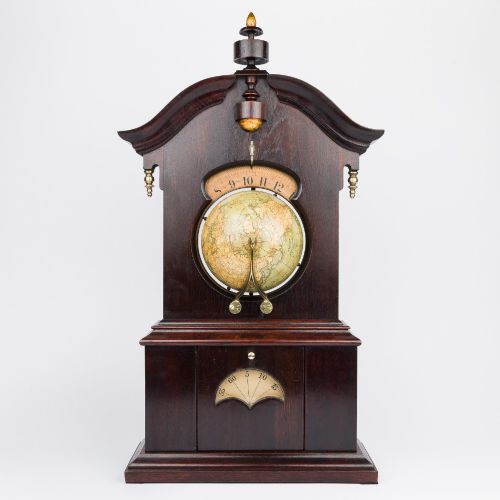
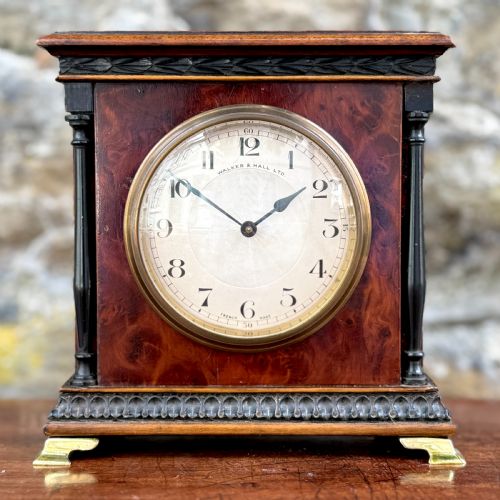

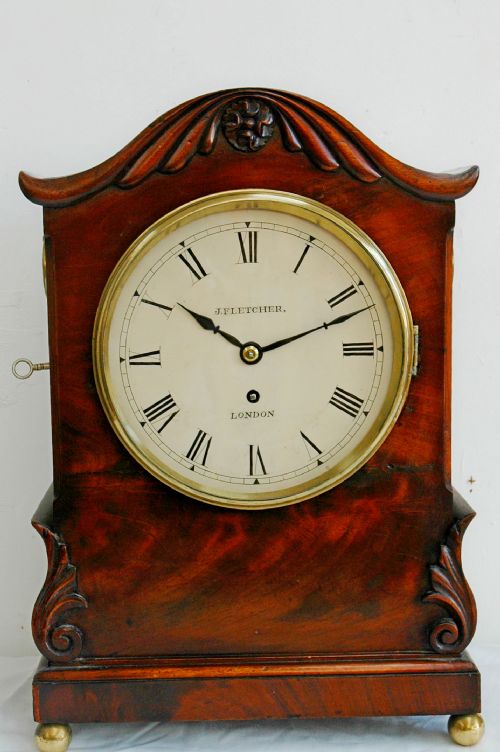


Carved Mahogany Desk Clock
These carved mahogany desk clock examples span Georgian library pieces to Art Nouveau designs, offering a reliable timepiece and striking period woodwork for any interior.
Carved Mahogany Desk Clock
A carved mahogany desk clock brings substantial timber cases and reliable timekeeping to a mantel, desk or shelf. Buyers searching for a carved mahogany desk clock encounter a variety of forms, including pad top bracket clocks, library timepieces, and mantel designs.
The pieces on this page draw from the Georgian, Regency, and Victorian periods, alongside Edwardian and later 19th Century examples. Makers range from provincial watchmakers to London firms, utilising rich timber grains and brass fittings.
Mantel clocks and bracket clocks dominate the selection, often housing single fusee movements behind glass faces and enamel dials. Each item displays the characteristic warm tone of polished mahogany shaped by period cabinet makers.
Materials and construction
Cabinet makers constructed these cases primarily from solid mahogany, occasionally incorporating burr walnut, ebonised wood, and brass details. The timber was selected for its deep grain and stability, then carved or moulded into architectural shapes.
Dials feature white enamel or painted paper protected behind hinged glass bezels, while internal movements rely on metal components such as fusee gear trains. Metal elements like handles, feet, and bezels are cast brass.
Specialist horologists produced the internal mechanisms, fitted into custom wooden housings built by skilled joiners. The marriage of heavy timber cases and intricate brass movements defines the physical structure of these pieces.
Carved Mahogany Desk Clock Retail Price Guide 2026
Typical asking prices for carved mahogany desk clock among the pieces listed under this phrase on Sellingantiques today, from the lower quarter to the upper quarter. They describe what is for sale here now, not the wider market.
Listings feature mahogany, brass, glass, enamel, and burr walnut across Victorian, Georgian, and Regency periods.
Assessing quality and finish
The distinction between standard examples and finer items rests in the crispness of the timber carving and the complexity of the movement. Superior pieces exhibit deeply figured mahogany, well-proportioned architectural cases, and signed dials from recognised makers.
Internal engineering also dictates standing, with single fusee movements representing a higher grade of horological production than simpler spring-driven alternatives. The integration of original brass mounts and clean enamel dials elevates the overall execution.
Bush of London·Walker and Hall·Piggin Norwich·J Kingerley Manchester·Hampson and Son·Purvis of London·Funnel of Brighton
The Carved Mahogany Desk Clock Glossary
- Fusee
- A conical pulley used in older clocks to equalize the power of the mainspring as it unwinds. This mechanism helps the clock maintain a consistent rate throughout its running time.
- Bracket clock
- A portable table or mantel clock originally designed to sit on a wall bracket to aid projection of sound. Many later examples functioned as substantial desk or shelf clocks.
- Pad top
- A curved, dome-like upper section characteristic of certain Georgian and Regency clock cases. This shape softens the architectural profile of the timber housing.
- Enamel dial
- A metal clock face covered with a fused glass powder coating to create a smooth, white surface. Numerals are typically painted onto this durable finish.
Carved Mahogany Desk Clock: Frequently Asked Questions
Where should I place a mahogany clock?
Position the piece away from direct sunlight, radiators, and damp exterior walls to protect the timber and internal metal components. Stable indoor conditions prevent the wood from warping.
Choose a level surface such as a heavy desk, mantel, or shelf so the pendulum or balance wheel beats evenly.
How do I identify a Georgian clock?
Georgian pieces typically display restrained classical proportions, architectural cornices, and bracket feet carved from solid mahogany. The dials are often brass or early white enamel.
Look for maker signatures engraved directly onto the brass backplate or painted onto the dial face for confirmation of period origin.
What maintenance do these clocks need?
Professional cleaning and oiling every few years keeps the brass gear trains functioning accurately. Dust the exterior mahogany gently with a dry, soft cloth.
Avoid applying modern furniture polishes that contain heavy silicone, opting instead for traditional wax feeds if the timber requires conditioning.