
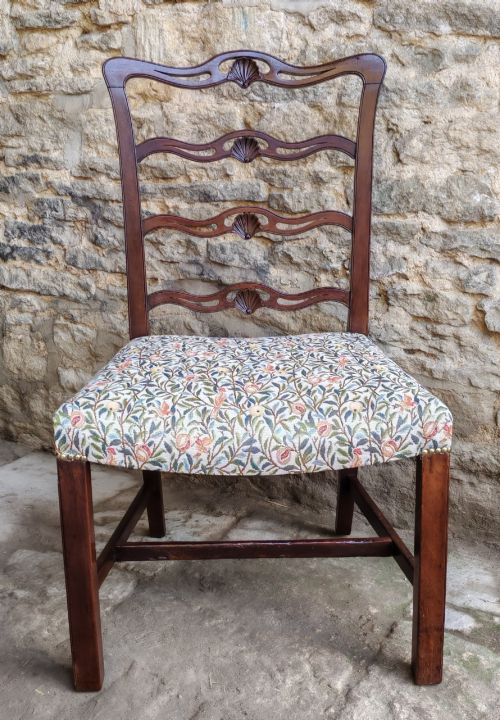
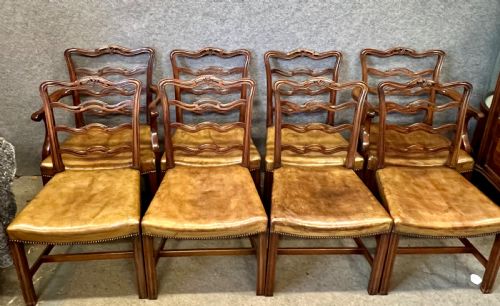


Carved Ladderback Side Chairs
These carved ladderback side chairs offer traditional dining and desk seating shaped from solid oak and mahogany across several centuries.
Carved Ladderback Side Chairs
These carved ladderback side chairs encompass formal dining seats, desk chairs, and country kitchen variants originating from the eighteenth, nineteenth, and early twentieth centuries. The selection includes individual seating, pairs, and larger sets spanning four to twelve chairs. Buyers will encounter both refined mahogany revival pieces and robust oak country examples.
Origins stretch from English workshops to French provincial makers and Irish makers. Forms range from George III style dining chairs and Chippendale revivals to Arts and Crafts country chairs. Many retain their traditional seating materials such as rush, while others feature upholstered pads in fabric, velvet, leather, or tapestry.
How they were made
Maker construction relies heavily on solid hardwoods like mahogany and oak, shaped into vertical uprights connected by horizontal slats. Joinery incorporates traditional techniques to secure the ladder rails within the frame. Brass fittings appear occasionally as structural or decorative accents.
Seating areas utilise woven natural rush or drop-in pads covered in velvet, leather, fabric, or tapestry. Wood surfaces receive manual carving details along the crest rails and splats, distinguishing revival and formal models from plain rustic variations.
At least one nineteenth-century example traded its stationary legs for wheels to roll more easily across the floor.
What varies in quality
Quality differentiates itself through the selection of timber, the crispness of the wood carving, and the integrity of the frame construction. Solid mahogany and dense oak represent the sturdier end of the range, whereas simpler country formats focus on utility. The presence of matching sets commands greater consistency across dining groups.
Upholstery and seating materials also dictate the standard of the piece, with intact rush or fine leather panels showing careful preservation. Original surface patination and period joinery elevate the overall distinction of the seating.
The Carved Ladderback Side Chairs Glossary
- Ladderback
- A chair design featuring a backrest composed of several horizontal wooden slats resembling the rungs of a ladder. These slats are often shaped or carved along the top edges.
- Side chair
- A chair without arms, traditionally used for dining tables or secondary seating around a room. They are designed to fit neatly beneath a table surface.
- Chippendale revival
- A later stylistic movement reproducing or reinterpreting the mid-eighteenth-century furniture designs associated with Thomas Chippendale. These pieces often feature more elaborate carved mahogany details.
- Rush
- A traditional seating material woven from marsh plants to create a durable, textured base. It is commonly found on country and provincial ladderback chairs.
- George III style
- Furniture design drawing upon the aesthetics of the Georgian period spanning the late eighteenth century. Pieces in this style typically display formal proportions and classical decorative motifs.
Carved Ladderback Side Chairs: Frequently Asked Questions
What rooms suit these chairs?
These chairs function naturally around dining tables, functioning equally well in traditional kitchens or formal dining rooms. Desk chair variants also serve effectively in studies.
Single chairs and pairs work well as accent seating in hallways or bedrooms, adding period character without requiring large floor spaces.
How do I care for rush seats?
Rush seating requires dry conditions to maintain the strength of the natural plant fibres. Regular light dusting keeps debris from settling within the weave.
Avoid excessive moisture and direct sunlight, which can dry out and weaken the material over time.
Are these chairs comfortable?
Comfort depends largely on the seat type and the ergonomic rake of the ladderback slats. Upholstered pads in leather, velvet, or fabric offer cushioned support.
Wooden slat backs provide solid upright support suited for dining and desk tasks rather than deep lounging.
Can I mix different wood tones?
Combining mahogany and oak pieces introduces varied textures and natural wood tones into a room scheme. Matching sets offer visual uniformity for formal dining spaces.
Individual chairs allow for eclectic arrangements around a central table, highlighting different periods from the eighteenth to twentieth centuries.