




Carved Hardwood Trunk
These carved hardwood trunk examples bring dense regional craftsmanship and tactile storage into a room.
Carved Hardwood Trunk
A carved hardwood trunk serves as a robust storage container and surface, appearing across styles such as Anglo-Indian, Chinese Export, and Middle Eastern. Buyers seeking a carved hardwood trunk will encounter pieces spanning the nineteenth century through the early twentieth century.
The selection ranges from large iron-bound storage chests to specialised tables and boxes. Regional workshops utilise dense timbers like teak and rosewood, often pairing the primary wood with contrasting inlay work.
How they were made
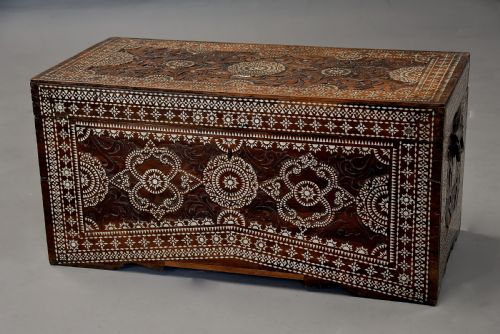
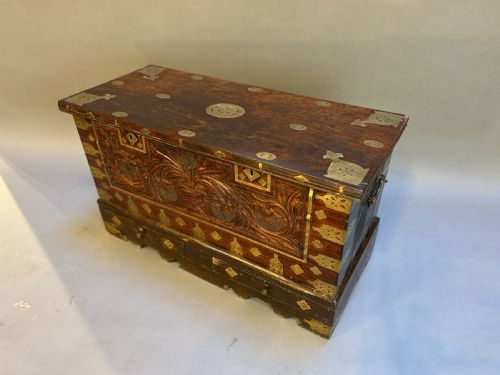
Artisans carved dense hardwoods directly using hand chisels to create deep relief patterns, floral motifs, and figural elements such as elephants. Iron mounts, straps, and corner brackets provide structural reinforcement to heavy timber walls.
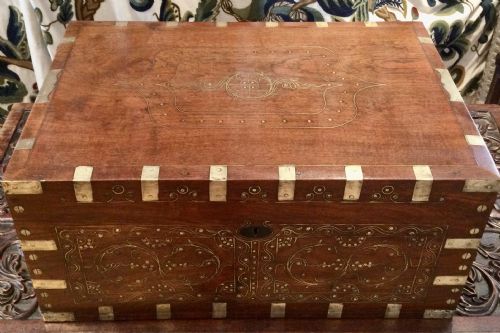
Details often incorporate contrasting materials like mother-of-pearl, bone, or brass wire inlaid into the carved timber surface. Joinery relies on traditional pinning and heavy dovetailing to support the weight of the dense woods.
The documented pieces originate across the nineteenth century and extend into the nineteen-twenties.
What varies in quality
The depth and clarity of the chisel work dictate visual distinction, where crisp undercutting separates master carving from hasty production. The choice of primary timber also matters, with richly grained rosewood and seasoned teak commanding greater appreciation than utility woods.
Completeness of original decorative elements such as bone or mother-of-pearl inlay alters the character of a piece. The survival of robust iron hardware and the stability of the original timber frame determine the integrity of the surviving structure.
The Carved Hardwood Trunk Glossary
- Zanzibar chest
- A heavy storage chest traditionally featuring brass studding, strapwork, and elaborate carved detailing. These pieces reflect trade connections across the Indian Ocean and African coast.
- Anglo-Indian
- A designation for items made in India during the British period, blending local craftsmanship with European forms. Tables and storage chests frequently combine native timbers with British furniture proportions.
- Mother-of-pearl
- The iridescent inner layer of certain mollusc shells used as thin cut pieces for inlay. Artisans press these fragments into recessed channels in the wood to form geometric or floral patterns.
- Camphor
- A fragrant wood valued for linings because its natural scent deters insects. Chinese trunks often utilise this timber for internal construction.
Carved Hardwood Trunk: Frequently Asked Questions
How do I date a trunk?
Dating relies on examining the construction methods, tool marks left by hand chisels, and the style of the brass or iron hardware.
Changes in regional trade routes and colonial influences also help narrow the decade of production.
Where were these pieces made?
Production centres span across India, China, and the Middle East, each region applying distinct carving motifs and timber choices.
Local workshops adapted traditional forms for export or domestic use during the nineteenth and early twentieth centuries.
How should I clean the wood?
Maintain the surface with a gentle application of microcrystalline wax to nourish the dry timber without building up heavy residues.
Avoid harsh chemical cleaners that can lift inlaid mother-of-pearl or discolour the natural grain.
Are all these trunks heavy?
Most examples use dense tropical hardwoods like teak or rosewood, which naturally weigh considerably more than European softwoods.
Iron straps and corner mounts add further structural weight to larger storage chests.