




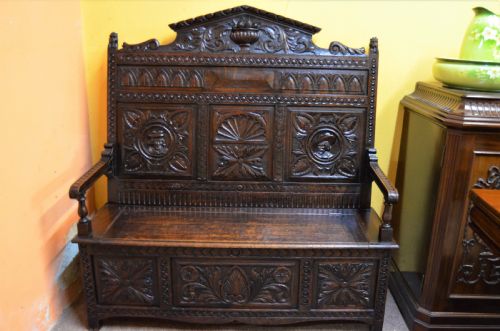


Carved Hall Chest Bench
A carved hall chest bench offers a sturdy seat and hidden storage, bringing robust woodwork and period character directly into an entranceway.
Carved Hall Chest Bench
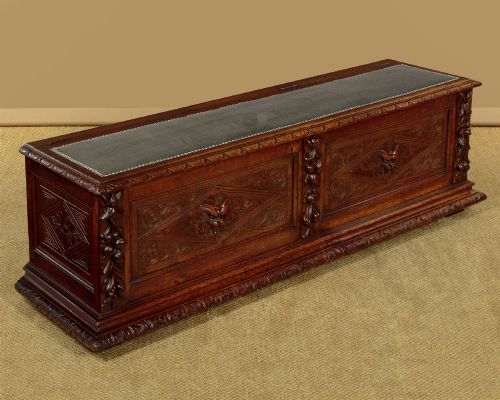
A carved hall chest bench combines seating with a box or compartment beneath, serving as a dual-purpose piece for an entrance hall. When buyers search for a carved hall chest bench, they encounter heavy wooden forms originating primarily from the nineteenth and eighteenth centuries. These items include settles, monks benches, and coffers adapted for seating, often displaying deep carving across the front panels and backrests.
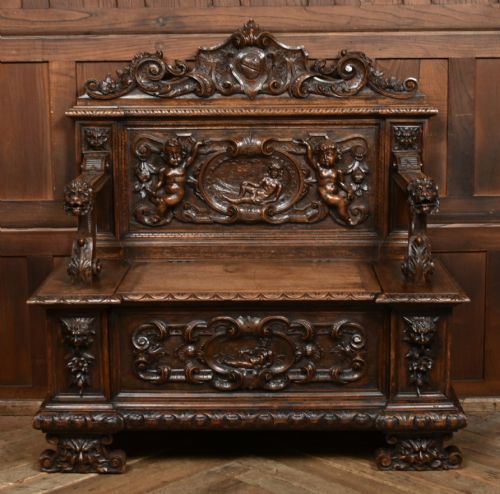
The pieces appearing on this page lean heavily towards the Victorian and Edwardian eras, alongside earlier eighteenth-century examples. Oak dominates the selection, frequently presented in revival styles such as Jacobean, Gothic, and Renaissance Revival. These heavy timber seats anchor a hallway, providing both a practical place to sit and enclosed storage for boots or blankets.
How they were made
Carpenters built these benches using solid oak and walnut, joined with traditional mortise and tenon construction to withstand heavy daily use. Panels were frequently recessed into frames to allow for the natural seasonal movement of the timber without splitting.
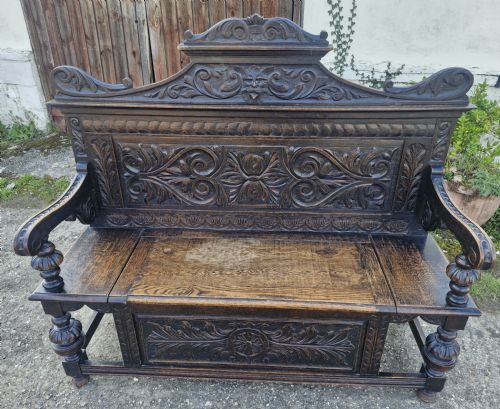
Carving was executed by hand directly into the solid wood boards, featuring motifs such as Green Man masks, scrolling foliage, and geometric strapwork. Iron, brass, and metal hinges or latches completed the construction, securing the lids and drop-front mechanisms.
Revival styles on this page span Jacobean, Gothic, Italian Renaissance, and rustic farmhouse aesthetics.
What varies in quality
The depth and crispness of the hand-carving separate standard production from superior examples. Crisp relief work with detailed figures and undercut foliage requires considerable skill, whereas shallow or mechanical stamping lacks definition.
Timber selection and structural integrity also dictate the standard of the piece. Well-figured oak with quartersawn medullary rays commands attention, while the retention of original ironwork and sound lid mechanisms preserves the integrity of the build.
The Carved Hall Chest Bench Glossary
- Settle
- A wooden bench with a high back, solid arms, and often a box base beneath the seat. This form protected sitters from draughts in entrance halls.
- Monks bench
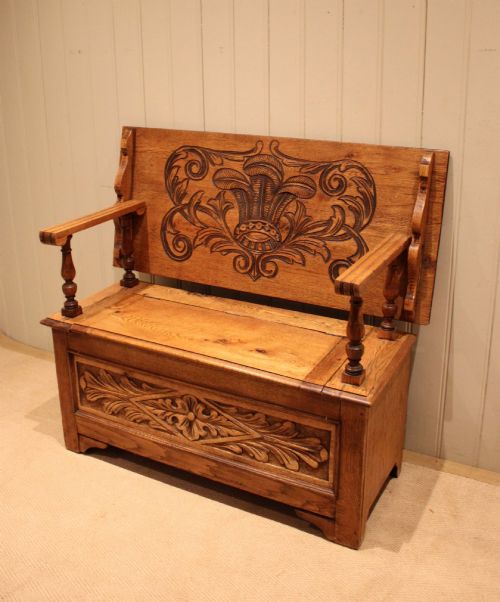
- A convertible piece of furniture featuring a pivoting backrest that folds down to form a table top over a box seat. It provides dual utility in compact spaces.
- Cassapanca
- An Italian chest bench combining a panelled back and arms with a deep storage box. These often display Renaissance revival detailing and rich walnut timbers.
- Green Man
- A sculptural motif depicting a human face carved with leaves, vines, or branches sprouting from the mouth. It appears frequently on nineteenth-century revival woodwork.
- Coffer
- A heavy wooden chest used primarily for storage, which gains function as a hall seat when fitted with a suitable top. These form the ancestral basis for many chest benches.
Carved Hall Chest Bench: Frequently Asked Questions
How do I use a monk's bench?
A monk's bench functions as a seat with a high back or transforms into a small table by pivoting the wooden backrest forward onto the arms.
This clever dual purpose allowed households to save space in smaller rooms or narrow hallways.
Are these benches comfortable to sit on?
Original wooden hall benches were built for utility and posture rather than deep cushioning, featuring upright panelled backs and hard seats.
Owners frequently add loose leather or fabric squab cushions to soften the seat for everyday use.
How do I identify a Victorian revival piece?
Victorian revival pieces often combine seventeenth-century Jacobean or Gothic motifs with heavy machine-sawn oak timbers and contemporary iron hinges.
Look at the interior boards and fixing methods, which reveal nineteenth-century workshop practices rather than genuine early modern construction.