

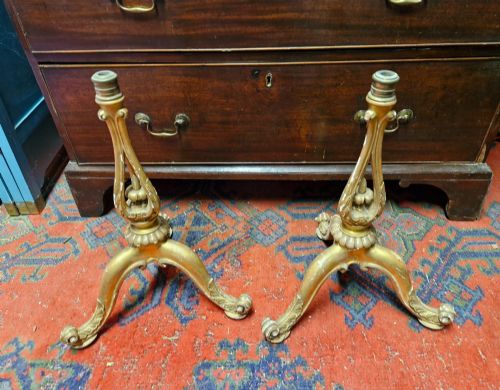
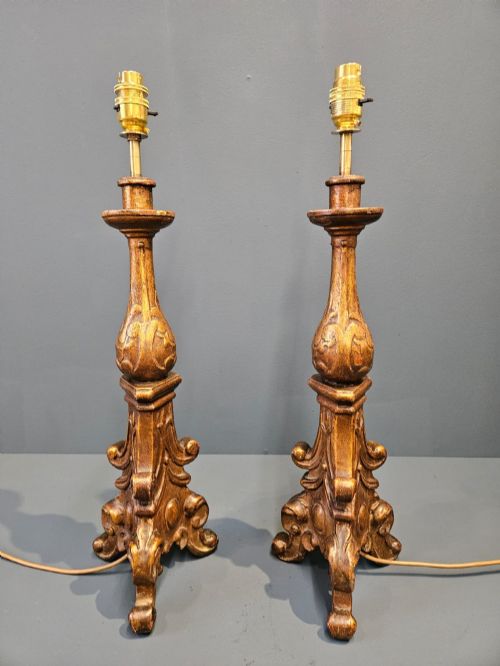


Carved Giltwood Candlestick Lamp
A carved giltwood candlestick lamp brings centuries of European craftsmanship and warm, gilded illumination into a room, offering both sculptural presence and historical character.
Carved Giltwood Candlestick Lamp
A carved giltwood candlestick lamp transforms historical lighting supports into functional illumination for modern interiors. These pieces take the form of table lamps, standard lamps, and converted candlesticks.
Most examples found here span the eighteenth and nineteenth centuries, originating from continental workshops in Italy, Spain, and France. Buyers will encounter both grand floor-standing standard lamps and smaller table versions adapted from altar sticks and pricket sticks.
Stylistic influences range from the exuberant curves of Baroque and Rococo designs to the restrained symmetry of Neoclassical pieces. Many retain the original architectural proportions of their lighting origins while serving as practical decorative objects.
Materials and construction methods
The foundation of each piece relies on traditional timber carving, often gessoed and built up to receive layers of gold leaf or gilt. Craftsmen shaped wood such as timber into intricate scrolls, acanthus leaves, and fluted columns before applying the metallic finish.
Surface treatments frequently combine burnished gold leaf with painted or marbleized details to create depth and contrast. Later additions include brass components and fitted fabric shades that complement the aged metallic surfaces.
Carved Giltwood Candlestick Lamp Retail Price Guide 2026
Typical asking prices for carved giltwood candlestick lamp among the pieces listed under this phrase on Sellingantiques today, from the lower quarter to the upper quarter. They describe what is for sale here now, not the wider market.
Listings feature pieces spanning the eighteenth century through to the 1920s, utilising materials such as gesso, brass, and gold leaf.
Assessing quality and character
Quality rests in the crispness of the hand-carving and the subtlety of the original gilding technique. Finer pieces display deep, expressive relief work where the wood beneath remains sharply defined beneath the metallic layers.
The integrity of the surface finish also distinguishes finer examples, as centuries of gentle wear reveal the warm red bole beneath thinning gold leaf. Proportion and balance in the turned or carved wooden shaft separate masterworks from more utilitarian workshop pieces.
The Carved Giltwood Candlestick Lamp Glossary
- Giltwood
- Timber that has been coated with gold leaf or a gold-coloured finish over a prepared gesso ground. This technique provides the signature luminous surface found on period lighting.
- Gesso
- A plaster-like mixture applied to wood surfaces as a smooth base for gilding and fine carving. It allows craftsmen to achieve sharp details before applying gold leaf.
- Pricket stick
- A traditional candlestick featuring an upward-facing metal spike designed to secure a wax candle. Many period lamps are converted from these ecclesiastical and domestic altar items.
- Baroque
- An ornate European design style characterised by dramatic curves, rich ornamentation, and dynamic movement. Pieces from this period exhibit bold, sculptural forms.
- Neoclassical
- A later style defined by symmetry, straight lines, and classical architectural motifs derived from antiquity. These pieces offer a more restrained silhouette compared to Baroque designs.
Carved Giltwood Candlestick Lamp: Frequently Asked Questions
What is a carved giltwood candlestick lamp?
A carved giltwood candlestick lamp is a lighting fixture created from a period wooden candlestick or lamp base finished with gold leaf. These pieces convert historical altar sticks and decorative supports into functional lamps.
They combine sculptural European woodwork with electrical fittings to provide ambient illumination in traditional and contemporary settings.
How do I choose between a table lamp and a standard lamp?
Table lamps work best on sideboards, desks, and occasional tables where they provide localized lighting and decorative height. Standard lamps stand on the floor to illuminate larger areas and corners.
Consider the scale of your room and the intended placement when deciding between a compact table base and a tall floor-standing standard lamp.
How do I care for antique giltwood?
Giltwood requires gentle maintenance to preserve the delicate gold leaf and underlying gesso layers. Dusting should be done lightly with a dry, soft brush rather than a cloth that might snag.
Keep these lamps away from direct sunlight, high humidity, and heat sources to prevent the wood and finish from drying out or cracking.
How can I tell an eighteenth-century piece from a nineteenth-century one?
Eighteenth-century pieces often display deeper, more fluid hand-carving associated with Baroque and Rococo movements, alongside authentic wear patterns on the gold leaf. Nineteenth-century examples frequently revive these earlier styles with distinct regional interpretations.
Examining the tool marks, timber type, and construction joins helps determine the chronological origin of each specific lamp base.