
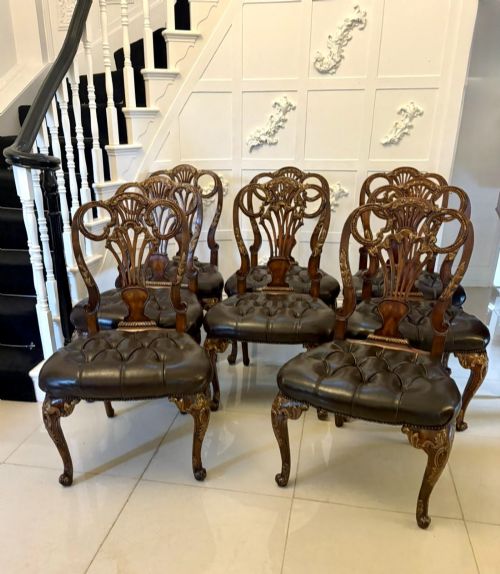
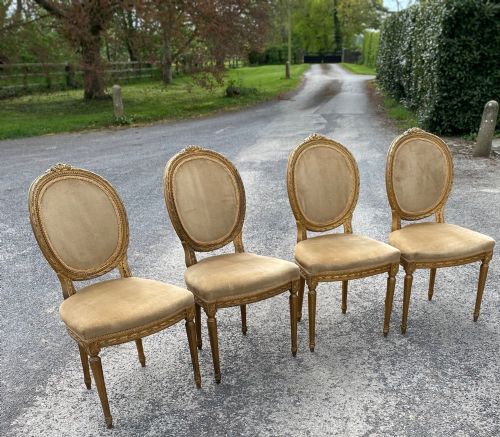


Carved Gilded Dining Chairs
These carved gilded dining chairs bring instant presence to a room, offering period craft and rich surface finish for daily dining.
Carved Gilded Dining Chairs
Carved gilded dining chairs encompass seating designed for formal meals, drawing upon historical revivals and classical proportions. The selections here span the nineteenth century into the twentieth century, bringing together French designs, Regency examples, and Edwardian interpretations.
Most pieces on this page appear as sets, pairs, or single salon and side chairs reflecting Louis XVI style, French Rococo, and Aesthetic Movement influences. Walnut, beech, and simulated bamboo form the structural frames beneath gold leaf, giltwood, and painted gold finishes.
Buyers encounter everything from large sets intended for grand dining tables to smaller groups of side chairs suitable for occasional use. The variety covers nineteenth-century Continental pieces alongside Edwardian walnut productions and later twentieth-century iterations.
How they were made
Cabinetmakers shaped structural timber such as walnut and beech using traditional joinery before applying decorative carving. Frames received layers of gold leaf or giltwood to create the metallic lustre characteristic of these formal seats.
Upholstery and cane seating completed the functional design, utilising materials like velvet and various decorative fabrics. Artisans frequently integrated hand-caning into frames alongside padded elements for comfort.
Listings span periods from the Regency era through the 1930s, featuring walnut, beech, and giltwood.
What varies in quality
The precision of the woodcarving distinguishes finer examples, where crisp detail in foliage or classical motifs demonstrates superior handwork. Lesser pieces often display softer or more uniform machine moulding across the frame.
The integrity of the gilding surface determines visual depth, with genuine gold leaf ageing gracefully compared to flat painted alternatives. Original structural stability and intact joinery also elevate the standing of a set.
Bruce J Talbert
The Carved Gilded Dining Chairs Glossary
- Giltwood
- Timber coated with gold leaf or powder applied over a prepared gesso ground. This finish provides a luminous and durable decorative surface.
- Louis XVI style
- A neoclassical design vocabulary characterised by straight tapered legs, geometric symmetry, and restrained classical ornament. It appeared frequently in revivals throughout the nineteenth and twentieth centuries.
- Caning
- Woven rattan or split cane panels used for chair seats and backs. It offers lightweight flexibility and visual transparency.
- Aesthetic Movement
- A late nineteenth-century design ethos emphasising artistic value over moral or narrative purpose. Pieces from this movement often incorporate stylized ornament and distinct structural lines.
- Simulated bamboo
- Wood turned and carved to imitate natural bamboo stalks. This technique gained popularity during various nineteenth-century exotic revival periods.
Carved Gilded Dining Chairs: Frequently Asked Questions
How do I care for giltwood dining chairs?
Dust surfaces gently with a soft dry cloth to protect the delicate gold leaf finish from abrasion.
Keep these chairs away from direct sunlight and fluctuating humidity to prevent the underlying wood and gesso from cracking.
Can I use these antique chairs every day?
Many sets handle regular daily use provided the joints remain tight and the structural timber is sound. Edwardian and nineteenth-century examples benefit from periodic checks of their underframe stability.
Heavier use suits sturdy walnut or beech frames better than delicate occasional chairs meant strictly for display.
What defines Louis XVI style chairs?
These pieces feature rectilinear frames, fluted straight legs, and circular or oval medallions on the backrests. The ornamentation draws on classical antiquity rather than the asymmetrical curves of earlier Rococo designs.
Such seating introduces formal symmetry and architectural presence into a modern dining space.
How do I distinguish nineteenth-century pieces from later revivals?
Examine the construction methods, tool marks, and wear patterns on the underside of the seat frame. Nineteenth-century pieces often show hand-cut joinery and period-specific ageing in the gilt layers.
Later twentieth-century interpretations may use standardised machine components while mimicking earlier stylistic vocabularies.