

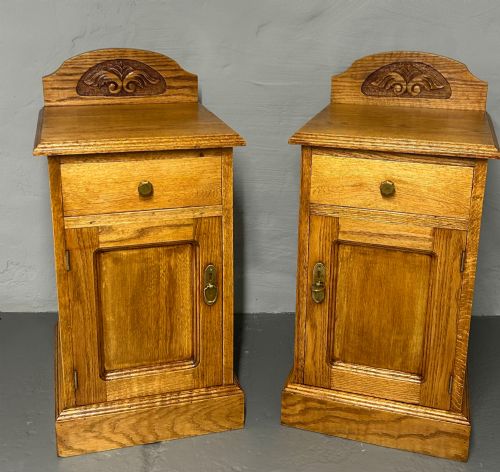
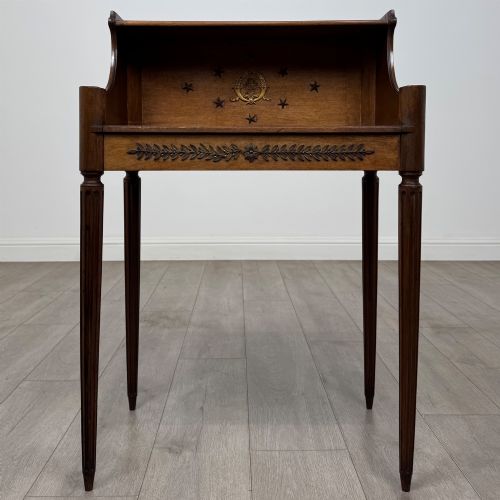


Carved Gallery Nightstands
These carved gallery nightstands bring period craftsmanship to the bedside, offering enclosed storage and raised rims.
Carved Gallery Nightstands
Carved gallery nightstands encompass bedside cabinets, side tables, bedside tables, and side cabinets spanning periods from the 18th century through to the 1930s. Buyers searching for carved gallery nightstands encounter diverse stylistic influences, including Victorian, Georgian, English country house, Gothic Revival, French Neoclassical, Queen Anne, and Edwardian Chippendale revival forms.
The most frequent examples on this page are Victorian and Edwardian pieces executed in mahogany, oak, and walnut, often featuring enclosed cupboards or tiered surfaces. These items combine practical bedside utility with decorative carved details and protective raised borders.
Origins stretch across English country workshop traditions and continental design vocabularies, showing how domestic furniture adapted to hold chamber items and lighting. Pieces range from straightforward oak cupboards to sophisticated walnut and exotic hardwood designs with brass fittings.
How they were made
Cabinetmakers worked primarily in mahogany, oak, and walnut, frequently selecting burr walnut veneers and exotic hardwoods for prominent surfaces. These timbers were shaped through traditional joinery and panel construction to build stable bedside cabinets and side tables.
Metal components such as brass galleries were added to secure items on the upper surface, while woodcarving enriched drawer fronts, friezes, and panel borders. Workshops relied on hand tools and timber selection to achieve the structural integrity seen in these bedside pieces.
Carved Gallery Nightstands Retail Price Guide 2026
Typical asking prices for carved gallery nightstands among the pieces listed under this phrase on Sellingantiques today, from the lower quarter to the upper quarter. They describe what is for sale here now, not the wider market.
One late Victorian bedside cabinet arrives stamped by Heal's, proving that even a humble nightstand once carried high retail ambitions.
What varies in quality
The hierarchy of quality rests on timber selection and the precision of the carving, distinguishing utilitarian pieces from finer workshop productions. Cabinets utilising burr walnut veneers, exotic hardwoods, or marked by known firms show superior execution.
Integration of hardware, such as fitted brass galleries and structurally sound tier supports, separates robust examples from simpler constructions. The harmony between period styling, such as Gothic Revival or Georgian proportions, and the joinery determines the standing of each piece.
James Shoolbred·Heals
The Carved Gallery Nightstands Glossary
- Gallery
- A raised border or rail around the top of a table or cabinet, designed to prevent items from rolling off. Brass galleries are frequently found on mahogany and walnut side tables from the Victorian and Edwardian eras.
- Bedside cabinet
- An enclosed piece of furniture with a door, designed to stand next to a bed for nighttime storage. These often feature internal shelving and a carved or panelled exterior.
- Burr walnut
- A prized timber harvested from walnut tree growths, displaying complex, swirling grain patterns. It is utilised on decorative tray top tables and cabinet facades for visual impact.
- Gothic Revival
- A 19th-century design style drawing on medieval architectural motifs such as pointed arches and heavy tracery. Side cabinets from this period apply these stone-carving forms to timber furniture.
- Exotic hardwood
- Dense, richly coloured timber imported from outside Europe, chosen for durable and decorative cabinetmaking. It appears alongside mahogany in late Victorian bedside cupboards.
Carved Gallery Nightstands: Frequently Asked Questions
What is a gallery nightstand?
A gallery nightstand is a bedside table or small cabinet featuring a raised rail or rim around the top surface. This raised border prevents small items from sliding off the table.
These pieces appear across various historical periods, combining enclosed storage below with a secure surface above.
How were these tables used?
Historically, these cabinets and tables stood beside the bed to hold chamber items, candlesticks, or books. The enclosed cupboards kept personal belongings out of sight.
Today, they serve the same bedside function while adding period character and surface space to a bedroom.
Are these pieces solid wood?
Construction varies between solid timbers like oak and mahogany, and pieces utilising decorative veneers over secondary woods. Burr walnut surfaces are typically applied as veneers over a stable timber base.
Examining the internal panels and joints reveals how the cabinetmaker balanced stability with decorative appearance.