


Carved Gallery Chiffonier
A carved gallery chiffonier brings architectural presence to a room, offering both display surface and enclosed storage.
Carved Gallery Chiffonier
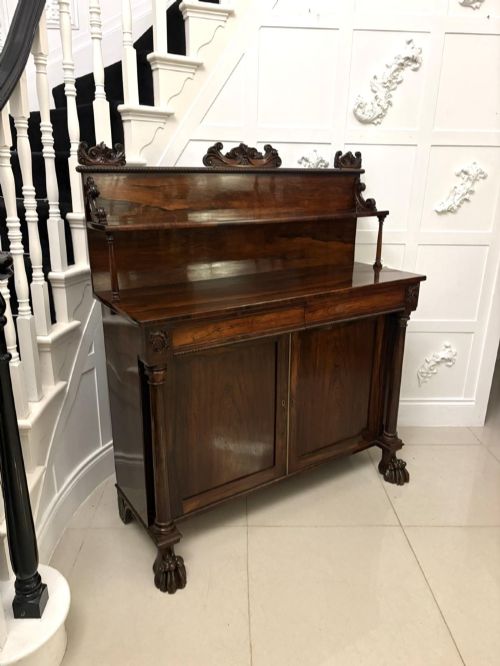
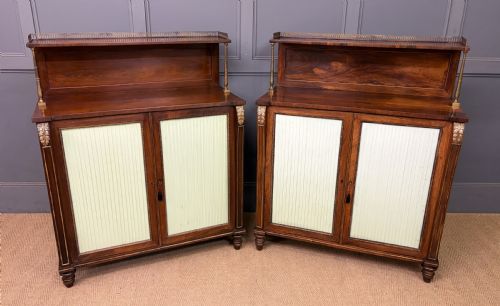
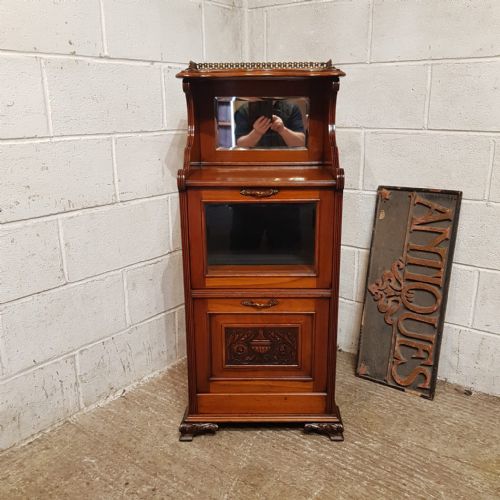
A carved gallery chiffonier stands as a principal low sideboard or side cabinet originating across the nineteenth century, including Regency, William IV, and Victorian periods. These pieces combine a stepped or raised back, known as a gallery, with a lower cupboard structure enclosed by doors.
The versions met most frequently on this page span mahogany, rosewood, and flame mahogany veneer, often taking the form of narrow side cabinets or serving sideboards. Formats range from breakfront configurations to simpler rectangular side cabinets designed to hold dining room or parlour essentials.
How they were made
Cabinet makers utilised dense primary timbers such as mahogany and rosewood, frequently applying flame mahogany veneer over secondary structural woods to create varied grain patterns on the cupboard fronts. Selected examples incorporate exotic woods like Gonçalo-Alvez and palisander to achieve rich surface variation.
Structural embellishments rely on hand carving, including barley twist supports and applied mouldings, complemented by functional elements such as brass galleries, glass panels, and silk or fabric linings behind glazed doors.
Some nineteenth-century cabinet makers discreetly lined cupboard interiors with pleated silk, turning storage into an unexpected visual reveal.
What varies in quality
The upper tier of these pieces distinguishes itself through the depth of timber selection and the precision of the veneer work, where book-matched flame mahogany aligns symmetrically across the doors. Finer examples display crisply executed hand carving on the mouldings and structural supports rather than cast or heavily simplified ornamentation.
Proportion and integration also separate standard utility items from superior cabinet work, seen in the seamless fit of doors, the quality of internal cedar or mahogany linings, and the structural integrity of the raised gallery back.
The Carved Gallery Chiffonier Glossary
- Chiffonier
- A low sideboard or cabinet featuring a raised shelf or gallery at the back and enclosed cupboards below. This form evolved during the Regency period to serve as a multifunctional piece for serving and storage.
- Gallery
- A raised superstructure incorporating shelves or spindles situated on the top surface of a cabinet. It provides decorative framing and a secure ledge for display items.
- Breakfront
- A cabinet design where the central section projects forward from the flanking outer sections. This architectural arrangement creates shadow and depth across the front elevation.
- Veneer
- A thin layer of figured wood applied over a more stable secondary timber ground. Flame mahogany and rosewood veneers create striking surface patterns unavailable in solid planks.
- Barley Twist
- A cylindrical furniture leg or support carved in a helical, rope-like spiral. This decorative turning technique appears frequently on nineteenth-century supports and columns.
Carved Gallery Chiffonier: Frequently Asked Questions
What is a carved gallery chiffonier?
A carved gallery chiffonier is a low nineteenth-century cabinet featuring enclosed lower storage and a decorative raised superstructure at the back. These pieces served primarily in dining rooms and parlours for serving food and displaying silver or glassware.
Today, they function effectively as sideboards in dining spaces or as media consoles and display surfaces in living rooms, combining compact floor footprints with useful interior shelving.
Where were these cabinets used?
These cabinets were originally designed for nineteenth-century dining rooms, drawing rooms, and large hallways as auxiliary storage and serving surfaces. Their enclosed lower cupboards held linens, cutlery, and glassware out of sight.
Their narrow profile allows them to sit comfortably against walls in modern hallways, dining areas, and reception rooms without obstructing walkways.
What woods were used?
Makers constructed these pieces primarily using solid mahogany and rosewood, frequently applying figured veneers like flame mahogany to the door panels. Exotic timbers such as palisander and Gonçalo-Alvez also appear on select Regency examples.
Internal elements often utilise secondary timbers like oak or pine for drawer linings and structural framing, while brass and glass provide decorative and functional accents.
How do I care for rosewood and mahogany?
Maintain these nineteenth-century timber surfaces by keeping them away from direct sunlight and sudden temperature changes, which can cause veneer to lift or wood to split. Regular dusting with a soft, dry cloth preserves the finish.
Apply a traditional beeswax polish sparingly when the wood appears dry, buffing gently to maintain the natural lustre of the polished grain.