
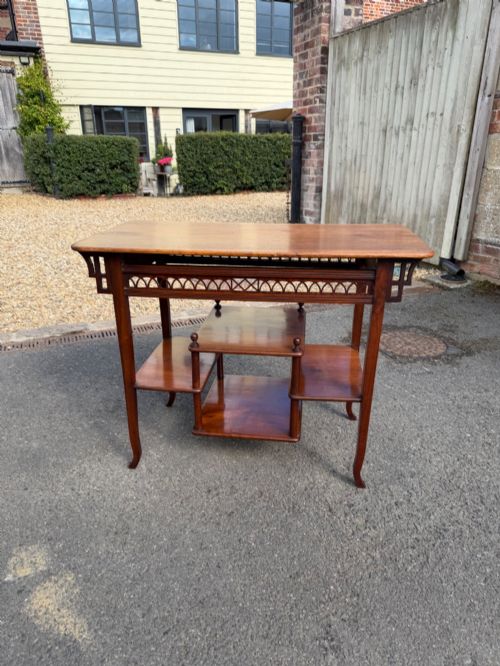
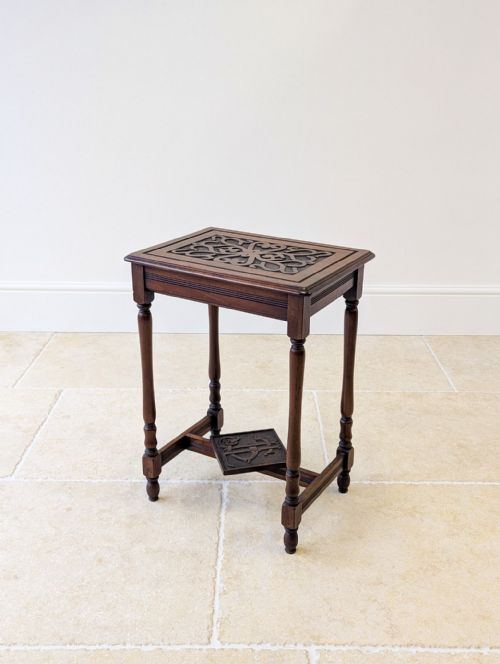


Carved Fretwork Console Table
A carved fretwork console table brings distinct structural line and intricate open-pierced detail to a hallway or drawing room.
Carved Fretwork Console Table
A carved fretwork console table combines structural timber frames with intricate open-cut decoration derived from eighteenth-century pattern books and global design traditions. When exploring a carved fretwork console table, buyers encounter forms ranging from English revival iterations to Qing dynasty altar pieces and Anglo-Indian rosewood furniture. The selection on this page demonstrates how cabinetmakers applied pierced fretwork galleries, brackets, and friezes to mahogany, walnut, hardwood, and rosewood substrates.
Most pieces date from the nineteenth century, including Victorian interpretations and Chippendale revival examples, alongside earlier eighteenth-century forms and early twentieth-century variations. These tables serve primarily as narrow display or serving surfaces against a wall, frequently utilising marble inserts, demi-lune shapes, or rectangular tops. The physical evidence bridges European neoclassical taste with Asian carving techniques, offering a diverse array of proportions and decorative schemes.
Materials and construction
Makers utilised dense timbers such as mahogany, walnut, rosewood, and hardwood to support deep piercing and undercut relief carving without structural failure. Fretwork panels were sawn and chiselled by hand from thin sheets of timber or applied directly to the frieze and legs as reinforcing brackets. In several examples, imported exotic woods were selected for their grain figure, while others incorporated inset marble top panels or brass mounts.
Joinery methods relied on traditional mortise and tenon frames to ensure stability despite the removal of timber mass through pierced ornament. Surface finishing involved hand-polishing with wax or shellac to seal the wood while retaining natural grain depth and colour variation.
Listings feature mahogany, walnut, rosewood, elm, and hardwood tables spanning the eighteenth, nineteenth, and early twentieth centuries.
Assessing quality
Quality rests upon the crispness of the carved detail and the depth of relief within the fretwork lattice. Superior tables display sharp internal corners and hand-finished piercing where the chisel work remains distinct from mechanical replication. The choice of timber grain, such as figured mahogany or burr walnut, further elevates a piece.
Proportion and structural integrity separate workshop standards, with finer examples maintaining balanced sightlines across the frieze and leg assemblies. The integration of secondary timbers and the precision of joint connections reflect the skill of the original cabinetmaker.
Edwards & Roberts·Butler
The Carved Fretwork Console Table Glossary
- Fretwork
- Openwork ornamentation cut from a thin board or panel in geometric, interlaced, or scrolling patterns. It provides ornamental lightness to heavy timber frames without sacrificing structural integrity.
- Console table
- A table designed to stand against a wall, traditionally secured with wall brackets if the legs were omitted. Surviving antique examples usually stand independently on front legs while relying on the wall for steady placement.
- Altar table
- A traditional Chinese form featuring elongated rectangular proportions and end flanges, often constructed from dense hardwoods. These tables served ceremonial functions in domestic interiors before entering the Western antique trade.
- Lowboy
- A small eighteenth-century English table with drawers, typically set on four legs, used as a dressing or side table. The lowboy represents an early precursor to later freestanding serving surfaces.
- Demi-lune
- A half-moon shape used for tabletops and console frames intended to sit flush against a wall. This profile maximises floor space in narrow hallways and reception rooms.
Carved Fretwork Console Table: Frequently Asked Questions
What is a carved fretwork console table used for?
These tables were designed to stand against a wall in hallways, drawing rooms, or dining spaces to hold lamps, decorative objects, or serving dishes. Their narrow profiles allowed them to occupy circulation areas without blocking foot traffic.
Today, they function effectively in modern interiors as statement entry tables or display surfaces that introduce historical texture and linear interest beneath a mirror or artwork.
How do I distinguish Chippendale revival from earlier periods?
Chippendale revival pieces typically date from the late nineteenth or early twentieth century and replicate the elaborate pierced fretwork and blind fret designs of the mid-eighteenth century. Examination of the timber dryness, secondary woods, and tool marks on hidden surfaces helps differentiate nineteenth-century workshop production from original Georgian manufacture.
Revival pieces often exhibit a more uniform machine-assisted precision in the fretwork cutting, whereas eighteenth-century work reveals minor irregularities from hand chiselling.
How should I care for a hardwood console table?
Maintain the finish by applying natural beeswax sparingly and buffing with a soft cloth to preserve the sheen of the timber. Avoid placing the table in direct sunlight or near heat sources to prevent the wood and delicate fretwork from drying and splitting.
Dust intricate pierced carvings regularly using a soft bristle brush to prevent particle accumulation in the recessed fretwork channels.