
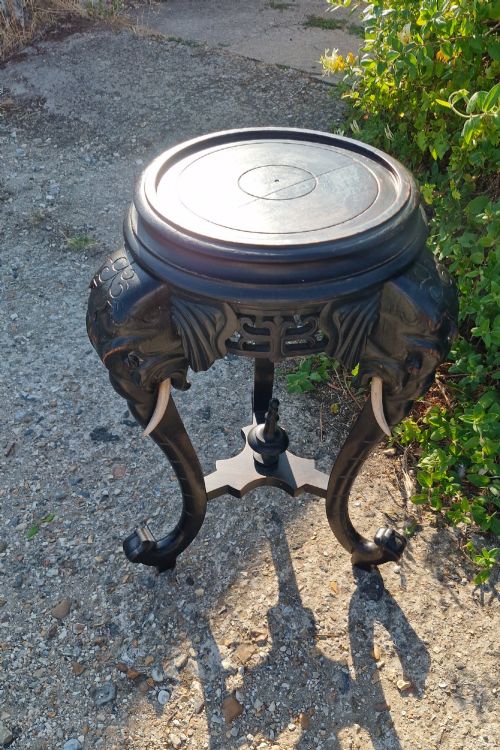
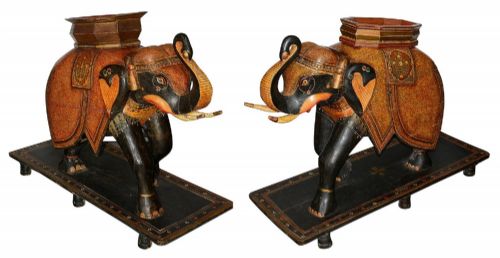


Carved Elephant Plant Stand
These carved elephant plant stands bring striking colonial and Asian folk art forms into a room, offering a sturdy surface for greenery.
Carved Elephant Plant Stand
A carved elephant plant stand combines functional furniture with sculptural animal forms, taking shape as side tables, occasional tables, stools, and traditional plant stands. You will find pieces originating from the 19th Century, Victorian, and Edwardian eras, alongside items dated from 1880 through to 1920.
The regional origins and styles span Anglo-Indian, Anglo-Indian Colonial, Asian Folk Art, and Anglo-Burmese Colonial traditions. Workshops in the Bombay Presidency and Hoshiarpur contributed heavily to the selection, producing octagonal, hexagonal, and circular tops supported by carved elephant figures.
How they were made
Makers utilised solid hardwoods such as teak and rosewood, carving the elephant bodies and supporting furniture frames by hand. Painted wood, lacquer, and gesso provide surface decoration, while bone and bone inlay add contrasting detail to specific tables.
Structural elements range from tripod bases to tray tops and pedestal configurations. Artisans applied regional techniques, incorporating painted wooden or sculpted tusks and intricate surface carving directly into the timber.
The listings show pieces spanning from the 1880s through to the Edwardian period, executed in teak, rosewood, bone, and gesso.
What varies in quality
Material selection and decorative enrichment also set pieces apart. Solid rosewood or teak frames combined with precise bone inlay or lacquer work represent the upper end of the range compared to plain painted wood.
The Carved Elephant Plant Stand Glossary
- Anglo-Indian
- Descriptive of furniture produced in India during the British colonial period, often combining local carving skills with European furniture forms.
- Hoshiarpur
- A town in Punjab known for intricate wooden furniture featuring dense geometric or floral bone inlay work.
- Teak
- A dense tropical hardwood valued for its durability and resistance to wear, commonly utilised in colonial Indian furniture.
- Gesso
- A plaster-like material applied to wood surfaces as a base for painting or gilding, found on specific decorative pieces.
- Tripod base
- A three-legged support structure frequently utilised on small occasional tables and plant stands to ensure stability.
Carved Elephant Plant Stand: Frequently Asked Questions
What were carved elephant plant stands used for?
These pieces served primarily as occasional tables, display stands for plants and lamps, or decorative seating within Victorian and Edwardian interiors.
They functioned both as practical furniture and as exotic decorative art items reflecting colonial trade and travel.
How do I style a carved elephant plant stand at home?
Place the stand in a corner or beside a chair to hold a potted plant, a small lamp, or decorative objects.
The carved wooden elephant figures act as strong visual focal points, so pairing them with simpler surroundings allows the detail of the woodwork to stand out.
How can I tell the period of an elephant plant stand?
Examine the timber, construction methods, and surface decoration to gauge the period.
Pieces from the late 19th Century and Victorian eras often display dense hand carving in teak or rosewood, while early 20th Century examples may incorporate bone inlay or lacquer.
What materials are used in these stands?
Makers constructed these stands using solid hardwoods including teak and rosewood.
Additional materials frequently include bone for inlay work, gesso, lacquer, and painted wood for surface decoration and tusks.