
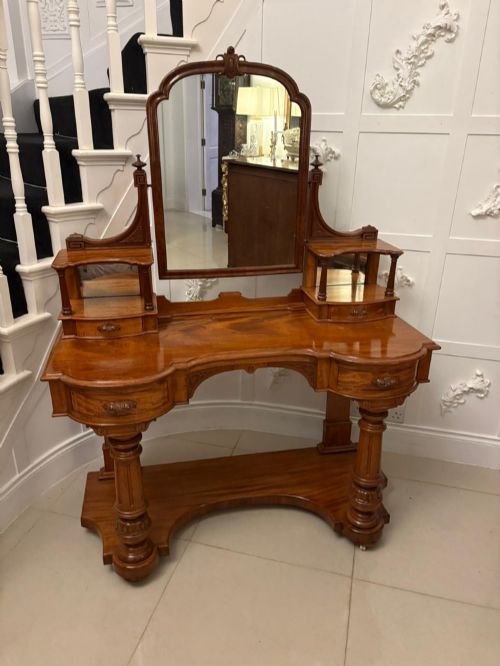
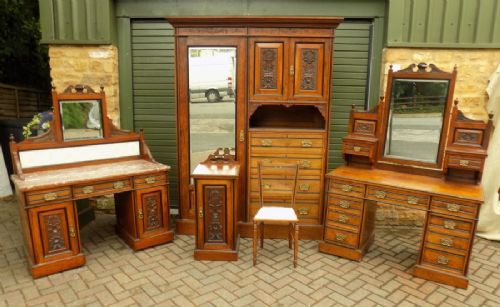


Carved Duchess Dressing Table
A carved duchess dressing table brings sweeping Victorian presence into a bedroom, offering grand mirrors and tiered drawers for daily toilette.
Carved Duchess Dressing Table
A carved duchess dressing table is a substantial bedroom piece typically featuring a large central mirror flanked by smaller swing glasses and numerous small drawers. Most examples seen on this page date from the Victorian and Edwardian periods, stretching from the mid nineteenth century into the early twentieth century.
The form developed to serve the detailed grooming rituals of the era, combining a low writing surface with elevated tiers for perfumes and trinkets. Walnut and mahogany dominate the selection, often enriched by burr veneers and elaborate carved wooden flourishes.
Beyond standard dressing tables, related forms such as toilet mirrors, bedroom suites, and pedestal dressing tables occasionally appear in the listings. These pieces reflect the stylistic shifts of their time, moving from heavy Victorian Rococo Revival and Gothic Revival lines toward lighter Edwardian proportions.
What Varies in Quality
Quality rests heavily on the choice of timber and the ambition of the carving, with burr walnut and flame mahogany examples displaying superior grain patterns. The depth and crispness of the hand-carved elements distinguish standard production from exceptional pieces commissioned for grander homes.
The integrity of the mirror glass and the complexity of the superstructure also define the upper tier of the range. Elaborate multi-drawer configurations and integrated side cabinets show a higher level of cabinet-making skill than simpler single-pedestal designs.
Many a Victorian lady entrusted her most delicate lace caps to the secret recesses of these multi-tiered trinket drawers.
The Carved Duchess Dressing Table Glossary
- Duchess dressing table
- A grand dressing table style featuring a large attached mirror, a tiered superstructure with small trinket drawers, and a low central writing surface. It became a bedroom centrepiece during the Victorian era.
- Burr walnut
- A highly prized timber veneer taken from the growth growths of the walnut tree, showing intricate swirling patterns. It was frequently utilised on high-end Victorian furniture.
- Gothic Revival
- An architectural and decorative style drawing on medieval pointed arches, heavy mouldings, and ecclesiastical motifs. Pieces from this movement often feature dramatic carved architectural pediments.
- Toilet mirror
- A smaller tabletop mirror resting on its own miniature chest of drawers or swing frame. These items served a similar function to full dressing tables in more compact spaces.
Carved Duchess Dressing Table: Frequently Asked Questions
What is a duchess dressing table?
A duchess dressing table is a large Victorian bedroom piece designed for hair and cosmetics, featuring a prominent central mirror and tiered drawers. Its distinctive layout combines a low writing surface with elevated side compartments.
Cabinet makers built these pieces to serve as both functional furniture and grand decorative statements within a bedroom suite.
How do I date a dressing table?
Dating relies on timber choices, construction methods, and stylistic cues such as Victorian revival carving or Edwardian simplicity. Mid-nineteenth-century pieces often display heavy mahogany or burr walnut with rich grain.
Later Victorian and Edwardian examples tend to show lighter proportions, different brass hardware styles, and occasional inlay work.
Are the mirrors original?
Many surviving pieces retain their original heavy glass plates, which can exhibit slight foxing or age spots over time. Replacement mirrors do occur when original glass has suffered damage through generations of use.
Inspect the bevels, silvering backing, and mounting hardware to understand the history of the mirror plate.
How do I care for burr walnut?
Burr walnut veneer requires protection from direct sunlight and excessive humidity to prevent the fine wood from drying or splitting. Regular gentle dusting with a soft cloth preserves the polished surface.
Application of appropriate wax polish maintains the natural depth of the grain without building up heavy chemical layers.