
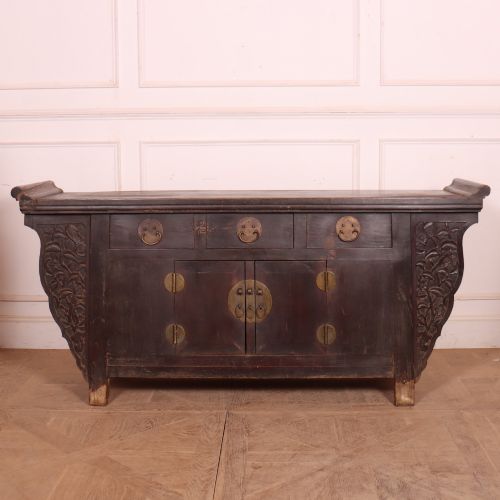
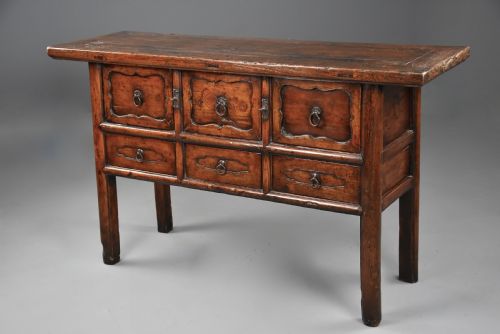
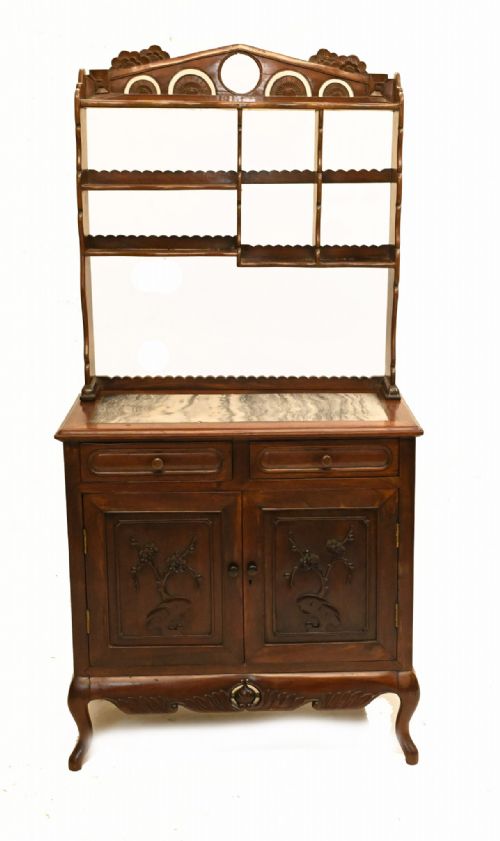


Carved Chinese Sideboard
A carved Chinese sideboard brings heavy timber, deep relief and regional style directly into a dining room or hallway.
Carved Chinese Sideboard
A carved Chinese sideboard covers a broad family of storage furniture, console tables and cabinets originating from various periods and regional workshops. When searching for a carved Chinese sideboard, buyers encounter items ranging from rustic elm dressers to lacquered and gilded side cabinets carrying Qing Dynasty or provincial influences.
The versions most commonly met on this page date from the nineteenth century, including pieces featuring black or red lacquer, hardwood construction and intricate carved decoration. Alongside traditional sideboards, the selection includes console tables, side cabinets and altar-style tables built for storage and display.
Origins stretch from regional provincial styles to export pieces influenced by European taste, such as eighteenth-century Kangxi designs or Chinese Chippendale interpretations. Each piece reflects the functional requirements of domestic storage combined with traditional woodwork traditions.
Materials and construction
Construction relies heavily on native timbers such as elm, camphor wood and dense hardwoods, selected for structural stability and finished with patinated surfaces. Master carpenters utilised traditional joinery methods to frame heavy doors and panels without relying on modern metal fasteners.
Surface decoration frequently involves layers of red or black lacquer applied over wood, sometimes complemented by intricate carving, gilding or inlaid details. Selected pieces incorporate contrasting materials like marble tops, brass mounts and iron hardware to finish the structural framework.
Listings feature woods ranging from native elm and camphor to dense unspecified hardwoods paired with traditional brass and iron hardware.
Assessing quality and craftsmanship
Quality reveals itself in the depth and crispness of the carved relief work, where skilled hands produce figures and motifs with sharp definition. Superior examples display balanced proportions, coherent regional styling and timber that has developed a deep, honest patina over generations.
The integrity of the lacquer work and the survival of original gilding or hardware also separate standard items from exceptional survivals. Construction details, such as the snugness of drawer joints and the stability of heavy doors, point directly to the original workshop standard.
The Carved Chinese Sideboard Glossary
- Lacquer
- A durable resin finish applied in multiple layers to wood surfaces. It provides a glossy protective coating that is frequently coloured in rich reds or deep blacks.
- Elm
- A resilient native hardwood favoured for rustic Chinese furniture. It offers a pronounced grain pattern that accepts wax finishes and develops a rich patina over time.
- Console table
- A wall-mounted or freestanding table designed for narrow spaces. These pieces often feature decorative front legs and flat tops suited to display objects.
- Altar table
- A traditional Chinese table form with upturned flanges at the short ends. Originally used for ritual purposes, these tables translate well into modern living spaces as side tables or sideboards.
Carved Chinese Sideboard: Frequently Asked Questions
How do I style a carved Chinese sideboard at home?
Position the piece against a plain wall in a hallway, dining room or living space to let the carved relief work and lacquer finish stand out without visual competition.
Keep surrounding furniture simple and uncluttered, using the top surface for a single large lamp, ceramic vase or curated collection of objects.
What is the difference between a sideboard and a console table?
Sideboards are primarily designed for storage, featuring enclosed cupboards, drawers or drop fronts to hide tableware and household items.
Console tables are generally more open structures built to stand against walls, serving decorative display purposes rather than heavy concealed storage.
How do I care for lacquered wood furniture?
Dust the surface regularly with a soft, dry cloth to prevent abrasive particles from scratching the delicate lacquer or gilded details.
Keep the piece away from direct sunlight and strong heat sources to avoid drying out the timber and cracking the traditional lacquer finish.
How can I tell a nineteenth-century piece from a modern reproduction?
Examine the timber for natural wear, shrinkage cracks and a deep, undisturbed patina that indicates decades of handling and atmospheric exposure.
Look closely at the construction methods inside the drawers and cabinet backs, where hand-cut joinery differs distinctly from modern machine production.