
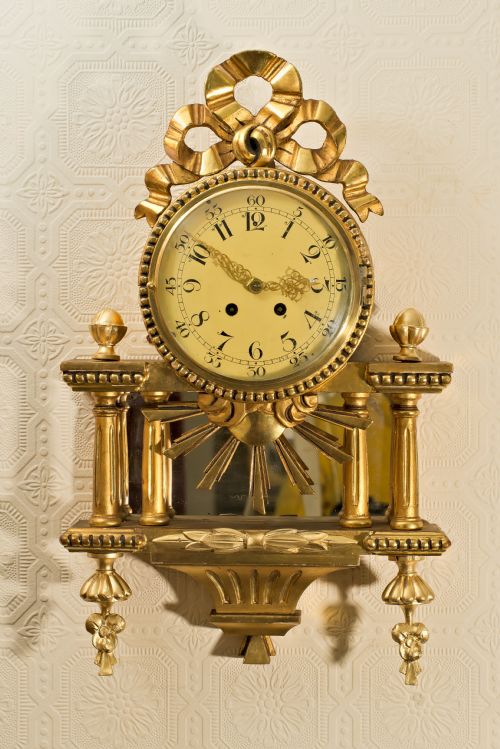


Cartel Style Clock
These cartel style clock pieces are ornate wall clocks from the eighteenth to twentieth centuries, bringing decorative French and Swedish flair to a room.
Cartel Style Clock
A cartel style clock is a wall clock housed in an elaborate, decorative frame that mounts directly to the wall rather than resting on a mantel or floor.
Buyers browsing this selection will frequently encounter nineteenth-century French and Victorian examples, alongside eighteenth-century Georgian and Swedish pieces.
The dominant forms span French Rococo, Louis XVI, and Gustavian Neoclassical styles, usually taking the shape of wall clocks designed to draw the eye.
How they were made
Makers shaped these cases from carved wood, giltwood, and painted wood, often applying rich gilding to enhance the decorative impact.
Metal components utilise gilt bronze, ormolu, brass, and gilt metal, creating heavy, ornate framing around the dial.
Glazing typically involves glass and mirror glass, protecting the enamelled dial while reflecting light within the room.
The listings span the eighteenth, nineteenth, and early twentieth centuries, incorporating materials from simple brass to elaborate gilt bronze.
What varies in quality
The crispness and depth of the carved wood or cast ormolu determine the visual sharpness of the scrollwork and asymmetrical motifs.
Material choice separates standard production from finer pieces, moving from simple gilt metal to heavy gilt bronze and substantial carved giltwood.
The refinement of the enamel dial and the presence of specialised elements such as églomisé glass panels elevate the overall execution.
WETTERSTRANDS·Perivale of England·Japy Freres
The Cartel Style Clock Glossary
- Cartel clock
- A wall-mounted clock featuring an ornate, unified frame enclosing the dial and movement. These pieces originated in France and became popular across Europe.
- Ormolu
- Gilt bronze created by applying a mercury and gold amalgam to a bronze base and firing it. This technique produces a rich, durable golden finish.
- Églomisé
- Gilding or painting on the reverse side of glass to create a reflective, metallic panel. Swedish and continental makers utilised this technique for decorative clock bodies.
- Giltwood
- Wood that has been coated with a thin layer of gold leaf or powder. Carved wooden cartel frames often received this treatment to mimic solid gold.
- Rococo
- An ornate design style characterised by asymmetry, scrollwork, and natural motifs. French clockmakers applied this vocabulary freely to their wall clock cases.
Cartel Style Clock: Frequently Asked Questions
How do I hang a cartel clock?
These wall-mounted pieces require a sturdy wall anchor and a heavy-duty screw or bracket capable of supporting the combined weight of the metal or wooden case and internal movement.
Ensure the mounting point secures directly into wall studs or utilises appropriate cavity fixings to bear the substantial weight safely.
Where should I place a cartel clock?
Position the clock at eye level on a prominent wall where the detailed carving, gilding, and enamel dial can be appreciated without obstruction.
Avoid hanging them in areas subject to excessive moisture or direct sunlight, which can damage the delicate gilding and enamel surfaces over time.
How do I tell Louis XVI from Rococo styles?
Rococo style cartel clocks feature asymmetrical scrollwork, C-scrolls, and flowing organic motifs that create a sense of dynamic movement.
Louis XVI style pieces introduce greater symmetry, straight lines, classical urns, and architectural restraint derived from neoclassical influences.
What maintenance do these clocks need?
Dust the carved wood and gilt surfaces gently with a soft, dry brush to prevent dirt buildup in the intricate crevices of the case.
Mechanical movements benefit from periodic professional servicing by a horologist to keep the gears running accurately without harming the antique components.