

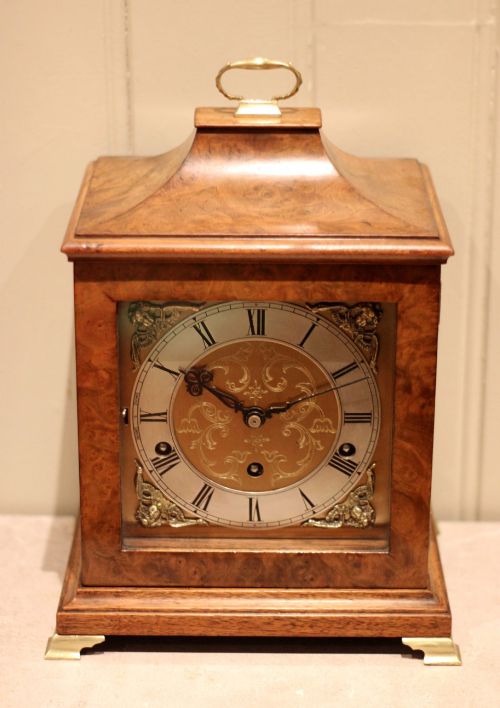

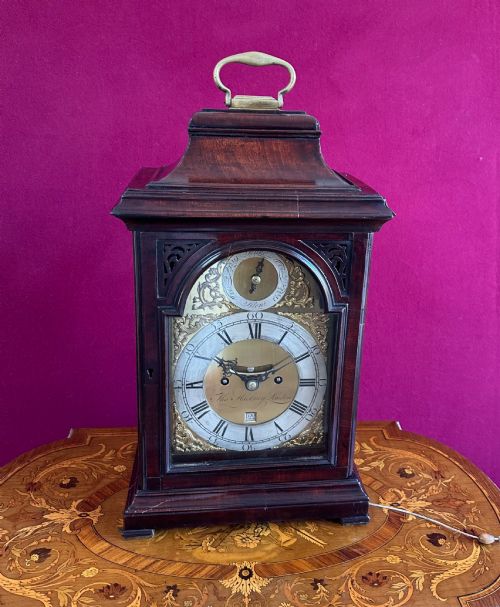


Caddy Top Table Clock
A caddy top table clock brings architectural presence and mechanical precision into a room through traditional forms.
Caddy Top Table Clock
A caddy top table clock is a bracket clock or mantel clock featuring a distinctive caddy top profile, appearing across periods from the seventeenth century through to the twentieth century. These timepieces take the form of bracket clocks and mantel clocks, often housed in rich timber cases designed to sit upon furniture or designated brackets.
The pieces seen on this page span Georgian originals to later revivals, including George II style, William and Mary, and seventeenth century style examples. Makers such as Henry Jones, John Taylor, Watson, Mappin & Webb, and Lenzkirch are represented alongside unsigned works.
Buyers encounter variations ranging from seventeenth century ebony cases with gilded brass to eighteenth century mahogany and later burr walnut veneer. Movements include verge, eight-day striking, quarter striking, and Westminster chime mechanisms, sometimes paired with alarm functions.
How they were made
Casework relies upon timber construction, utilising solid mahogany, walnut, and ebony, alongside burr walnut veneer. Brass and gilded brass supply decorative mounts, dials, and handle details, while glass protects the clock face.
Internal mechanisms combine intricate brass gear trains with verge or pendulum escapements, driven by spring or weight power. Makers integrated striking mechanisms and chime trains, including Westminster chimes and quarter-striking arrangements, requiring precise hand-fitting of metal components.
Caddy Top Table Clock Retail Price Guide 2026
Typical asking prices for caddy top table clock among the pieces listed under this phrase on Sellingantiques today, from the lower quarter to the upper quarter. They describe what is for sale here now, not the wider market.
Listings feature mahogany, walnut, burr walnut veneer, and ebony, paired with brass and gilded brass.
What varies in quality
Quality rests upon the crispness of the timber cabinetry and the depth of the veneer work, where burr walnut or figured mahogany displays deliberate grain selection. Finer examples maintain original brass mounts and well-proportioned caddy top profiles that balance the height of the case.
The standard of the internal movement dictates execution at the highest level, distinguishing basic timekeepers from complex quarter-striking or chiming mechanisms signed by established makers.
Henry Jones·John Taylor·Watson·Mappin & Webb·Lenzkirch
The Caddy Top Table Clock Glossary
- Caddy top
- A stepped or domed upper section to a clock case, echoing the form of tea caddies popular in the eighteenth century. This silhouette defines the architectural character of the upper case.
- Bracket clock
- A portable mechanical clock originally designed to rest upon a wall bracket to project sound effectively. Many now sit comfortably upon mantelpieces and tables.
- Verge movement
- An early type of escapement mechanism utilising a crown wheel and pallet verge to regulate the speed of the clock. It represents traditional horological construction in older pieces.
- Westminster chime
- A four-quarter chime melody traditionally associated with clock movements of the late nineteenth and twentieth centuries. It sounds the quarters and the full hour on multiple gongs.
- Quarter striking
- A mechanism that sounds the quarters of the hour on bells or gongs in addition to striking the full hour count. This adds mechanical complexity to the movement.
Caddy Top Table Clock: Frequently Asked Questions
Where should I place a caddy top table clock?
These clocks sit well on sturdy mantelpieces, sideboards, or dedicated wall brackets where their proportions can be appreciated.
Ensure the surface is level to keep the mechanical movement beating evenly.
What is the difference between a bracket clock and a mantel clock?
Bracket clocks historically required a wooden wall bracket for acoustic projection, whereas mantel clocks were designed specifically to stand on fireplace mantelpieces.
Over time, the terms became largely interchangeable for portable table clocks with handles.
How can I tell a Georgian original from a revival piece?
Examine the timber ageing, internal movement construction, and secondary woods used inside the case for period indicators.
Revival pieces from the nineteenth and twentieth centuries often employ heavier mechanical plates and machine-finished details.