
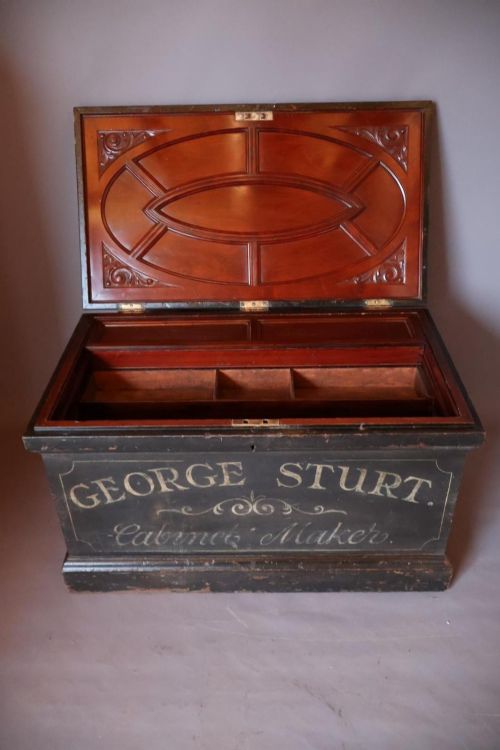


Cabinet Maker Chest
A cabinet maker chest brings together serious craftsmanship and clever internal storage, offering both practical utility and historic character for the home.
Cabinet Maker Chest
The most common examples on this page are Victorian tool chests and miniature apprentice pieces, alongside larger bedroom chests produced by notable cabinet maker firms. Their forms vary from fitted multi-drawer tool trunks to kneehole desks and Wellington chests, reflecting the diverse output of period workshops from the 18th century onward.
Materials and construction
Makers utilised dense timbers such as mahogany, oak, elm and pine to ensure structural rigidity, frequently selecting burr walnut and figured veneers for decorative surfaces. Brass hardware, including flush carrying handles and robust locks, was standard on functional tool chests to withstand heavy transit.
Joinery techniques involved precise dovetailing for drawers and carcasses, paired with internal partitions tailored to hold delicate tools, watch repair equipment or architectural instruments. Surfaces were finished with polish or left in natural limed oak, depending on the prevailing style of the period.
Some tool chests survive with over a century of genuine carpenter pencil marks and sawdust tucked deep inside their secret compartments.
Assessing quality and execution
Quality rests primarily in the precision of the internal arrangement and the crispness of the exterior cabinet work. Superior pieces demonstrate meticulous dovetailing, well-fitted internal drawers, and high-grade secondary timbers rather than hurried assembly.
The choice of primary veneer also dictates distinction, moving from utilitarian pine to highly figured mahogany, burr walnut or amboyna. Maker attribution adds considerable weight, with signed pieces by established workshops commanding particular interest.
Edwards & Roberts·Gillows of Lancaster·Whytock & Reid of Edinburgh·Druce & Co·Bath Cabinet Makers·George Simpson
The Cabinet Maker Chest Glossary
- Apprentice piece
- A small-scale item created by a trainee to demonstrate mastery of joinery and woodworking techniques to a guild or master.
- Wellington chest
- A tall, narrow chest of drawers secured by a hinged locking side pilaster that fastens over the drawer edges.
- Dovetail
- A joinery method interlocking wedge-shaped fingers, prized for its tensile strength in drawer construction.
- Kneehole desk
- A compact desk or writing table featuring a central recess for the legs flanked by pedestals of small drawers.
- Limed oak
- A finish treatment filling the grain of oak with a white composition, popular in early 20th-century design.
Cabinet Maker Chest: Frequently Asked Questions
What is a cabinet maker chest?
A cabinet maker chest refers either to a fitted wooden trunk used by carpenters and artisans to transport tools, or to a miniature salesman sample and apprentice chest.
These pieces showcase exceptional joinery, featuring multiple internal compartments, secret drawers or finely scaled proportions reflecting full-sized furniture.
How were tool chests used?
Working tradesmen utilised these heavy chests to organise, protect and transport specialised hand tools between commissions.
The fitted interiors included dedicated trays, brackets and small drawers designed to keep chisels, saws and measuring instruments secure during transit.
Where should I place an apprentice chest?
Miniature and apprentice chests suit tabletops, sideboards or shelves where their intricate proportions can be appreciated up close.
Because they occupy a smaller footprint than standard furniture, they function well in hallways or living rooms for storing small items.
How do I identify a Victorian chest?
Victorian examples typically display darker mahogany or walnut timbers, robust brass handles, and machine-sawn elements alongside hand-cut dovetails.
Tool chests from this era often retain original fitted interior layouts, paper trade labels, or traces of workshop use.