


Button Backed Daybed
A button backed daybed is a nineteenth-century reclining seat designed for daytime resting, combining rich timber frames with deep tufted upholstery.
Button Backed Daybed
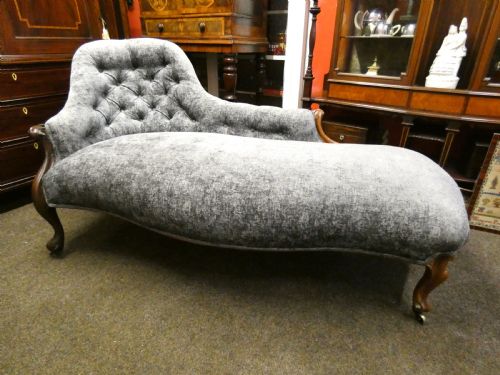
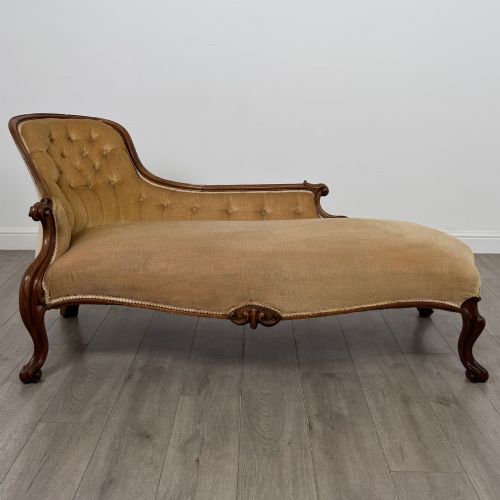
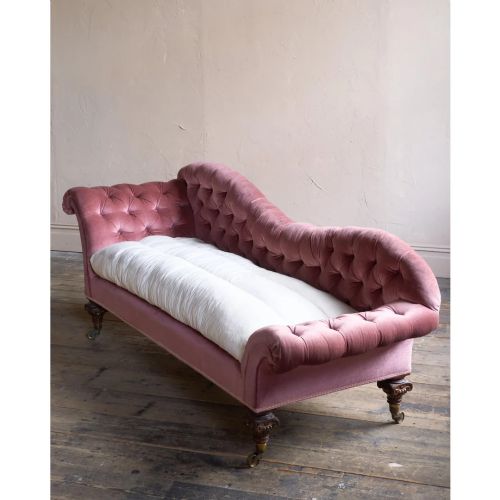
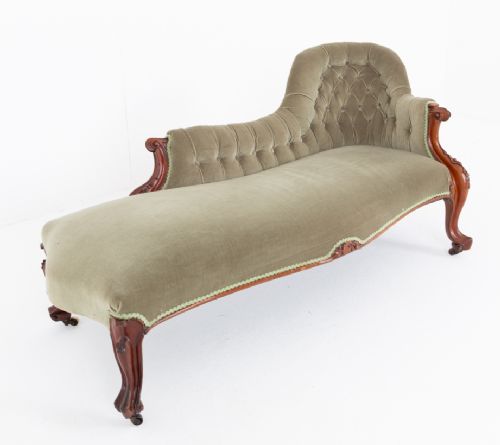
A button backed daybed encompasses nineteenth-century chaise longues, day beds, and salon sofas originating from Victorian, Regency, and William IV periods. These seating forms appear in mahogany, rosewood, walnut, and ebonised wood, often taking the shape of single-ended couches with scroll ends and exposed wooden frames.
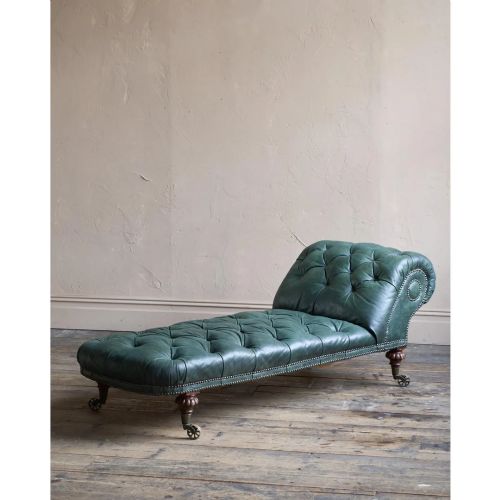
The version most commonly met on this page is the Victorian rosewood or mahogany chaise longue, featuring scrolled armrests and button-tufted upholstery in fabric, velvet, or leather. Alongside these full-scale seating pieces, occasional miniature furniture and day beds broaden the selection.
Materials and construction methods
Makers utilised solid timbers such as mahogany, rosewood, and walnut for the structural frames, applying hand-carved details, ionic column legs, or gilt decoration. Wood selection dictated the weight and visual tone of each piece.
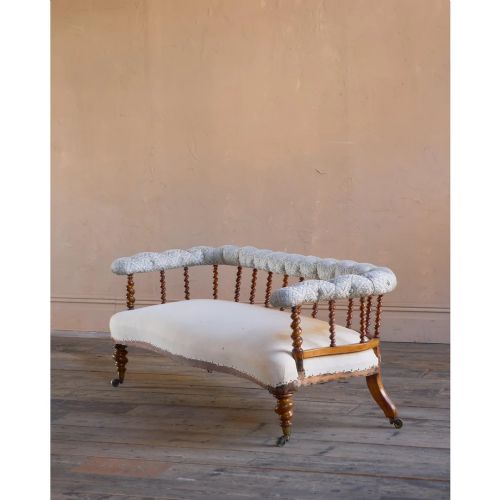
Upholstery relied on traditional stuffing methods secured with deep buttoning through fabric, velvet, or leather. Frames incorporated turned or spindle backs, alongside specific configurations like double spoonbacks.
For miniature collectors, the selection includes an ebonised miniature chaise lounge scaled down from full-size parlour furniture.
Distinctions in craftsmanship
The refinement of the timber carving separates standard seating from exceptional examples, with crisp mouldings, detailed scrollwork, and substantial rosewood or mahogany frames indicating superior workshop output. Structural integrity in the joinery of the scroll ends and legs also determines the lasting stability of the frame.
The execution of the upholstery work defines the finish, where precise buttoning and high-grade leather, velvet, or fabric complement the underlying woodwork. The distinction lies in whether the carved details and upholstery textiles remain harmonious and well-balanced.
C. Hindley & Sons·Holland & Sons·Miles & Edwards·Howard and Sons
The Button Backed Daybed Glossary
- Chaise longue
- An upholstered sofa in the form of a chair with a long seat large enough to support the user's legs.
- Day bed
- A form of long chair or couch utilised for resting during daytime hours.
- Double spoonback
- A upholstered backrest divided into two oval shapes resembling hollowed spoons, typical of Victorian seating.
- Regency
- An English design style spanning the early nineteenth century characterised by classical influences and mahogany framing.
- William IV
- A transitional nineteenth-century period style bridging late Regency and early Victorian heavy carved forms.
Button Backed Daybed: Frequently Asked Questions
How were these daybeds used originally?
These pieces served as daytime seating for resting, reading, or receiving guests in nineteenth-century drawing rooms and parlours. Their asymmetrical scroll ends allowed the user to recline in a semi-recumbent posture.
They occupied prominent positions in formal reception rooms rather than bedrooms.
How do I style a daybed at home?
A nineteenth-century daybed works well as a focal point in a living room, library, or large hallway, placed against a wall to showcase the carved wooden frame. The low profile keeps sightlines open in a room.
Pair the seating with traditional side tables or position it to highlight the grain of the mahogany or rosewood timber.
How do I tell Victorian from Regency pieces?
Regency daybeds, dating from around the early nineteenth century, tend to feature cleaner classical lines inspired by antiquity. They frequently utilise mahogany with restrained mounts or scroll ends.
Victorian examples from the mid-nineteenth century onwards often display heavier carved rosewood or walnut frames, ornate foliage motifs, and complex upholstery configurations such as double spoonbacks.