

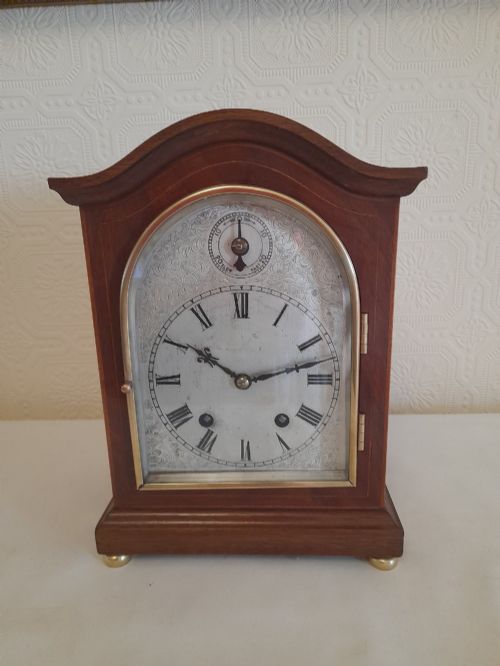


Brown Wood Table Chime
A brown wood table chime sits quietly on a shelf or desk, offering a warm tone and rich timber grain to mark the passing hours.
Brown Wood Table Chime
The versions most likely to meet you on this page span the Victorian, Edwardian, and Regency periods, alongside pieces from around nineteen hundred. They range from small English and German striking clocks to Burmese gongs and carved novelty dinner pieces.
Makers and makers' marks such as W&H and German H.A.C. appear amongst these wooden cases. The forms vary from break arch silhouettes to inlaid mahogany and walnut bodies.
How they were made
Cases rely heavily on mahogany and walnut timbers, frequently enhanced with wood inlay, specimen marquetry, and herringbone patterns. These materials provide the structural integrity and visual depth required for surface placement.
Brass and enamel details accent the timber structures, particularly around clock dials, bezels, and hanging gong mechanisms. Glass covers protect the delicate dial faces from dust and damage.
Movements span eight-day and fourteen-day striking configurations, alongside ting-tang mechanisms that create distinct auditory chimes. Construction techniques join traditional cabinetmaking with mechanical clockwork assembly.
Brown Wood Table Chime Retail Price Guide 2026
Typical asking prices for brown wood table chime among the pieces listed under this phrase on Sellingantiques today, from the lower quarter to the upper quarter. They describe what is for sale here now, not the wider market.
Listings feature woods like mahogany and walnut paired with brass and enamel, spanning the Regency to the nineteen thirties.
What varies in quality
The refinement of the timber work and inlay separates different examples. Fine specimens display precise herringbone lines and careful marquetry, while simpler items feature plain polished surfaces.
The complexity and origin of the movement also define the piece. German and English movements with striking or ting-tang capabilities demonstrate higher mechanical ambition than basic forms.
Proportion and scale dictate visual success. Small proportions and balanced break arch silhouettes command greater attention than heavier, unrefined shapes.
German H.A.C.·W&H
The Brown Wood Table Chime Glossary
- Mantel clock
- A household timepiece designed to sit on the mantelpiece above a fireplace or upon a table. These domestic clocks combine cabinetry with striking mechanical movements.
- Bracket clock
- A portable household clock originally designed to sit on a wall bracket or table. They frequently feature small proportions and brass carrying handles.
- Ting-tang
- A striking mechanism that sounds two different notes on two bells or gongs before the hours are struck. This creates a distinct double chime.
- Marquetry
- Decorative veneer work arranged in pictorial or geometric patterns across the timber surface. Specimen marquetry uses various natural wood grains to create tonal pictures.
- Break arch
- A clock case shape where the top of the wooden door forms an arched profile with distinct corners. This architectural silhouette originates in earlier tall clock designs.
Brown Wood Table Chime: Frequently Asked Questions
What is a table chime?
A table chime is a domestic timepiece or resonant gong housed in a wooden case designed for display on a table or mantel.
These pieces combine decorative timber cabinets with mechanical striking functions or hanging metal gongs.
How do I tell an Edwardian clock from a Victorian one?
Edwardian brown wood clocks often lean towards lighter inlaid mahogany cases and Sheraton Revival styles.
Victorian examples tend to feature darker woods, bolder architectural forms, and sometimes Gothic influences.
Where should I place a table chime?
These pieces suit flat surfaces such as sideboards, desks, mantels, or tables where their wood grain can be appreciated.
Ensure the surface is level so the mechanical movement or pendulum operates evenly.
What woods were used for these cases?
Cabinetmakers utilised mahogany, walnut, and mango wood to construct the outer housings.
Inlay work, mother-of-pearl, and specialised marquetry often decorate these primary timbers.