
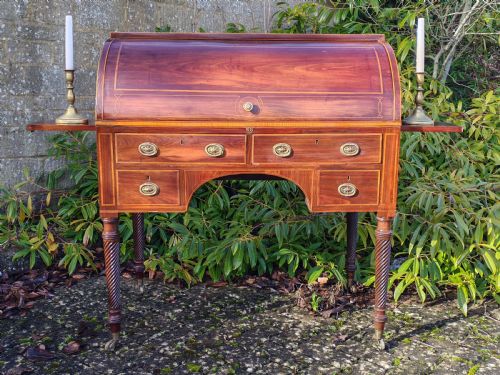


Brown Wood Cylinder Bureau
These brown wood cylinder bureau pieces combine concealed writing surfaces with fitted storage, offering a traditional workspace for the home.
Brown Wood Cylinder Bureau
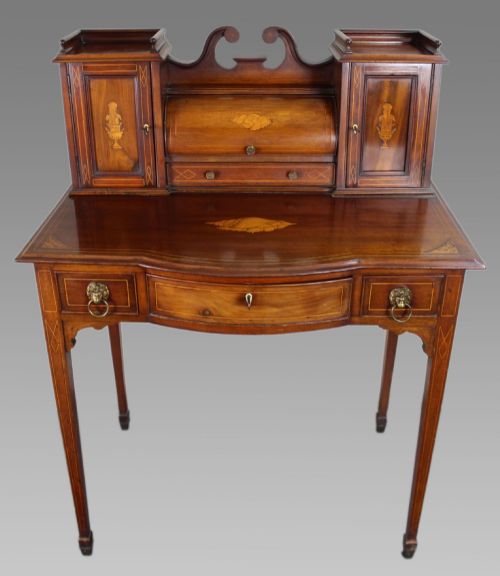
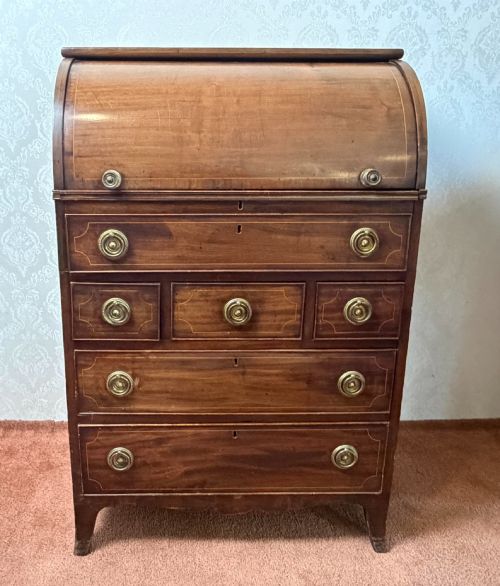
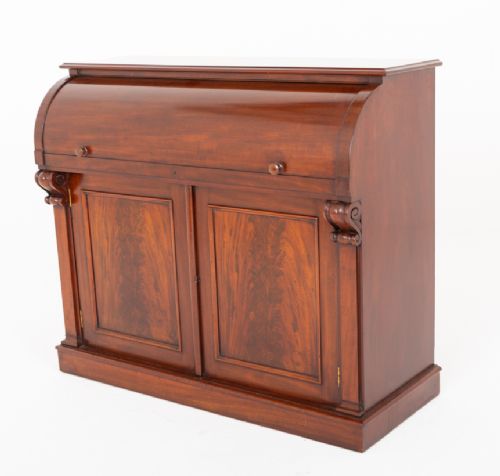
A brown wood cylinder bureau provides a practical writing station featuring a curved wooden shutter that rolls back to reveal pigeonholes, small drawers and a pull-out slide. Buyers searching this phrase encounter practical writing desks and large bureau bookcases originating from the Georgian, Victorian and Edwardian periods.
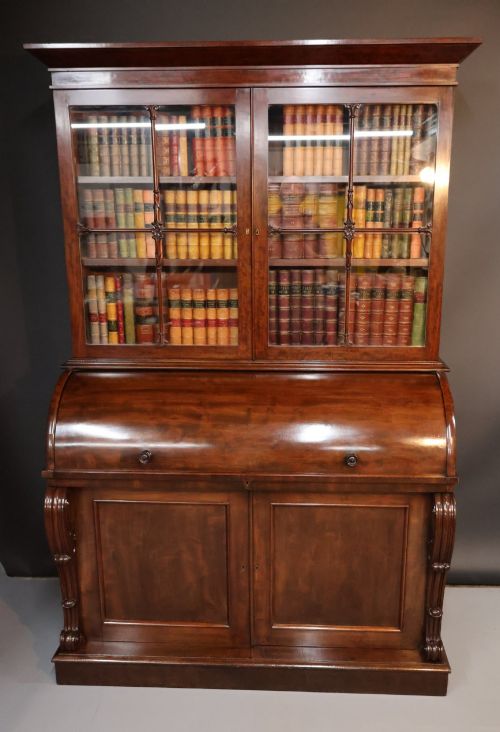
The selection ranges from compact Edwardian satinwood inlaid desks to substantial William IV mahogany bureau bookcases and architectural Hepplewhite period examples. Mahogany serves as the principal timber, often complemented by walnut, yew and fruitwood.
Most examples function as primary study furniture, combining enclosed document storage with a solid writing surface. The forms vary from pedestal variations to tall bookcase combinations fitted with glazed upper doors.
Materials and construction
Cabinet makers utilised solid mahogany, walnut and yew alongside flame mahogany veneers to construct these cylinder desks. Fine cabinet work often incorporates satinwood inlay, parquetry and marquetry details across the exterior surfaces.
Internal components frequently feature brass hardware and delicate drawer construction within the tambour or cylinder housing. Secondary timbers support the structural framework while decorative veneers define the exterior aesthetic of the period.
Secret drawers wait behind pigeonholes in these cylinders, designed for letters no one else should read.
The spectrum of quality
Quality rests in the precision of the rolling cylinder mechanism and the selection of figured timbers like flame mahogany and yew wood. Superior pieces exhibit seamless movement in the shutter alongside meticulous marquetry or parquetry patterning.
The refinement of internal pigeonholes, drawer dovetailing and the choice of brass fittings distinguish standard production desks from exceptional cabinet work. Hepplewhite and Georgian examples display finer proportions and more sophisticated inlay work than later variants.
Boston Chair Company of Massachusetts
The Brown Wood Cylinder Bureau Glossary
- Cylinder desk
- A writing desk featuring a curved, quarter-circle wooden shutter that slides back to uncover the writing surface and interior compartments. This mechanical roll top conceals paperwork when closed.
- Tambour
- A flexible shutter formed of narrow vertical strips of wood glued to canvas or leather backing, allowing it to slide along a track. It serves the same concealing function as a solid cylinder.
- Bureau bookcase
- A dual-purpose piece combining a lower desk section with an upper shelving unit enclosed by doors. The upper section typically stores books while the lower bureau handles correspondence.
- Parquetry
- A geometric mosaic of wood pieces used for decorative floors and furniture surfaces. It creates repeating patterns like cubes or chevrons using contrasting timbers.
- Marquetry
- The art of applying pieces of veneer to a structure to form decorative patterns and pictures. Craftsmen utilise various coloured woods to achieve pictorial designs.
Brown Wood Cylinder Bureau: Frequently Asked Questions
How do cylinder desks work?
The curved wooden cylinder or tambour slides along curved tracks within the desk frame. Pulling the writing slide forward often retracts the cylinder automatically, exposing the internal compartments.
This mechanical action keeps writing materials dust-free and secures the desktop contents when the panel is closed and locked.
Where were these bureaus placed?
These pieces traditionally occupied private studies, libraries and drawing rooms of large townhouses and country estates. They provided a private space for managing correspondence and household accounts.
Today they function effectively as standalone writing desks in home offices or living spaces, offering concealed storage for modern laptops and paperwork.
How do I identify a Georgian piece?
Georgian and Hepplewhite period desks demonstrate classical proportions, restrained satinwood inlay and high-grade figured mahogany or yew wood. The interior joinery relies on hand-cut dovetails and traditional cabinet-making techniques.
Later Victorian and Edwardian examples often feature heavier timber dimensions, simpler internal layouts and machine-made components alongside characteristic marquetry.
What is the difference between a cylinder and a roll top?
A cylinder desk uses a solid, curved wooden quarter-circle panel that rotates smoothly on a fixed radius. A roll top utilises a flexible tambour shutter made of narrow slats.
Both designs serve to conceal the writing surface, but the solid cylinder represents a more formal Georgian and Victorian cabinet-making tradition.