


Brown Wood Candle Holder
These brown wood candle holder pieces range from Georgian fruitwood twists to Victorian treen, offering warm grain and traditional illumination for any room.
Brown Wood Candle Holder
When you search for a brown wood candle holder, you are looking at functional lighting items fashioned from walnut, fruitwood, mahogany, and olive wood. The inventory on this page spans utilitarian chamber sticks, travelling pairs, and grander architectural or figural standards.
The selection includes turned pairs from the Georgian and Edwardian eras alongside continental Baroque carvings and figural pieces. You will find items designed for domestic tables, travelling convenience, and specific devotional or display uses.
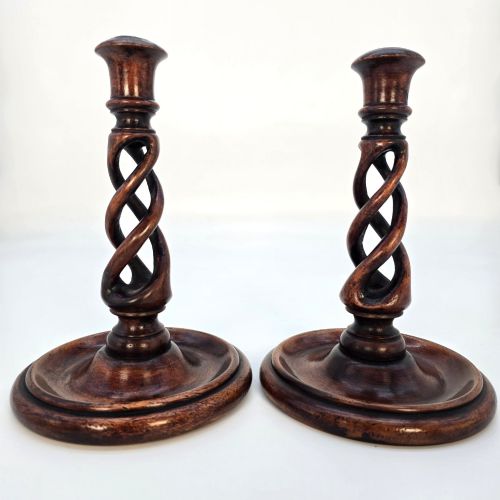
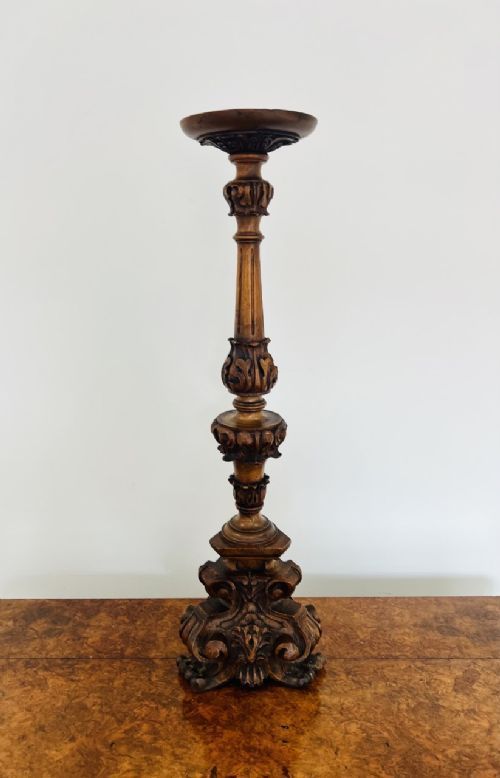
Forms stretch from simple turned shafts to elaborate open twists, spiral carvers, and sculpted wooden figures resting on socle bases. Each piece reflects the particular lighting needs of its period, whether for a bedroom chamber or a formal parlour.
How they were made
Carvers and turners utilised dense timbers like walnut, fruitwood, and mahogany, often shaping them on a lathe to create smooth columns, spiral carvers, and open twists. Skilled hands also carved figurative works, such as acolytes and female figures, from solid blocks of wood.
Many examples incorporate contrasting brass nozzles, pans, or fittings to protect the timber from direct flame and hot wax. Travelling pieces, including Brighton buns, demonstrate clever threading and compact design for portability.
Listings feature woods such as walnut, fruitwood, mahogany, olive wood, and hardwood across periods from the 17th century to the Edwardian era.
What varies in quality
Quality in a brown wood candle holder rests upon the crispness of the turning and the depth of the hand carving, particularly on figural and Baroque pieces. Finer items exhibit balanced proportions, tight joints in turned sections, and well-executed spiral twists.
The choice and figuring of the timber also define the grade of a piece, with richly grained walnut and select fruitwood marking out superior examples. Original brass elements and intact patination further separate standard items from the finest surviving specimens.
The Brown Wood Candle Holder Glossary
- Treen
- Small handmade wooden objects for the home, encompassing items like small candle holders and treen walnut chamber sticks. These domestic pieces were valued for their practical utility.
- Brighton bun
- A compact, two-part travelling candlestick that unscrews and nests together into a wooden sphere resembling a bun. They were popular in the Edwardian period for journeys.
- Socle base
- A stepped or rounded plinth supporting a figure, candlestick, or sculpture. It provides stability and visual elevation to carved wooden works.
- Open twist
- A decorative column cut through to leave an airy, intersecting spiral of wood. This technique requires considerable skill from the turner.
- Acolyte
- An assistant in religious services, whose likeness was frequently carved into continental Baroque candlesticks. These figural pieces often hold sockets for tapers.
Brown Wood Candle Holder: Frequently Asked Questions
What is a chamber stick?
A chamber stick is a low candle holder featuring a flat pan to catch wax and a loop handle for carrying from room to room.
They were essential for lighting a path through dark corridors before the advent of electricity.
How do I date a wooden candlestick?
Dating relies on observing turning styles, timber choices, and tool marks left by the maker.
Earlier pieces often display hand-carved details or fruitwood construction, while later 19th-century examples may use mass-produced brass fittings alongside turned walnut.
Are wooden candle holders safe to use?
Most wooden candle holders are safe provided they feature metal drip pans or nozzle inserts to prevent the flame from reaching the timber.
Extinguishing candles before the wax burns down to the wood preserves the integrity of the piece.
What is an open twist?
An open twist is a spiral column carved with negative space running entirely through the centre.
This intricate technique became popular on decorative fruitwood and walnut candlesticks during the 18th and 19th centuries.
Why use olive wood for travelling sticks?
Olive wood is exceptionally dense, durable, and naturally oily, making it resistant to splitting during travel.
This toughness suited compact items like Brighton buns that were packed into luggage.