


Brown Scottish Landscape Canvas
A brown scottish landscape canvas brings the brooding atmosphere of the Highlands directly into a room through rich earth tones and oil paint.
Brown Scottish Landscape Canvas
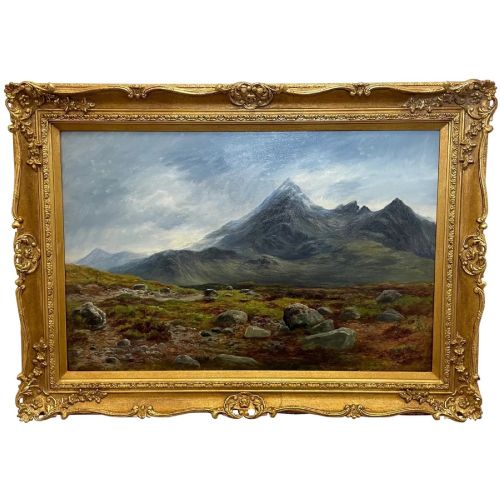
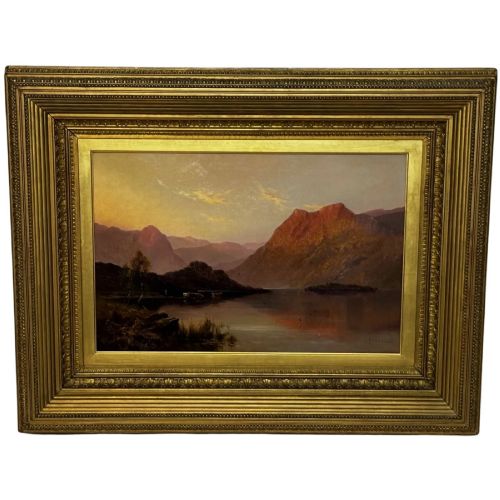
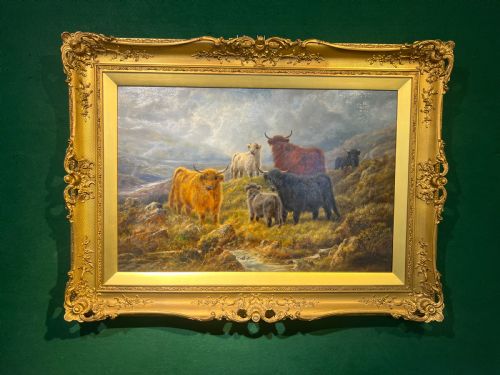
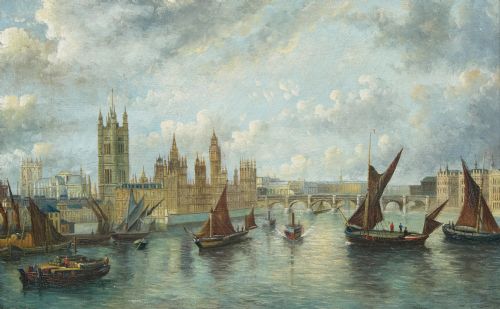
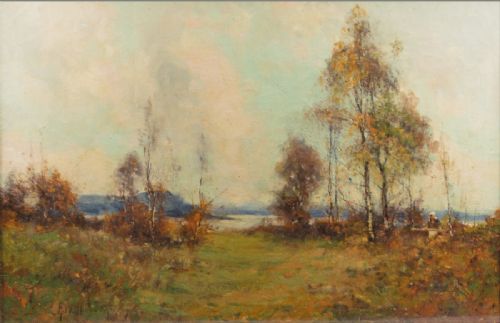
A brown scottish landscape canvas presents pastoral scenes, misty lochs, and rugged mountains captured by artists working primarily during the Victorian era and early twentieth century. These artworks focus on the muted, earthy palettes of peat, heather, and stone characteristic of northern terrain, often incorporating cattle or figures beside water. Most examples on this page date from the nineteenth century through the 1930s, reflecting shifts from romantic realism toward impressionist treatments.
The subjects range from tranquil morning mists over Highland lochs to dramatic coastal inlets and river valleys rendered in oil on canvas. Viewers frequently encounter depictions of Highland cattle, sheep, or sporting dogs integrated into the expansive topography. These paintings serve as historical windows into how generations of painters translated the northern wilderness into framed fine art.
Materials and construction
Artists applied oil paint directly onto stretched woven canvas using bristle brushes and palette knives to build up textured passages of earth and sky. The pigments relied heavily on natural earth tones, mixing umbers, siennas, and ochres with lead whites to achieve the subdued lighting typical of northern weather.
Many of these works remain housed within their original wooden frames, often finished with moulded gesso and applied gold leaf. The combination of durable linen support and stable oil media has allowed these paintings to survive centuries with proper environmental care.
Evaluating quality and execution
The success of a brown scottish landscape canvas rests upon the artist's command of atmospheric perspective and tonal harmony. Superior examples capture the specific moisture of Highland air and the play of light across rugged terrain through confident brushwork rather than flat, formulaic application.
Compositional balance and the integration of animal or human figures dictate the visual strength of the piece. Stronger paintings utilise natural sightlines - such as winding rivers or mountain ridges - to guide the eye deep into the canvas while maintaining a cohesive palette of browns and greys.
William Beattie-Brown·Alfred Fontville de Breanski·Robert Watson·Alexander Wellwood Rattray·Henry Robinson Hall·William Littlejohn·Sir David Murray·William Miller Frazer·John W Morris·Owen Bowen·Charles Jones·Louis Bosworth Hurt·Josephine Haswell Miller·Edward John Niemann·James Kay·Samuel Bough·Clarence Roe·Julius Caesar Ibbetson
The Brown Scottish Landscape Canvas Glossary
- Canvas
- A heavy woven fabric, typically linen or cotton, stretched tightly across a wooden frame to serve as a stable painting surface. It provides the foundational texture visible beneath layers of dried oil paint.
- Gesso
- A traditional primer mixture consisting of a binder mixed with chalk, gypsum, or pigment, applied to wooden frames or panels to prepare them for gilding or painting. It creates a smooth, absorbent base for gold leaf.
- Giltwood
- Wood carved and coated with a thin layer of gold leaf or metallic powder, frequently used for traditional picture frames. This finish adds warm reflectivity that complements dark oil paintings.
- Oil Paint
- A slow-drying paint made by mixing pigments with a drying oil, most commonly linseed oil. This medium allows artists to blend tones smoothly and build rich, translucent layers.
- Scottish Impressionism
- A painting style developed in the late nineteenth and early twentieth centuries characterised by loose brushwork and an emphasis on spontaneous light effects. Artists working in this manner moved away from rigid academic realism.
Brown Scottish Landscape Canvas: Frequently Asked Questions
What periods do these paintings come from?
The selection spans from the eighteenth century through the mid-twentieth century, with a heavy concentration of Victorian and Edwardian works. Painters from these eras frequently travelled north to capture the untamed scenery of the Highlands.
Dates on these canvases reflect either the active period of the artist or specific exhibition years recorded in the title documentation.
Where were these Scottish scenes typically painted?
Artists worked across diverse regions including Skye, the Trossachs, Stirlingshire, and the banks of various Highland lochs and rivers. Many painters set up portable easels outdoors to capture direct observations of weather and light.
Finished studio canvases were often exhibited in Edinburgh and London galleries for collectors of pastoral art.
How do I identify the original frame?
Original frames generally show period-appropriate construction techniques, such as corner mitres secured with wooden pegs, alongside age-appropriate wear to the gesso and gold leaf. The accumulated patina on the wood often matches the estimated age of the canvas it surrounds.
Replacements or later mountings typically display cleaner joinery and fresher gilding that contrasts with an older painting.