



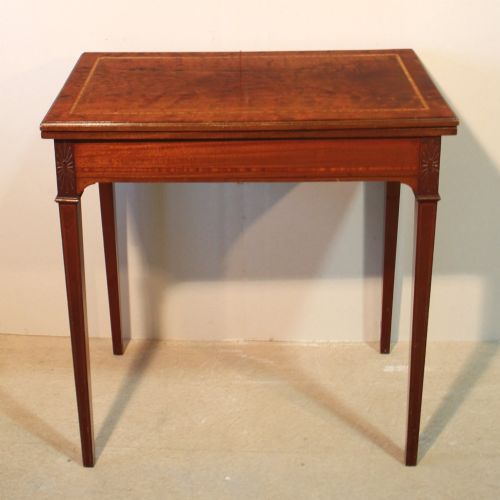


Brown Satinwood Card Table
A brown satinwood card table offers folding leaves and striking timbers, bringing refined Georgian and Edwardian craftsmanship directly into a modern drawing room.
Brown Satinwood Card Table
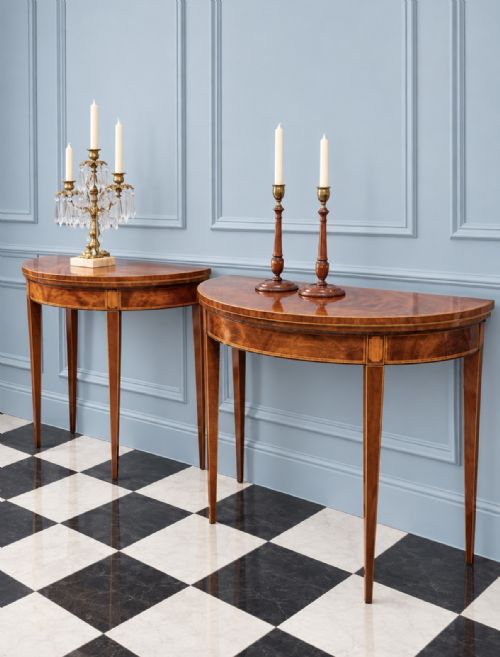
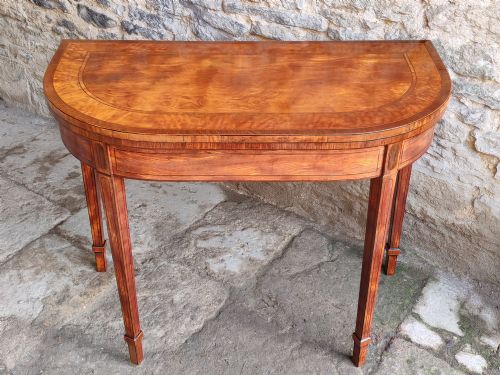
A brown satinwood card table is a specialised piece of antique furniture designed for gaming and social gatherings, featuring a fold-over or turn-over top that reveals a baize-lined surface when opened. These tables function as sophisticated console or side tables against a wall when closed, transitioning effortlessly into functional gaming surfaces.
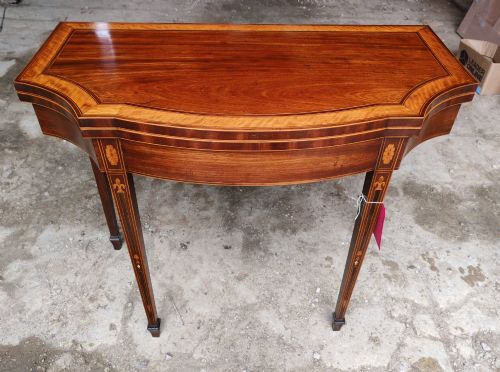
The brown satinwood card table varieties appearing on this page span several distinct periods, most notably the 18th century, Georgian era, and the Edwardian Sheraton Revival. Buyers frequently encounter demilune, serpentine, and rectangular forms utilising timber veneers alongside solid construction.
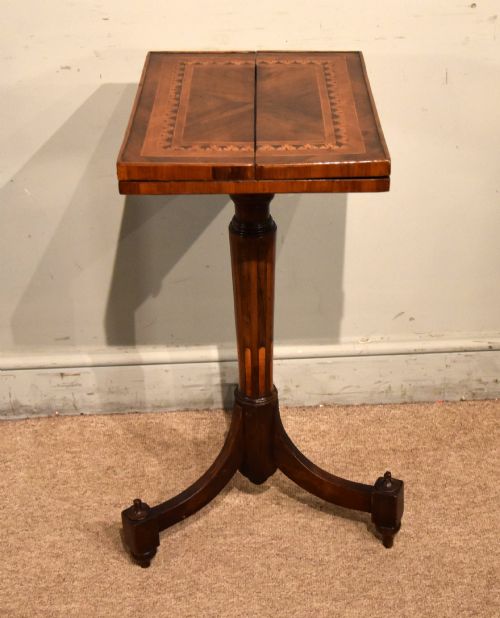
Makers and cabinetmakers across these periods applied intricate stringing, marquetry, and parquetry to enhance the natural golden-brown hue of the satinwood. The integration of mahogany, ebony, boxwood, and brass further defines the decorative vocabulary of these tables.
Assessing quality in execution
Quality rests upon the selection and matching of the satinwood veneer across the top leaf and frieze. Superior examples display symmetrical figuring and tight grain patterns that have aged to a rich, warm brown colour.
The precision of the inlaid stringing and the crispness of any hand-painted or marquetry details separate finer workshop productions from standard commercial output. Structural integrity in the folding mechanism and the smooth operation of the swing-leg remain essential indicators of superior cabinetmaking.
Brown Satinwood Card Table Retail Price Guide 2026
Typical asking prices for brown satinwood card table among the pieces listed under this phrase on Sellingantiques today, from the lower quarter to the upper quarter. They describe what is for sale here now, not the wider market.
Periods represented span from the 18th century through Georgian, Victorian, and Edwardian eras.
Maples of London·Howard and Son's·Linke
The Brown Satinwood Card Table Glossary
- Demilune
- A half-moon shape commonly seen in the top and frame of late 18th-century card tables. This design allowed the table to sit flat against a wall when closed.
- Parquetry
- A geometric mosaic of wood pieces used for decorative inlay on tabletops. It creates repeating patterns utilising contrasting timbers like satinwood and mahogany.
- Marquetry
- The art of applying pieces of veneer to a structure to form decorative pictures or designs. Craftsmen utilised various coloured woods to achieve intricate floral or architectural scenes.
- Stringing
- Thin strips of contrasting wood inlaid into channels cut into the primary surface. This technique outlines edges, legs, and tabletops to define the form.
- Envelope table
- A type of card table with a four-flap folding top that opens like an envelope. When rotated, the flaps unfold to reveal a baize-lined interior.
Brown Satinwood Card Table: Frequently Asked Questions
How do I use a card table today?
These tables function well as console or side tables in a hallway or living room when the top is closed.
Opening the leaf transforms the piece into a functional surface for games, writing, or display during social gatherings.
How can I date a satinwood table?
Examine the secondary timbers, construction joints, and overall style to establish a period baseline.
Georgian and 18th-century pieces often display hand-cut dovetails and subtle patination, while Edwardian Sheraton Revival examples show late 19th- or early 20th-century manufacturing methods.
Why is satinwood paired with mahogany?
Makers combined satinwood and mahogany to create strong visual contrast through colour and grain variation.
Satinwood provided a bright, golden-brown field for veneering, while mahogany offered structural stability and dark framing borders.