

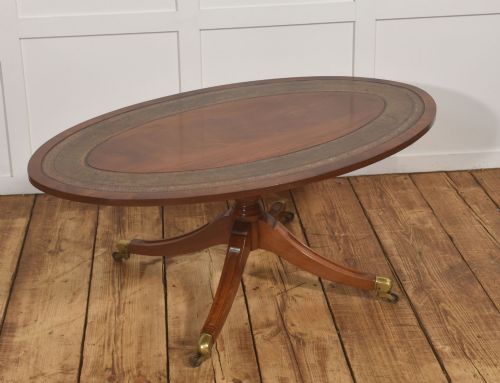
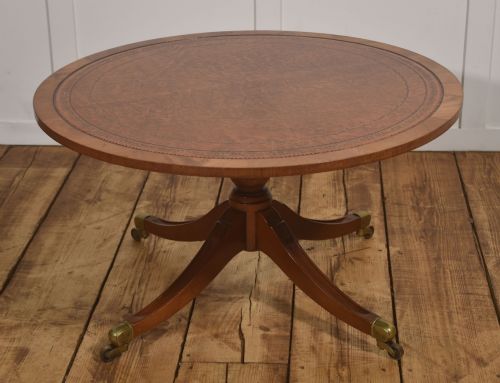

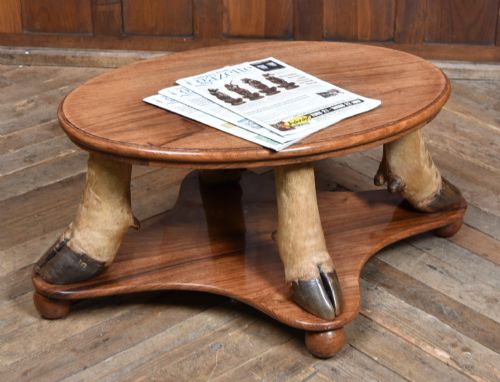


Brown Leather Low Table
A brown leather low table brings centuries of practical craft and rich material into a room, offering a sturdy surface or a low rest.
Brown Leather Low Table
When you search for a brown leather low table, you are looking at coffee tables and footstools that combine timber with hide upholstery. These pieces span periods from the Georgian era through the Victorian period and into the 1900s, 1910, 1920, and 1930.
You are most likely to meet mahogany coffee tables finished with tooled leather tops, alongside footstools and ottomans featuring buttoned leather upholstery. Styles range from military campaign and Regency to Victorian taxidermy, industrial, and Spanish revival.
How they were made
Cabinet makers utilised mahogany, hardwood, and general wood for the frames, building sturdy structures designed for daily use. Surfaces often received hand-dyed leather hides, sometimes decorated with tooled borders.
Metal components such as brass hardware appeared on campaign pieces, while iron and taxidermy hooves provided structure or distinct decorative forms for specific Victorian designs.
Brown Leather Low Table Retail Price Guide 2026
Typical asking prices for brown leather low table among the pieces listed under this phrase on Sellingantiques today, from the lower quarter to the upper quarter. They describe what is for sale here now, not the wider market.
Listings feature mahogany, hardwood, and brass alongside leather hides.
What varies in quality
Quality rests upon the selection of timber and the execution of the leatherwork, particularly how neatly the hide meets the wooden frame. Hand-dyed surfaces and precise tooling elevate certain examples above simpler builds.
The integrity of the underlying structure defines longevity, with well-joined hardwood and original brass fittings marking out superior pieces across the various periods.
The Brown Leather Low Table Glossary
- Campaign
- A style of furniture designed to fold or dismantle for travel, often fitted with brass corners and recessed handles. These items originated for military officers on the move.
- Tooled leather
- Leather decorated by impressing metal tools into the damped surface to create patterns. Gilding is frequently added to the depressed lines.
- Buttoned
- An upholstery technique where deep buttons are pulled through the padding to secure the stuffing and create a diamond pattern. This method adds firmness and texture.
- Mahogany
- A durable tropical hardwood prized for its reddish-brown colour and fine grain. It forms the primary timber for many traditional English tables.
Brown Leather Low Table: Frequently Asked Questions
What periods do these low tables come from?
The pieces span a wide timeline, reaching from the Georgian period through the nineteenth century and into the early decades of the twentieth century. Specific decades represented include 1880, 1900, 1910, 1920, and 1930.
Earlier examples often reflect traditional cabinet making traditions, while later items embrace specific revivals like Regency style and Spanish revival.
How were campaign style tables used?
Military campaign furniture was built to be portable for officers on active service. These tables featured practical elements to withstand frequent transport.
Today, these functional design details translate into distinctive low tables with sturdy frames and characteristic metal hardware.
What materials are used in these tables?
Mahogany and various hardwoods form the primary wooden structures for the tables and frames. Leather provides the main surface material, often hand-dyed or tooled.
Additional materials include brass for handles and corners, iron for industrial supports, and taxidermy hooves on specific nineteenth century pieces.
Are these pieces coffee tables or footstools?
The category includes both coffee tables and footstools or ottomans. Many coffee tables feature wood frames with inset leather tops.
Footstools rely entirely on leather upholstery over a padded frame, serving double duty as low resting surfaces.