
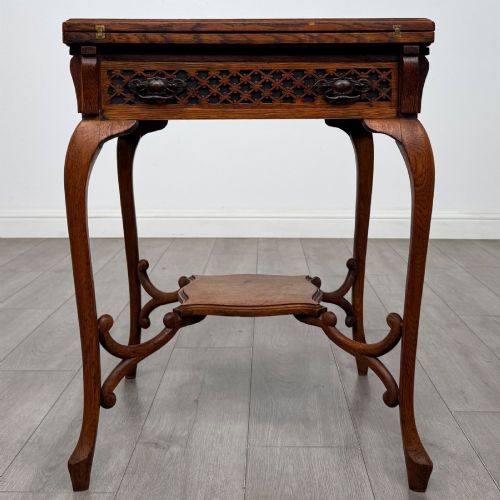

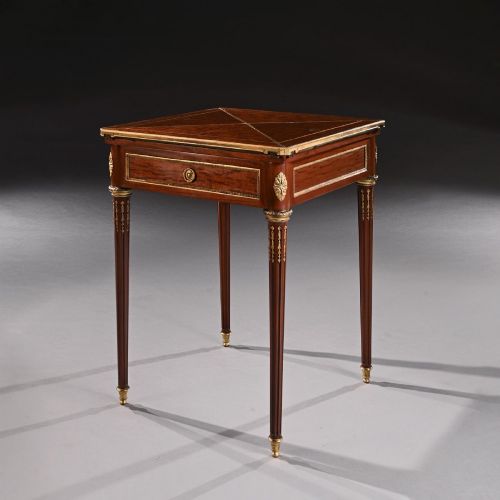
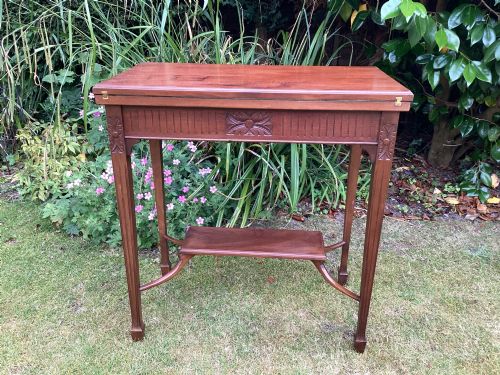


Brown Envelope Table
A brown envelope table is a clever folding piece designed for cards and tea, offering a clever pivoting mechanism that reveals a baize-lined playing surface.
Brown Envelope Table
A brown envelope table takes its name from the clever folding action of its four triangular flaps, which rotate and fold open like an envelope to reveal a baize-lined surface. These pieces function primarily as card tables, games tables, or occasional tables, with some doubling as tea tables.
The versions met most frequently on this page span the Victorian, Edwardian, and late nineteenth-century periods, alongside occasional Regency and Georgian pieces. They appear in rich timbers such as mahogany, rosewood, and walnut, frequently detailed with intricate wood inlay, boxwood, and satinwood.
Makers and workshops including Antoine Lampre, Maple & Co., and Howard & Sons Ltd produced notable examples, while revival styles such as Louis XVI, Louis XV, and Edwardian Chippendale reflect the diverse aesthetic influences found across the selection.
How they were made
Cabinet makers utilised dense hardwoods such as mahogany, walnut, and rosewood for the structural frames and folding flaps, ensuring the timber could sustain the mechanical movement of the top. Finer examples incorporate contrasting veneers of satinwood and boxwood, along with delicate wood inlay and gilt brass or ormolu mounts.
The defining mechanical feature relies on a pivoting hinge system where opening one flap causes the remaining three to unfold synchronously in an envelope motion. Interior wells are often incorporated beneath the flaps to hold counters, cards, and gaming paraphernalia securely.
Some tables hide tiny velvet-lined compartments beneath their folding leaves, designed for stashing winnings away from prying eyes.
What varies in quality
Quality rests in the precision of the pivoting mechanism and the smoothness with which the four triangular flaps operate in unison. A superior table exhibits tight joints, stable legs when fully opened, and a balanced weight distribution that prevents sagging.
The refinement of the timber selection and the execution of the wood inlay also divide the standard production from the exceptional workshop pieces. Maker attribution to firms such as Maple & Co., Howard & Sons Ltd, or Antoine Lampre elevates the standing of a piece.
Antoine Lampre·Maple & Co.·Howard & Sons Ltd·Francoise Linke
The Brown Envelope Table Glossary
- Envelope table
- A small folding table with four triangular leaves that pivot open simultaneously to form a square playing surface. The design became particularly popular during the late Victorian and Edwardian periods.
- Baize
- A coarse woolen fabric, typically green, used to line the playing surface of card and games tables. It provides a soft texture that protects playing cards and reduces noise during a game.
- Marquetry
- The art of applying pieces of veneer to a structure to form decorative patterns and pictures. Craftsmen utilise various coloured woods to achieve pictorial designs.
- Ormolu
- Gilded bronze mounts applied to furniture for decorative effect. The technique was widely favored in French revival pieces of the nineteenth century.
- Gaming wells
- Small recessed compartments built into the corners of a card table surface to hold counters and chips during play. They are frequently exposed when the envelope flaps are opened.
Brown Envelope Table: Frequently Asked Questions
How do the flaps open?
The top consists of four triangular leaves hinged diagonally. Rotating the upper section causes the leaves to slide and unfold outward in an envelope motion to reveal the square table.
This clever mechanism allows the piece to function as a small occasional table when closed and a full card table when opened.
What were gaming wells used for?
Gaming wells are small recessed compartments carved into the corners of the table surface. They held card counters, tokens, and coins during parlour games.
When the envelope flaps are closed, these wells are concealed safely beneath the folded wood panels.
How do I date a table?
Dating relies on observing the timber, the style of inlay, and the construction methods used in the frame. Victorian and Edwardian pieces often display lighter satinwood details and machine-assisted joints.
Earlier Regency and Georgian examples tend to feature solid mahogany construction with simpler geometric lines and heavier proportions.
Can I use it as a tea table?
Many of these tables served multiple purposes in the drawing room, doubling as tea tables or occasional surfaces between card games. The folded top provides a stable surface for cups and books.
Care should be taken with moisture and heat to protect the polished wood finish and internal hinges.