

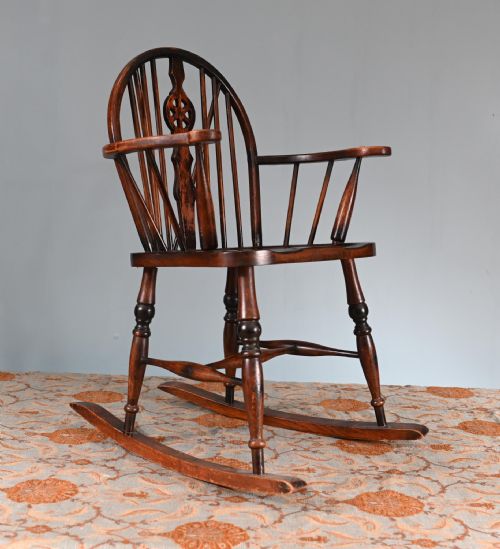


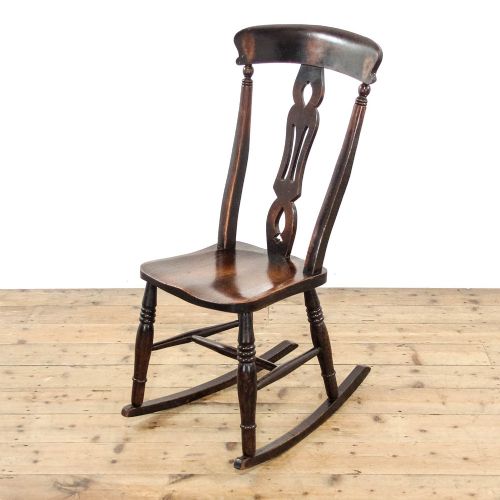


Brown Elm Rocking Chair
A brown elm rocking chair is a seating staple of traditional rural homes, prized for its robust timber and comforting motion.
Brown Elm Rocking Chair
A brown elm rocking chair represents a cornerstone of country seating, shaped by regional makers from the eighteenth century through to the nineteenth century. These items include both full-sized fireside seats and smaller child's versions designed for domestic use.
Most examples encountered on this page belong to the Windsor tradition or regional country styles, featuring spindle backs, wheelbacks, or low nursing chair formats. They combine native timbers to create sturdy seating suited to cottage interiors.
How these brown elm rocking chairs were made
Makers utilised elm for its tough, interlocked grain that resisted splitting, often pairing it with beech, ash, or yew for structural spindles and bows. This mix of native hardwoods provided the necessary flexibility and strength for daily motion.
Constructed using traditional Windsor techniques, the seats were typically carved from a single thick slab of elm into which the legs and back pillars were wedged and pegged. The addition of curved rockers completed the conversion from a standard armchair into a rocking seat.
Brown Elm Rocking Chair Retail Price Guide 2026
Typical asking prices for brown elm rocking chair among the pieces listed under this phrase on Sellingantiques today, from the lower quarter to the upper quarter. They describe what is for sale here now, not the wider market.
Listings feature items spanning the eighteenth century, the Regency period, and the Victorian era, constructed from elm, beech, ash, and yew.
What varies in quality across these brown elm rocking chairs
Quality rests upon the sculptural character of the elm seat and the grace of the turned spindles, where finer pieces display deeper saddle-shaped carving and balanced proportions. The integration of contrasting timbers, such as ash or yew, often elevates the visual depth of the construction.
The integrity of the original rocker base and the tightness of the pegged joints determine the structural success of the chair. Heavier wear on the foot rails and the rocker bottoms distinguishes pieces that saw generations of active domestic service.
The Brown Elm Rocking Chair Glossary
- Windsor chair
- A chair built with a solid wooden seat into which the back and legs are separately inserted. This method creates a sturdy, skeletal frame typical of country furniture.
- Wheelback
- A Windsor chair design featuring a pierced wooden splat shaped like a cartwheel centred in the backrest. This decorative motif gained popularity during the nineteenth century.
- Spindle back
- A chair back constructed from a series of slender turned wooden rods rather than a solid board. These vertical supports distribute weight evenly and offer comfortable flexibility.
- Nursing chair
- A low-seated armchair designed to allow comfort close to a hearth or bed. These pieces often feature compact dimensions suited to domestic chores.
Brown Elm Rocking Chair: Frequently Asked Questions
What defines a brown elm rocking chair?
A brown elm rocking chair is a traditional wooden seat featuring curved rockers attached to the base. These chairs utilise native elm for the carved seat alongside mixed hardwoods for the frame.
Most examples reflect regional English country styles spanning from the eighteenth century into the Victorian era. Their construction relies on Windsor framing techniques rather than upholstered upholstery.
How do I date a brown elm rocking chair?
Dating relies upon examining the construction methods, tool marks, and design motifs present in the timber. Earlier eighteenth-century models tend to feature heavier proportions and simpler turned elements compared to Victorian iterations.
Characteristics such as wheelback splats or specific chair sizes help place pieces within the nineteenth century. Comparing the wear patterns and timber ageing provides further context on age.
Were child's rocking chairs used historically?
Child's rocking chairs served as functional household seating for young family members in rural and domestic settings. They scaled down the sturdy construction of adult Windsor chairs to suit smaller occupants.
These smaller versions display the same careful timber selection and turning techniques found in full-sized counterparts. They survived through generations as cherished household objects.
How do I live with a brown elm rocking chair?
Living with a brown elm rocking chair involves placing it in stable environmental conditions away from direct heat sources. This prevents the native timbers from drying out and maintains the stability of the pegged joints.
Routine dusting and occasional waxing help preserve the natural patina of the elm and secondary hardwoods. The chairs function practically as fireside seating or decorative accents in traditional interiors.