

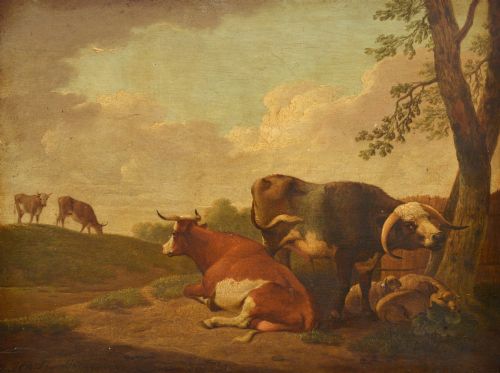

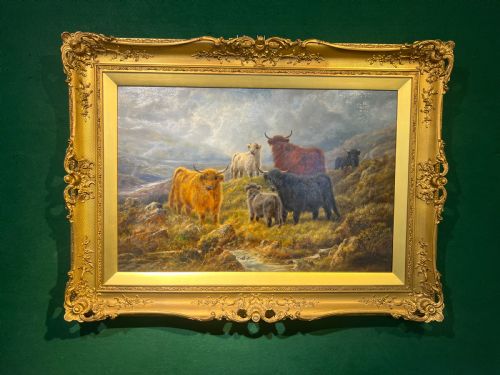


Brown Cattle Oil Painting
A brown cattle oil painting brings the pastoral calm of the nineteenth and early twentieth centuries directly into a room.
What these pieces are
A brown cattle oil painting depicts livestock in rural British landscapes, ranging from river banks and moody moors to sheltered farmyard barns. These works capture pastoral scenes through the hands of named artists working across the Victorian period, British Impressionism, and the English School.
The compositions frequently feature herds resting near water, driven along country lanes, or gathered beneath wide skies. Canvas sizes span from intimate studies to large gallery-scale landscapes framed in decorative wood and giltwood.
How they were made
Painters applied oil paint directly onto stretched canvas surfaces using traditional brushwork techniques to build depth in both the animal anatomy and the surrounding foliage. Pigments were layered to create naturalistic textures for the hides of the cattle and the shifting light of the countryside.
Finished canvases were secured within wooden frames, many embellished with gesso and gold leaf detailing to complement the warm tones of the painted pastoral scenes.
Retail Price Guide 2026
Typical UK retail prices for brown cattle oil painting, calculated from the Sellingantiques database of over a million retail prices indexed since 2003. This retail price guide relies exclusively on Sellingantiques data; no external sources or auction records are used, so the figures do not describe the wider market.
Recorded materials span canvas, oil paint, wood, gesso, and gold leaf.
What varies in quality
The strength of a brown cattle oil painting rests on the artist's command of anatomical proportion and the atmospheric interplay between the livestock and the landscape. Finer examples display confident brushwork that defines the muscle and texture of the animals against a luminous sky, whereas lesser works rely on stiff repetition and flat backgrounds.
The quality of the surrounding frame also influences the piece, with original giltwood and gesso mouldings providing a period-appropriate setting that enhances the depth of the canvas.
The Brown Cattle Oil Painting Glossary
- Canvas
- A heavy woven fabric stretched across a wooden frame to serve as the foundational surface for oil paintings. It holds the layers of pigment and oil securely over generations.
- Giltwood
- Timber carved and coated with a thin layer of gold leaf or metallic gilt. It frequently frames nineteenth-century paintings to add reflective brilliance.
- Gesso
- A plaster-like mixture applied to wooden frames before gilding to create a smooth base for intricate moulding. It hardens into a durable surface for decorative details.
- English School
- A classification grouping artists trained or working within British traditions of painting, particularly those focusing on landscape and pastoral subjects.
- British Impressionism
- An art movement adopting looser brushstrokes and an emphasis on natural light, visible in late nineteenth and early twentieth-century pastoral works.
Frequently Asked Questions
What periods do these paintings come from?
The available evidence points to works originating across the nineteenth and early twentieth centuries, specifically spanning decades from the eighteen-fifties through to nineteen-twenty. These dates encompass Victorian pastoral traditions and the shifts into British Impressionism.
Artists from these eras documented rural British life, recording specific regions such as the Lake District and the River Stour through detailed livestock and landscape compositions.
How should I display a large oil painting?
Large canvases demand stable wall space away from direct heat sources and strong sunlight to protect the canvas and the oil pigments. Ensuring secure fixings for heavy wooden and giltwood frames is essential.
Allowing sufficient distance for viewing helps the perspective of expansive pastoral landscapes and detailed cattle studies to read clearly across the room.
How do I identify the artist on a framed work?
Signatures are frequently found in the lower corners of the canvas, sometimes accompanied by inscribed titles or artist plaques affixed to the wooden frame. Comparing the handling of light and livestock to known recorded works provides further confirmation.
Archival records and past sale catalogues help match specific signatures to painters working within the English School and Victorian periods.
What subjects typically accompany cattle in these scenes?
Cattle paintings frequently incorporate pastoral elements such as rivers, barns, moorlands, and distant hills. Figures of drovers or farm workers occasionally appear guiding the livestock along country paths.
The mood shifts according to the setting, ranging from calm morning light over river banks to sheltered barn interiors during harsher weather.