
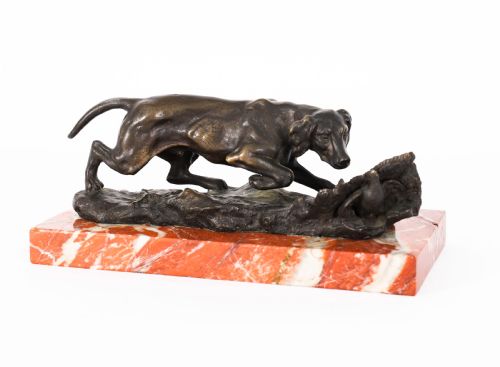


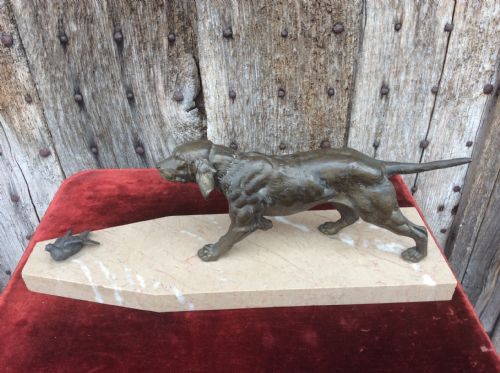

Bronze Hunting Dog Figurine
These bronze hunting dog figurine examples capture canine form and movement in metal, bringing classic nineteenth and twentieth century animal sculpture into the home.
Bronze Hunting Dog Figurine
A bronze hunting dog figurine represents hound and gun dog subjects, including setters, pointers, borzois and greyhounds, modelled with keen attention to anatomy and posture. You meet these primarily as nineteenth century French animalier sculptures, alongside later Art Deco interpretations.
The subjects range from solitary hounds on alert to dynamic groups featuring dogs with game like pheasants and rabbits. Many pieces incorporate integral bases or mount onto marble and onyx plinths for display.
How they were made
Many sculptures received a chemical patination to achieve deep brown, golden or greenish tones, while others featured cold painted colour finishes applied over the metal surface.
Several hounds are caught in the permanent act of putting up a pheasant, freezing a fleeting moment of field sports forever.
What varies in quality
The sharpness of the cast and the precision of the chasing determine how realistically the musculature, fur and facial expressions read. Weaker casts lose definition in the paws and head, whereas superior examples preserve the artist's original touch.
The quality of the secondary materials, such as heavy veined marble plinths or finely turned onyx bases, distinguishes standard productions from more ambitious works.
Carl Kauba·Jules Moigniez·Delabrierre·Auguste Nicholas Cain·Antoine Louis Barye·Christophe Fratin·Dubucand·L Bureau
The Bronze Hunting Dog Figurine Glossary
- Animalier
- A nineteenth century artistic movement focused on the realistic depiction of animals, particularly in bronze sculpture. Practitioners studied live specimens closely in menageries.
- Patinated bronze
- Metal treated with chemical solutions to produce a stable coloured surface layer. This finish protects the bronze while enhancing visual depth.
- Cold painted bronze
- Metal sculpture decorated with oil or paint applied after casting without subsequent firing. This technique produces vibrant polychrome surfaces.
- Spelter
- A zinc alloy utilised as a less costly alternative to bronze during the nineteenth and twentieth centuries. It often received a bronze coloured coating to simulate true metal.
- Chasing
- The manual refinement of a cast metal surface using small hammers and punches. Artisans use this step to sharpen lines and remove casting flaws.
Bronze Hunting Dog Figurine: Frequently Asked Questions
How do I clean a bronze dog sculpture?
Dust the piece gently with a soft dry brush to remove particles from crevices. Avoid chemical polishes, which can strip the original patination.
Apply a very thin coat of microcrystalline wax occasionally if the surface requires protection against moisture and handling.
Are these figures solid bronze?
Many nineteenth century sculptures are cast hollow to save weight and metal, while smaller pieces or specific parts may be solid. Heavier figures often incorporate internal armature or solid bases.
Alternative materials like spelter appear in the listings and offer a lighter weight alternative to bronze.
What is an animalier bronze?
An animalier bronze is a nineteenth century sculpture focusing specifically on naturalistic animal subjects. French studios produced numerous works capturing dogs, horses and wildlife in active poses.
These sculptures often bear the signature of the modeller on the bronze base.
Why are some mounted on marble?
Marble and onyx plinths provide a stable footing for heavier metal sculptures and create a defined architectural boundary for display. Makers selected contrasting stone colours to complement the tone of the bronze patination.
Many period pieces retain their original fitted stone bases.