

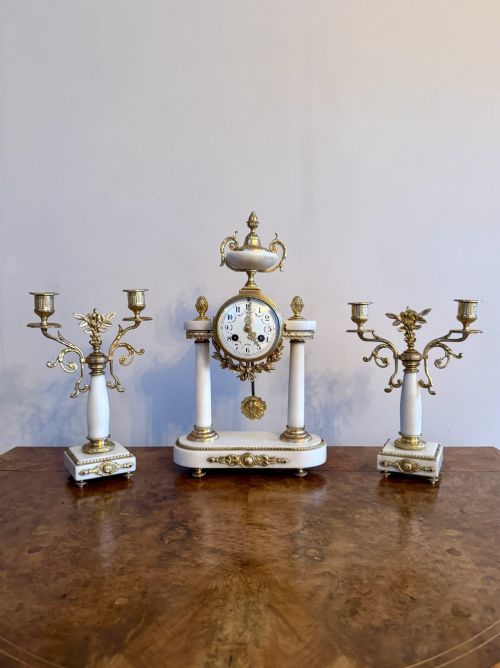
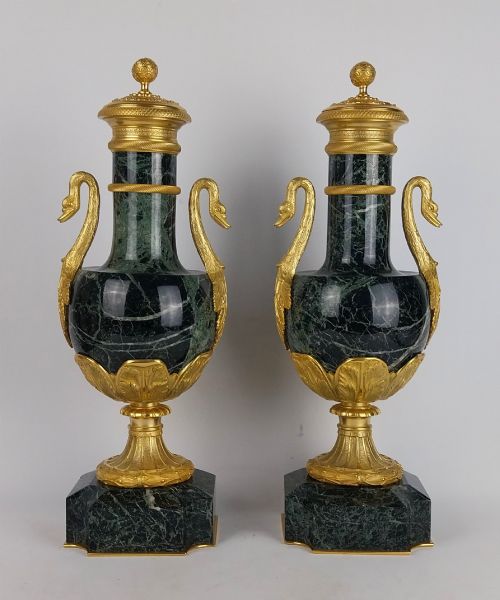
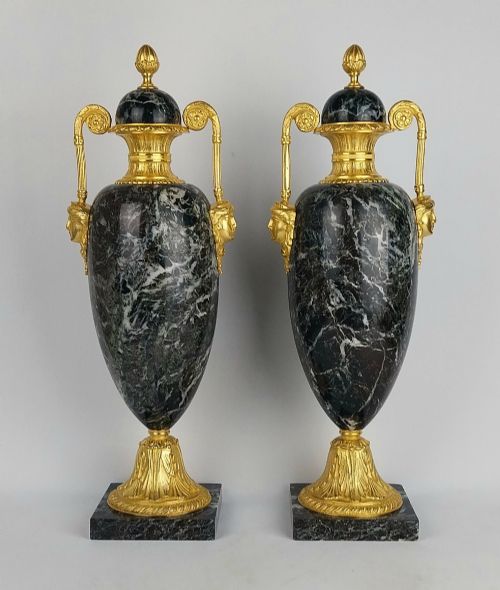
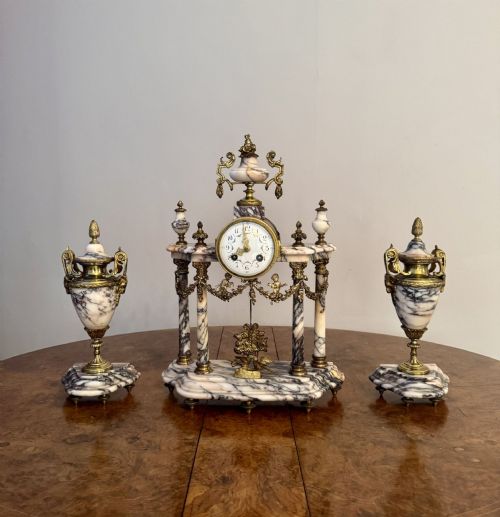




Bronze Garniture Urns
These bronze garniture urns bring classical elegance and symmetry to a mantelpiece, designed in pairs or matched sets to anchor a room.
Bronze Garniture Urns
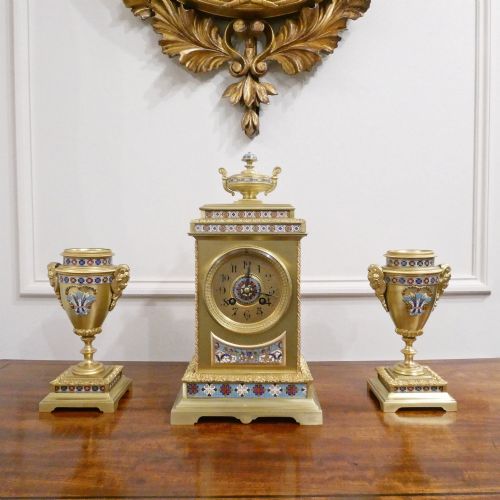
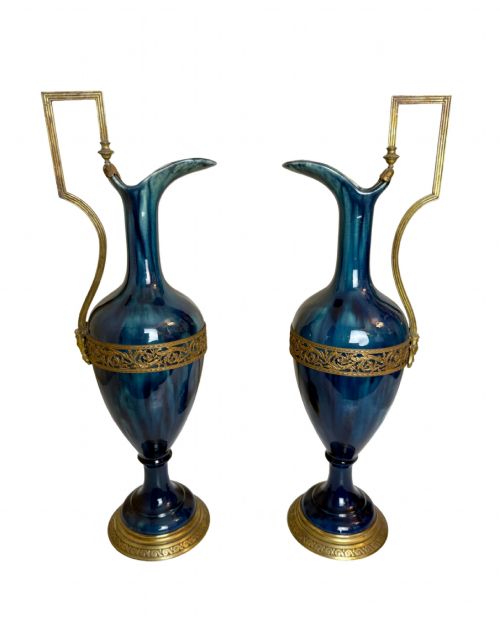
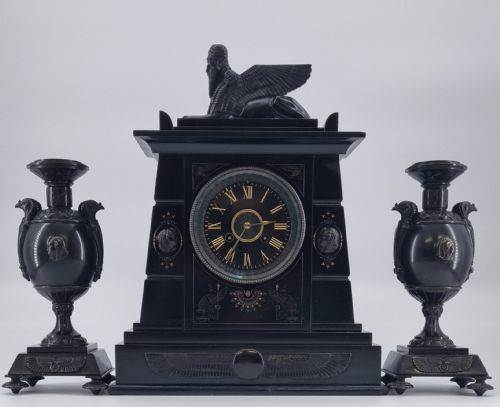
When you examine bronze garniture urns on this page, you encounter nineteenth-century decorative pieces originating predominantly from French workshops and found alongside matching candelabra or mantel clocks. The selection spans the Victorian era, specifically the decades between eighteen-fifty and nineteen-hundred, incorporating styles from Louis XVI Revival, Empire, and Neoclassical periods.
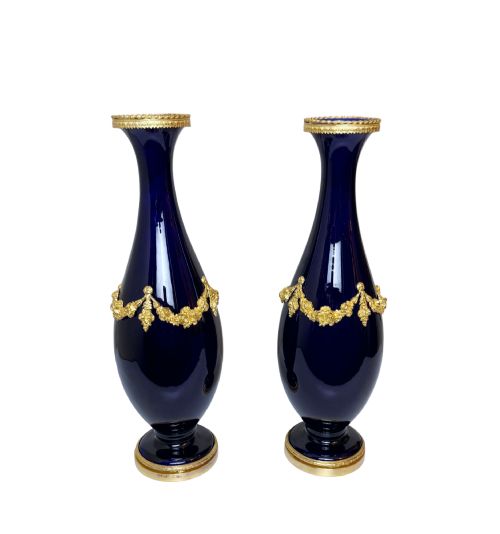
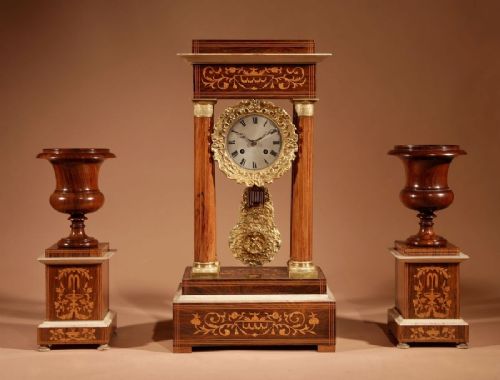
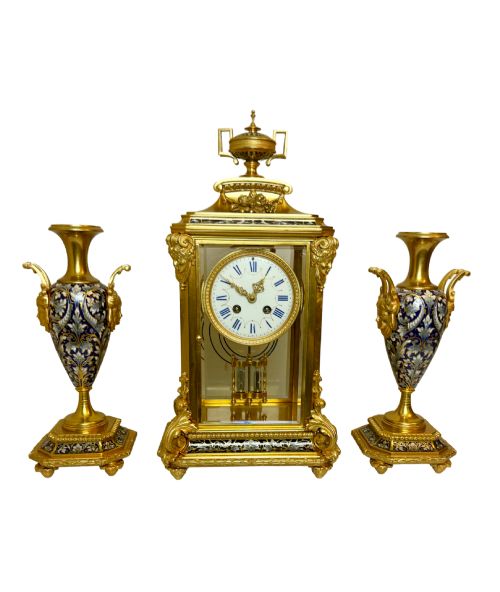
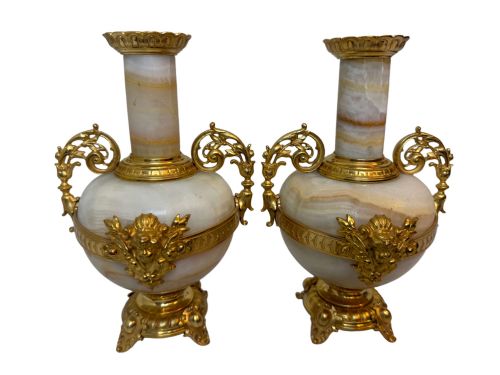
The most common forms are matched pairs of decorative vases, cassolettes, or ewers flanked by a central clock. These items were built to display on drawing-room mantelpieces, often mounted upon pedestals of white marble, siena marble, or onyx.
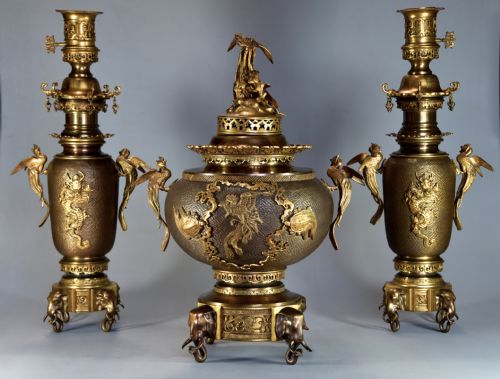
Originating largely from continental Europe, these garniture sets reflect historical revivals ranging from Egyptian motifs to Japanese-inspired Japonisme designs. Buyers select them to recreate period interior schemes or to introduce symmetrical ornamentation to a room.
How they were made
Maker's workshops cast bronze and ormolu elements using traditional foundry methods, applying fire-gilding or chemical patination to achieve the metallic surface finish. These metal mounts are fitted meticulously to bodies turned from natural stone such as white marble, onyx, and siena marble, or formed from fired porcelain and glass.
Many garnitures incorporate champlevé enamel or delicate ceramic inserts painted with classical scenes. Metal components are secured with threaded pins and nuts, joining the cast handles, bases, and rims directly to the central stone or ceramic vessel.
Bronze Garniture Urns Retail Price Guide 2026
Typical asking prices for bronze garniture urns among the pieces listed under this phrase on Sellingantiques today, from the lower quarter to the upper quarter. They describe what is for sale here now, not the wider market.
Listings feature nineteenth-century pieces combining gilt bronze, ormolu, marble, onyx, and Sèvres-style porcelain in classical and revival styles.
What varies in quality
The degree of crispness in the bronze chasing separates ordinary castings from exhibition-quality pieces. Superior examples exhibit deeply incised detail on acanthus leaves, scrollwork, and figural mounts, whereas lesser items show softer, shallower lines resulting from worn foundry moulds.
The selection of materials dictates the tier of the garniture, with monumental Sèvres porcelain bodies and heavy fire-gilded ormolu resting at the upper end. Integration between the bronze mounts and the underlying marble or onyx determines structural integrity, where precision in fitting distinguishes master workshops from standard commercial production.
A D Mougin·Vincenti of Paris
The Bronze Garniture Urns Glossary
- Garniture
- A set of decorative objects designed to be displayed together, typically consisting of a central clock flanked by two matching vases, urns, or candelabra.
- Cassolette
- A dual-purpose vessel featuring a reversible lid that transforms a decorative urn into a candleholder. The lid often exposes a nozzle on one side and a solid finial on the other.
- Ormolu
- Gilt bronze created by applying a finely ground gold-mercury amalgam to a bronze base and heating it to vaporise the mercury. It provides a durable golden finish seen on nineteenth-century French mounts.
- Champlevé
- An enamelling technique where troughs are dug into the surface of a metal object and filled with vitreous enamel powder before firing. This technique appears frequently on nineteenth-century clock sets and urn trims.
- Ewer
- A large pitcher with a wide spout and a curved handle, often produced in pairs alongside urns as part of a decorative garniture set.
Bronze Garniture Urns: Frequently Asked Questions
What is a bronze garniture set?
A bronze garniture set is a matching group of ornamental objects, usually comprising a central mantel clock accompanied by two matching urns, vases, or candelabra.
These sets were designed during the nineteenth century to sit in harmony upon a fireplace mantelpiece, creating a balanced and formal display.
How were cassolettes used?
Cassolettes functioned as versatile decorative pieces that could serve as either covered urns or candleholders depending on the position of the lid.
By reversing the lid, owners could switch the display from a solid stone or bronze vase to a functional candle socket.
Where should I place a garniture?
Garniture sets find their traditional home centred upon a mantelpiece, where the symmetry of the central clock and flanking urns can be fully appreciated.
They also sit effectively upon large sideboards, console tables, or pedestals where adequate depth and support exist.