





Bronze Cherub Clock Set
A bronze cherub clock set brings classical French elegance to a mantelpiece, pairing sculptural figures with precision timekeeping.
Bronze Cherub Clock Set
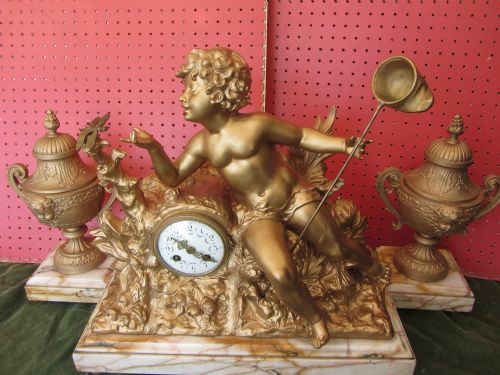
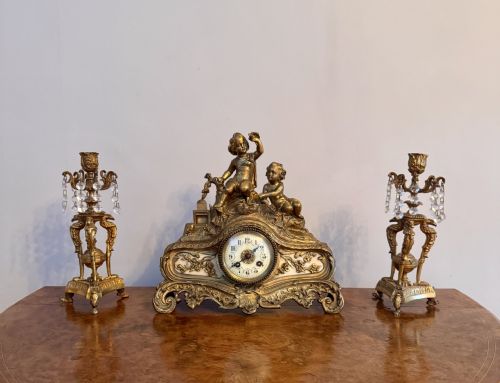
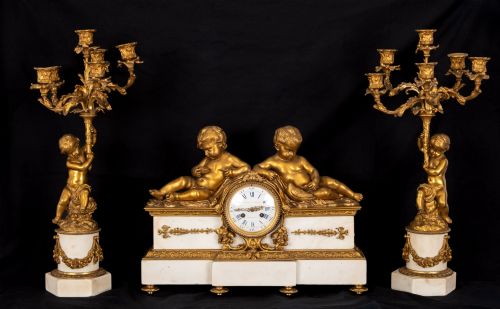
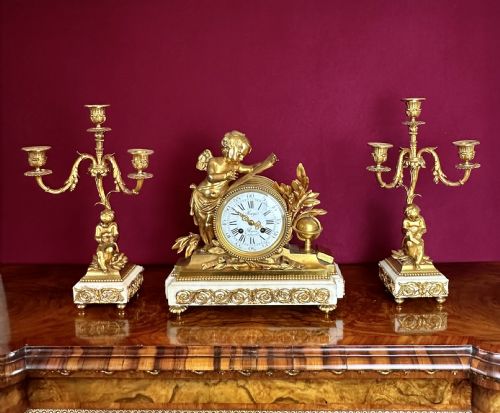
A bronze cherub clock set comprises a central mantel clock accompanied by matching garniture pieces, typically side vases or candelabra. These assemblies predominantly date from the nineteenth century, spanning Victorian, Second Empire, and Belle Epoque periods.
The dominant aesthetic draws heavily on Louis XVI revival and French Empire styles, frequently pairing cast metalwork with contrasting stone bases. Buyers frequently encounter complete three-piece sets featuring figural cherubs cast in bronze or gilt bronze alongside the primary dial.
Most examples originate from French workshops and utilise eight-day striking movements housed within architectural or sculptural cases. The cherub motifs appear as supporting figures, attendants to time, or playful putti flanking the central clock face.
Materials and construction methods
Foundries produced these objects by casting bronze, ormolu, and gilt metal, then combining the metallic elements with carved marble, onyx, or glass components. Ormolu surfaces received a fine mercury gilding treatment that yielded a durable, luminous finish.
Dial faces frequently integrated white enamel with painted Arabic or Roman numerals, occasionally protected beneath glazed bezels. Stone bases relied on white, red, or dark marble, shaped and polished to support the heavy metal ornamentation.
Bronze Cherub Clock Set Retail Price Guide 2026
Typical asking prices for bronze cherub clock set among the pieces listed under this phrase on Sellingantiques today, from the lower quarter to the upper quarter. They describe what is for sale here now, not the wider market.
The listings on this site demonstrate a strong preference for nineteenth-century French production, combining gilt bronze and marble.
Factors of quality and execution
The refinement of the bronze or ormolu casting dictates the visual success of the piece, separating crisp, hand-chased figural detail from softer, mass-produced results. Superior sets display meticulous attention to the musculature, hair, and facial expressions of the cherub figures.
Material selection and movement integration also define the tier of the work, with genuine marble and signed Parisian movements commanding greater attention than simpler gilt metal and unmarked mechanisms.
H Luppens Paris
The Bronze Cherub Clock Set Glossary
- Gilt Bronze
- Bronze that has been coated with a layer of gold or gold-coloured amalgam. This technique protects the metal underneath while providing a bright, decorative sheen.
- Ormolu
- Finely chopped gold applied to a bronze base using a mercury amalgamation process. The resulting finish yields a distinct yellow-gold brilliance characteristic of French decorative arts.
- Garniture
- A set of decorative matching objects designed to be displayed together on a mantelpiece. These typically include a central clock flanked by two matching vases or candelabra.
- Visible Pendulum
- A clock dial design featuring a glass aperture that reveals the swinging pendulum within. This mechanical detail allows viewers to watch the escapement in motion.
Bronze Cherub Clock Set: Frequently Asked Questions
What is a clock garniture?
A clock garniture is a matched set consisting of a central mantel clock and two companion side pieces, such as urns or candelabra. These sets were designed for symmetrical placement on mantelpieces or large sideboards.
The matching side pieces share the same materials, architectural styling, and decorative motifs as the clock housing, creating a unified display.
How do I wind these clocks?
Most nineteenth-century French clocks utilise an eight-day mechanical movement requiring a specialised winding key inserted into the dial face. Turning the key tensions the internal springs that power both the timekeeping and the striking train.
Care must be taken not to overwind the mechanism, stopping as soon as resistance is felt to preserve the historical springs.
Where should I place my clock set?
These heavy sets require a sturdy, level surface such as a mantelpiece, large console table, or heavy sideboard capable of supporting substantial bronze and marble weight. Direct sunlight and damp environments should be avoided to protect the enamel dials and gilt finishes.
Adequate clearance around the garniture pieces ensures the side ornaments balance the central clock without crowding.
How do I distinguish Louis XVI style?
Louis XVI style draws on classical symmetry, straight architectural lines, and restrained ornamentation rather than the extravagant curves of earlier Rococo periods. Look for urns, swags, ribbons, and classical columns incorporated into the bronze work.
Cherubs in this style often display calmer, more balanced postures that reflect neoclassical artistic ideals.