



British Military History Art
British military history art captures campaigns, battles and portraits across canvas and paper through centuries of service.
British Military History Art
British military history art encompasses framed oil paintings, watercolours, wood engravings and lithographs recording officers, naval commanders and significant engagements. Collectors seeking british military history art encounter works spanning the Georgian era, Victorian period and twentieth-century conflicts.
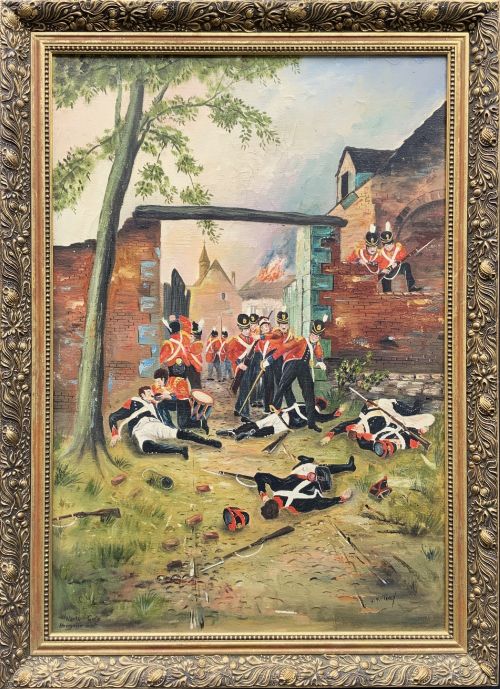
The selection ranges from large battle scenes on canvas to delicate portrait studies in ink and wash. Pieces document specific historical moments such as the Second Anglo-Afghan War and the Battle of Waterloo.
Materials and methods
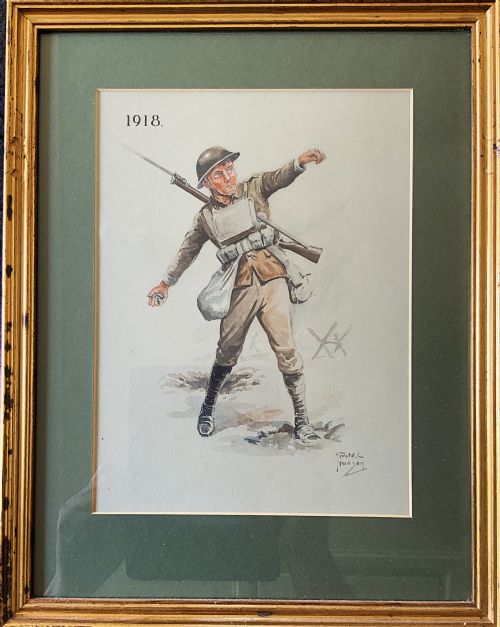
Artists deployed oil paint on canvas alongside watercolour, wash and ink on paper to render uniforms, portraits and naval actions. Wood engravings and authentic lithographs also preserved campaign scenes for contemporary publication and record.
Framed works frequently utilise traditional wood framing to protect fragile paper sheets and stretched canvases. Pigments applied by hand capture the distinct details of regimental attire and naval dress.
British Military History Art Retail Price Guide 2026
Typical asking prices for british military history art among the pieces listed under this phrase on Sellingantiques today, from the lower quarter to the upper quarter. They describe what is for sale here now, not the wider market.
A portrait subject wears a poppy in his lapel while holding a Poppy Day Report book.
Assessing quality and execution
Finer works display superior draftsmanship in facial likenesses, uniform accuracy and compositional balance. Masterly handling of light and shadow distinguishes accomplished portraiture from standard military illustration.
Signatures by documented artists or association with recognised historical sitters elevate the standing of a piece. The preservation of the original medium, whether oil on canvas or delicate watercolour, also influences desirability.
Sir John Gilbert·Sir Muirhead Bone·Henry L Gates·Maurice Codner·Sir William Charles Ross·Sir Richard Westmacott
The British Military History Art Glossary
- Lithograph
- A print produced by printing from a flat stone or metal plate treated to repel ink except where required. This technique allowed faithful reproduction of campaign sketches.
- Wood engraving
- A printmaking method where an artist carves an image into the end-grain of a dense block of wood. These detailed prints frequently illustrated nineteenth-century military journals and histories.
- Wash
- A thin, transparent layer of diluted watercolour or ink applied across paper to create smooth backgrounds or shadows. It often provides atmospheric depth in portrait studies.
- Realism
- An artistic style focused on accurate, unidealised depiction of subjects. Military realism prioritises historical fidelity in uniforms, equipment and battlefield topography.
British Military History Art: Frequently Asked Questions
What periods do these artworks cover?
The works span from the Georgian and Victorian eras through the First and Second World Wars. Pieces record naval and land operations across multiple centuries.
Dates range from the early nineteenth century into the mid-twentieth century, reflecting changing artistic styles and military uniforms.
Are these works signed by artists?
Certain pieces bear artist signatures or attributions to named painters and printmakers. Others are authenticated works by prominent recorders of military service.
Attributions connect individual sheets and canvases to established figures working within British art traditions.
What subjects typically appear in these pieces?
Subjects include portraits of admirals, generals, militia officers and princes in uniform. Battle scenes, marches and naval engagements also form core visual themes.
Artworks document specific regiments, campaigns and historical milestones from British military annals.
How are these historical artworks best displayed?
Framed oil paintings and paper prints require stable indoor wall environments away from direct sunlight. Proper framing protects delicate watercolours and engravings from atmospheric damage.
Displaying pieces with adequate clearance lets the detail of uniforms and campaign settings remain clearly visible.