



British Architectural Watercolour Painting
These works capture urban and rural scenes through delicate pigment on paper, prized for their preservation of historic streetscapes and buildings.
British Architectural Watercolour Painting
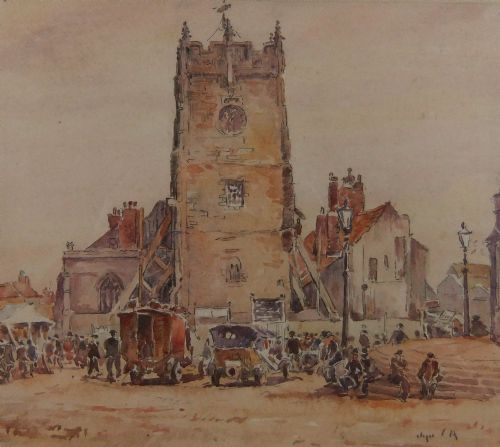
A british architectural watercolour painting depicts city streets, cathedrals, and historic buildings rendered through transparent pigment on paper. The selections on this page span from the nineteenth century through the mid-twentieth century, encompassing Victorian, Edwardian, and twentieth-century modernist movements.
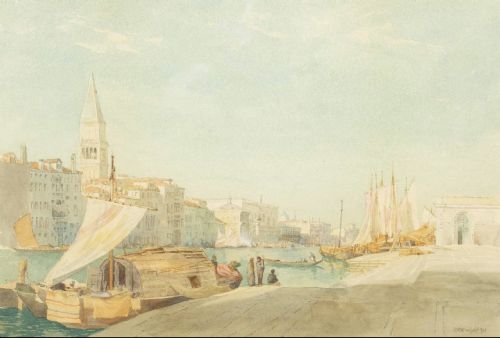
Most examples concentrate on recognizable landmarks, townscapes, and street scenes across Britain and Europe. Buyers encounter framed paintings, wall art, and fine art pieces executed by named artists and regional painters alike.
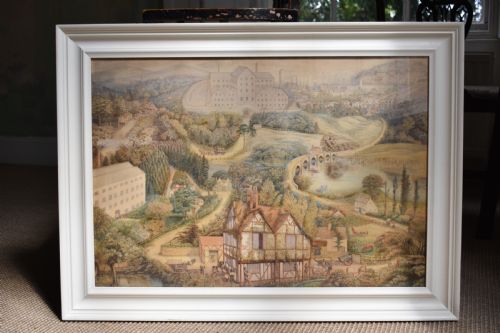
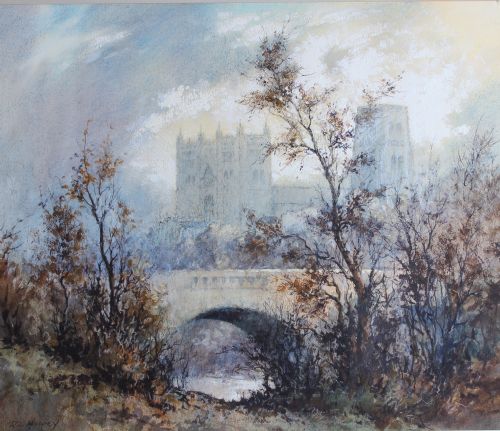
Works range from detailed depictions of abbeys and bridges to broader village and coastal views. These paintings serve as historical records of architecture and landscape from past eras.
Materials and Technique
Artists relied primarily on watercolour pigment applied to paper, often supported by initial pencil or ink underdrawing. The transparency of the medium required deliberate brushwork, as lighter areas depended on the untouched white of the paper rather than opaque white paint.
Framing typically involved glass and wood to protect the delicate paper surface from atmospheric moisture and handling. Ink and watercolour paint combinations allowed creators to define sharp architectural lines alongside softer washes for skies and shadows.
Listings span periods from the nineteenth century through the 1960s, featuring paper, watercolour pigment, and ink.
Evaluating Quality
Quality rests upon the artist's control of perspective, handling of light, and precision in rendering architectural detail. Stronger examples display confident brushwork that captures the texture of stone and brick without relying on heavy outlining.
The preservation of the paper and the vibrancy of the pigments dictate overall visual appeal. Pieces with minimal fading and well-preserved original framing maintain a stronger presence on the wall.
Thomas Ellison·John Smith Atherton·Richard Henry Wright·Robert Leslie Howey·Alfred George Morgan·Fred Lawson·Anne Dorrien Smith·Charles James Lauder·Rowland Henry Hill·Stanley Orchart·Louie Stanley Maurice Prince·George Whyatt·Edith E Caswall·Hercules Brabazon Brabazon·David Small·John Sowden·Jack Merriott·Tom Dudley·David Law·Noel Harry Leaver·Wilfred Knox·Sonia Lawson·Peter Toft·Beatrice Parsons·John J. Hamer
The British Architectural Watercolour Painting Glossary
- Watercolour
- A painting method in which the paints are made of pigments suspended in a water-soluble vehicle. This medium allows for luminous washes and transparent layers.
- Wash
- A thin, transparent layer of diluted watercolour paint spread across the paper. It is often utilised to render skies, water, or broad shadowed areas.
- Gouache
- An opaque watercolour paint containing white pigment added to create density. Artists occasionally combined it with transparent watercolour to highlight architectural details.
- Provenance
- The documented history of ownership of a work of art. Strong provenance establishes the authenticity and past exhibitions of a painting.
- Diptych
- A painting comprising two separate hinged or matched panels forming a single composition. In this medium, it typically presents paired views of related architecture or street scenes.
British Architectural Watercolour Painting: Frequently Asked Questions
How should I hang these watercolours?
Keep them away from direct sunlight to prevent the pigments from fading over time. UV-filtering glass provides an extra layer of protection for the paper.
Ensure they are displayed on interior walls where temperature and humidity fluctuations remain minimal. Proper framing with acid-free mounts prevents the paper from degrading against the backing.
How do I date a piece?
Examine the costume of any figures depicted, the style of the buildings, and the framing materials. Victorian and Edwardian works often feature specific signature styles and mounting techniques characteristic of their decades.
Signatures, gallery labels on the reverse, and artist biographical dates offer the clearest clues. Comparison with dated works by the same artist helps narrow the timeline.
Are these works always signed?
Many examples bear the artist's signature or monogram, typically placed in one of the lower corners. Signatures confirm the attribution when paired with known examples of the creator's hand.
Unsigned pieces still appear frequently, identified through stylistic traits, subject matter, or historic gallery labels. Attribution for unsigned works relies on stylistic consistency with documented paintings.
What subjects are most common?
Street scenes, cathedrals, bridges, and coastal architecture dominate the works on offer. Major cities like London and Venice appear alongside regional English towns and abbeys.
Artists frequently recorded local landmarks undergoing transition or historic streetscapes that have since vanished. These topographical records reflect both personal travels and local commission work.