
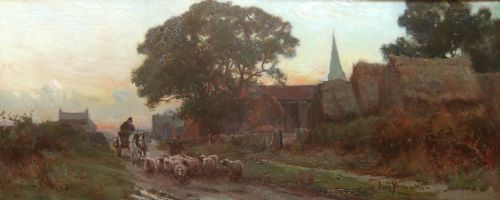


Staithes Group Artist Painting
These staithes group artist painting works capture northern coastal and rural life through vibrant brushwork and atmospheric light.
Staithes Group Artist Painting
A staithes group artist painting represents a distinct movement of northern British artists inspired by French Impressionism, capturing local scenes around Yorkshire. You will frequently encounter works depicting coastal harbours, rural landscapes, and domestic moments from the late Victorian era through the interwar years. These pieces often record specific locations such as Whitby, Staithes, and surrounding Yorkshire villages with remarkable local character.
The selection ranges from intimate watercolours on paper to substantial oil paintings on canvas and panel. Domestic interiors, still life compositions, and pastoral views of sheep grazing or figures outside country houses appear regularly. Each piece serves as a visual record of northern village life during the early decades of the twentieth century.
Assessing Quality and Execution
Quality rests upon the confidence of the brushwork, the handling of light, and the compositional strength of the scene. Stronger examples display energetic, purposeful strokes that define form and atmosphere without unnecessary detail. Weaker pieces can feel static, relying on formulaic colour arrangements rather than direct observation.
The handling of the medium dictates visual depth, whether through rich impasto in oils or transparent, luminous washes in watercolours. Condition of the underlying paper or canvas, alongside originality of surface, further separates standard decorative examples from accomplished artistic records.
The documented periods span from Victorian times through the Edwardian era and into the nineteen thirties.
Owen Bowen·Rowland Henry Hill·Florence Hess·James Watson·Frederick W Jackson·Paul Paul·James William Booth·Ernest Higgins Rigg
The Staithes Group Artist Painting Glossary
- British Impressionism
- A style of painting that adopted French Impressionist techniques of light and colour while retaining British subject matter. Practitioners focused on everyday scenes and plein air observation.
- Impasto
- Paint applied thickly to a canvas or panel, standing out in relief from the surface. This technique adds tactile dimension and captures reflected light.
- Plein air
- Painting outdoors in direct natural light to capture the immediate visual conditions of a landscape. Artists used this approach to record changing weather and coastal atmospheres.
- Watercolour pigment
- Colour suspended in a water-soluble binder, applied to paper in translucent washes. It allows for rapid sketching and delicate tonal transitions.
Staithes Group Artist Painting: Frequently Asked Questions
What defines a staithes group artist painting?
These works are created by members or associates of the northern British art colony influenced by Impressionist principles. They document Yorkshire coastal communities, landscapes, and daily rural life.
Subjects range from busy fishing harbours and cliff tops to quiet domestic gardens and still life arrangements.
How should I display oil and watercolour pieces?
Oil paintings on canvas or panel benefit from stable indoor environments away from direct heat sources. Watercolours on paper require protection from direct sunlight to prevent fading of pigments.
Both mediums are best housed in appropriate frames that allow the paper or canvas to breathe naturally.
How do I distinguish watercolours from oil paintings?
Watercolours are painted on paper, often showing delicate washes and visible paper texture beneath the pigment. They are traditionally displayed behind glass for protection.
Oil paintings utilise heavier paint layers applied to canvas or wood panel, presenting a textured, opaque surface that does not require glass.
What periods do these paintings represent?
The available works span from the late Victorian period through the Edwardian era and into the interwar years of the nineteen thirties. This timeframe captures the peak years of the northern art colony.
Stylistic shifts reflect broader movements from academic realism toward brighter Impressionist colour palettes.