
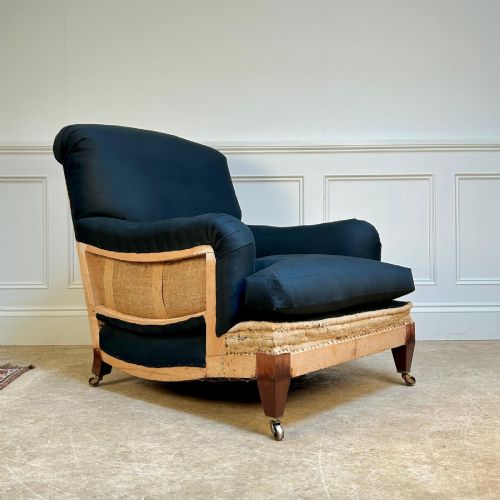
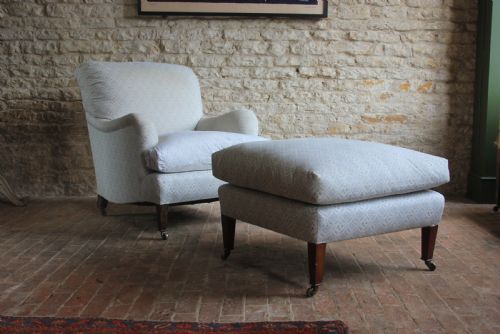


Bridgewater Armchair
A bridgewater armchair offers deep, sprung comfort wrapped in English country house character.
Bridgewater Armchair
A bridgewater armchair is a deep-seated upholstered seat defined by rolled arms and a relaxed profile. These pieces range from Victorian originals to later style variations found across Edwardian and twentieth-century periods.
Most examples encountered here follow the English country house tradition, often associated with maker workshops and distinct period textiles.
Buyers look for these armchairs to anchor a traditional sitting room with generous proportions and unpretentious form.
Construction and Materials
Makers built the foundational frame using hardwood timbers such as beech and mahogany to ensure lasting structural integrity. Traditional upholstery techniques deployed coiled springs, hessian webbing, and horsehair stuffing beneath outer layers of fabric.
Surface details often include turned wooden supports, brass castors, and ball and claw feet. Upholstery choices span cotton prints, patterned textiles, and kilim coverings.
Listings feature pieces spanning the Victorian, Edwardian, and 1930s periods, constructed from mahogany, beech, and brass.
Judging Quality
The distinction between standard examples and top-tier pieces rests on maker attribution, originality of frame, and period upholstery preservation. Pieces bearing documented maker stamps command greater attention from collectors.
The integrity of the internal springing and the weight of the timber frame dictate daily resilience. Original period fabric coverings in sound condition elevate a chair above standard reupholstered counterparts.
Howard & Sons·Lenygon & Morant
The Bridgewater Armchair Glossary
- Hessian
- A coarse woven fabric typically utilised for internal webbing and foundation support beneath upholstery. It provides stable tension across the frame springs.
- Kilim
- A flatwoven textile originating from Near Eastern traditions, occasionally utilised for distinctive upholstery. Such coverings alter the visual weight of the chair.
- Edwardian
- A stylistic period spanning the reign of King Edward VII, noted for refined domestic comfort. Pieces from this era often refine earlier Victorian proportions.
- Castor
- A small wheel fitted to the base of furniture legs for ease of movement. Brass versions are common on traditional upholstered seating.
Bridgewater Armchair: Frequently Asked Questions
What defines a bridgewater armchair?
A bridgewater armchair is distinguished by its low rolled arms, deep seat, and relaxed proportions. These elements combine to create an informal silhouette associated with country house interiors.
Makers built them for comfort, often pairing the generous seat with sprung support and turned wooden legs.
How do I identify a Victorian example?
Victorian examples display heavier timber frames, traditional stuffing materials, and period textile coverings. Maker stamps on the castors or webbing often confirm the era.
Compare the upholstery tacking and frame construction to distinguish nineteenth-century originals from later twentieth-century interpretations.
Where should I place this armchair?
These armchairs suit studies, drawing rooms, and reading corners where deep seating is desired. Their traditional styling complements patterned rugs and classic wooden furniture.
Allow sufficient space around the chair to accommodate the rolled arms and any matching footstool.
Are footstools usually matched?
Some armchairs appear with matching footstools designed in the same upholstery fabric. These companion pieces share the period turned legs and low profile of the main seat.
Matched sets offer an extended surface for relaxing within a traditional sitting room layout.