



Brass Twin Branch Sconces
Brass twin branch sconces bring period illumination to a room, offering functional wall mounting alongside ornamental metalwork from the nineteenth and early twentieth centuries.
Brass Twin Branch Sconces
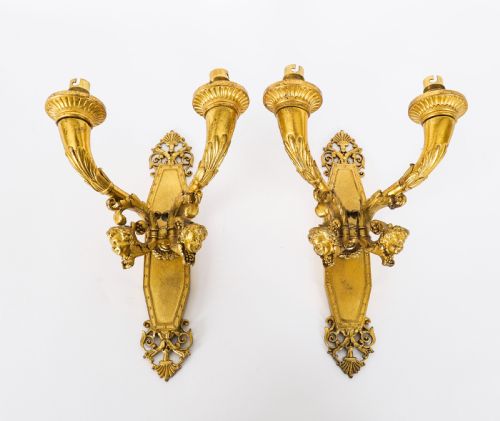
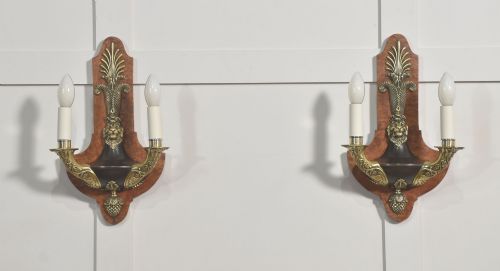
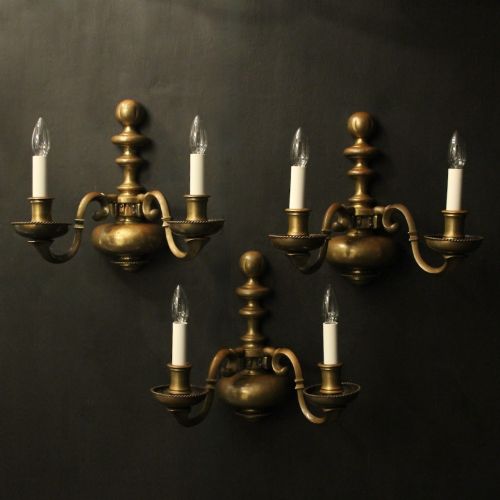
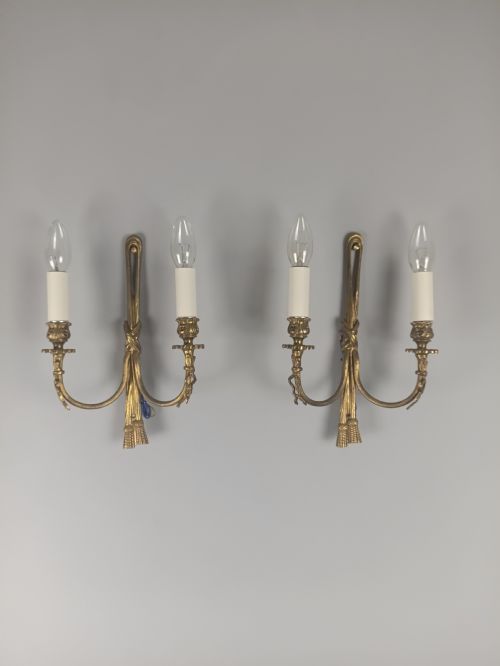
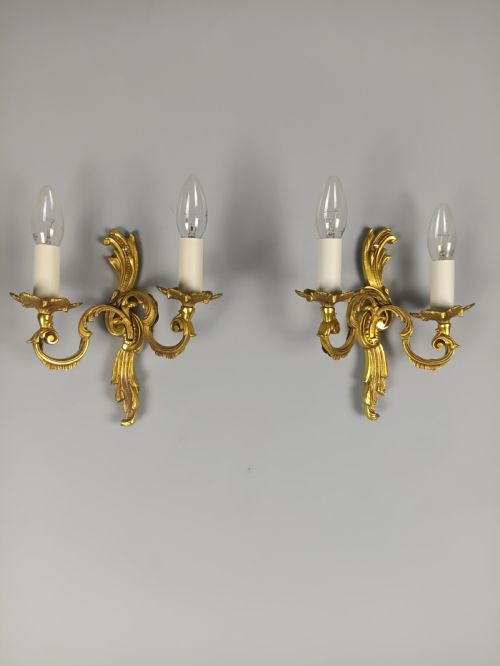
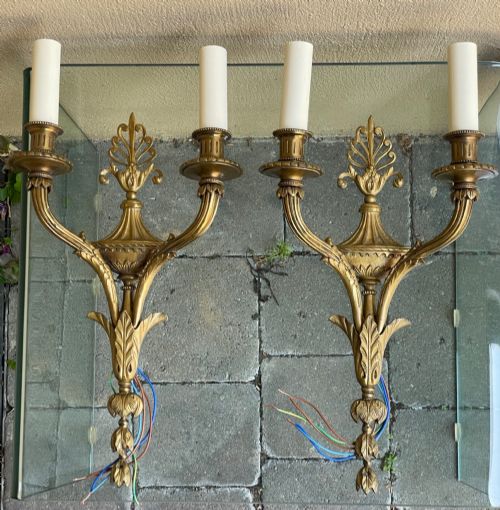
Brass twin branch sconces are wall lights and girandoles designed to hold candles or bulbs across two distinct arms, drawing from French Louis XIV Revival, Empire, Neoclassical, and Edwardian styles. These pieces range from simple brass and cast metal constructions to ornate gilded bronze, ormolu, and burr walnut combinations.
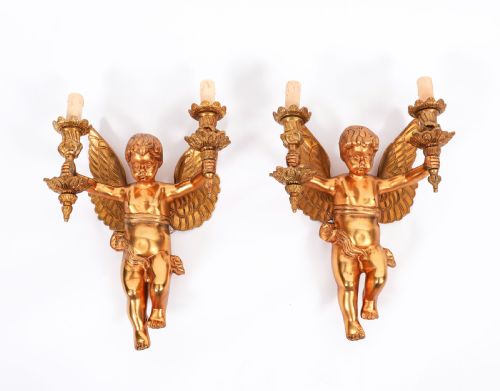
The selections available here lean heavily into early twentieth-century interpretations, particularly pieces from the 1920s and 1930s, alongside nineteenth-century examples spanning the Victorian period and the 1880s. Buyers will frequently encounter French and English designs, including specific motifs like ribbons, cherubs, and Chinoiserie.
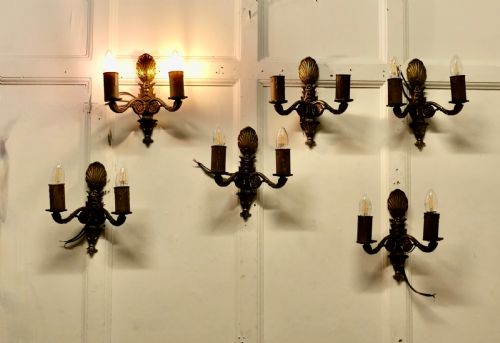
Forming pairs or larger sets, these wall lights function as flanking fixtures for mirrors, fireplaces, or architectural panels. The inventory encompasses both restrained English traditional brass work and elaborate continental gilt bronze pieces.
Materials and construction methods
The primary metals utilised across these fixtures include brass, cast brass, bronze, gilt bronze, and ormolu, sometimes combined with wood such as burr walnut or supplemented by glass elements. Workshops cast the metal components in sections before assembling the twin branches and backplates.
Surface finishes involve careful gilding, silverplating, or silver gilding applied to the base metal to achieve a rich metallic lustre. Detailing is often hand-finished through chasing and sculptural moulding, particularly on French Rococo and Neoclassical revival pieces.
Listings for brass twin branch sconces span the Victorian period through to the 1930s, incorporating French Rococo, Empire, and Neoclassical styles.
Distinctions in craftsmanship
The standard of a fixture rests upon the crispness of the metal casting and the depth of the chasing on the branches and backplates. Finer examples display sharp anatomical details on figures like cherubs and smooth, integrated joints between the arms and the main body.
Material choice and finishing also dictate the tier of the piece, with heavy ormolu and fire-gilded bronze sitting above simpler plated metal or basic cast brass. The coherence of the design style, whether strictly executed in an Adam, Empire, or Louis XIV idiom, governs the overall artistic merit.
F. & C. Osler
The Brass Twin Branch Sconces Glossary
- Ormolu
- Gilded bronze, typically produced by applying a mercury-gilding amalgam to a bronze base in nineteenth-century and earlier workshops. This technique yields a deep, enduring golden surface.
- Girandole
- An ornamental branched wall light or sconce, frequently paired with a mirror or reflective backplate to amplify the candle flame. The term often describes decorative twin arm wall fittings.
- Neoclassical
- A style drawing inspiration from classical antiquity, featuring symmetrical lines, urns, ribbons, and restrained ornamentation. It appears frequently across Edwardian and early twentieth-century lighting.
- Chinoiserie
- European artistic interpretations of Chinese and East Asian decorative motifs. These sconces incorporate whimsical orientalist themes into the metalwork of the backplate.
- Cast brass
- Molten brass poured into a mould to form intricate structural and decorative components. It serves as the primary structural medium for many wall sconces.
Brass Twin Branch Sconces: Frequently Asked Questions
How do I tell an 1880 piece from a 1930 piece?
Nineteenth-century pieces, such as those from the Victorian era or around 1880, typically feature heavier cast bronze or ormolu construction with deeper hand-chased details. Styles from this era lean heavily into French revivals like Louis XIV and ornate Empire designs.
Fixtures from the 1930s often reflect more stylised or simplified interpretations, including Adam and Edwardian revivals, with lighter gauge brass or silver gilding. Examining the fastening screws, wiring channels, and metal patination helps clarify the era of manufacture.
Are these sconces suitable for modern wiring?
Most antique wall lights of this type have already been converted to accept modern electrical fittings during their working life. The hollow arms and backplates generally accommodate standard internal wiring conduits safely.
Buyers should consult a qualified electrician to inspect the internal wiring and ensure the fixture meets current safety standards prior to installation. The structural mounting points remain sturdy enough for domestic wall placement.
What is the difference between ormolu and gilded brass?
Ormolu specifically refers to gilded bronze, where a layer of gold is bonded to a bronze casting using traditional mercury-gilding techniques or high-grade modern equivalents. This results in a heavy, warm, and durable golden finish characteristic of finer antique pieces.
Gilded brass involves applying a gold-coloured finish or leaf to a lighter brass substrate. While visually similar, brass is generally lighter in weight and reacts differently to cleaning than solid bronze or ormolu.