
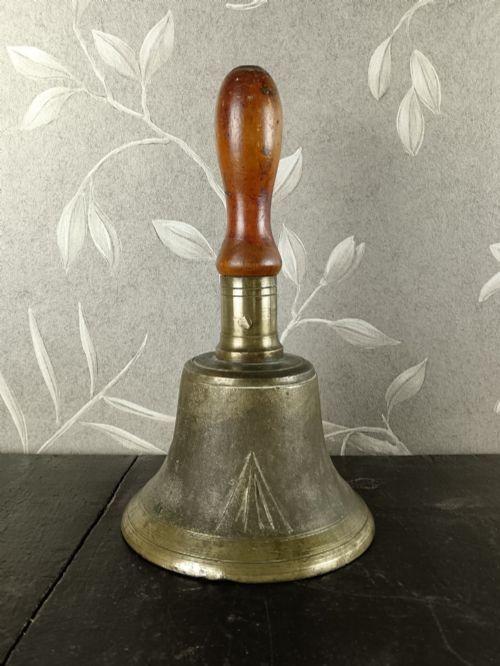


Brass School Bell
These heavy, bright brass school bell examples bring an authoritative ring and solid Victorian or Edwardian craftsmanship straight into your hallway.
Brass School Bell
A brass school bell serves as a tangible piece of institutional history, functioning both as a practical hand ringer and a striking decorative object. When you search for a brass school bell, you encounter handheld instruments designed to gather attention across classrooms, yards, or assembly halls.
The selections available here span the late nineteenth century through to the mid twentieth century, encompassing Victorian and Edwardian periods. Alongside traditional hand bells with turned wooden handles, the evidence shows wall-mounted chimes and military warning pieces that share the same resonant metal construction.
Most pieces you meet on this page are English or continental examples forged from brass and bronze, often paired with handles made from oak, mahogany, lignum vitae, or ebonised wood. These items cross over into domestic use easily, serving effectively as dinner chimes or hallway decor.
How they were made
Maker workshops relied on traditional casting methods to shape the brass and bronze bodies, pouring molten metal into moulds to achieve the thick walls necessary for a clear, carrying tone. This process produced sturdy bells designed to withstand daily use in bustling school environments.
Handles were turned on lathes from dense timbers such as oak, mahogany, and lignum vitae, then attached securely to the metal domes. The combination of cast metal and hard timber created a balanced weight that made frequent ringing manageable for a teacher or town crier.
Listings incorporate items forged from cast brass and bronze, paired with wooden handles in oak, mahogany, and lignum vitae.
What varies in quality
Quality in these pieces rests upon the purity and thickness of the cast brass, which dictates the warmth and longevity of the tone. Superior examples exhibit clean casting lines and well-proportioned domes that project sound clearly without harsh metallic rattling.
The secondary materials reveal the care taken in construction, distinguishing standard utility items from finer specimens. Well-turned hardwood handles displaying rich grain and secure joinery elevate a piece above simpler utilitarian counterparts.
The Brass School Bell Glossary
- Hand bell
- A portable bell designed to be picked up and rung by hand using an attached handle. These items typically feature a brass or bronze dome and a wooden grip.
- Dinner chime
- A secondary function for a bell where it is used within a home to announce meals. They share the same acoustic properties as school and town criers' instruments.
- Lignum vitae
- A dense, heavy exotic hardwood used for turnery on tool handles and bell grips. Its natural oils give it exceptional durability.
- Cast brass
- Metal shaped by pouring liquid alloy into a mould rather than beating it from sheet metal. This technique allows for thicker walls and deeper acoustic resonance.
- Edwardian
- The period spanning the reign of King Edward VII, characterised by refined decorative arts following the Victorian era.
Brass School Bell: Frequently Asked Questions
How loud is a typical school bell?
These bells are cast with thick metal walls designed to project sound clearly across a large room or an open courtyard.
When rung indoors, they produce a sharp, resonant tone that carries well without needing excessive force from the user.
Were all these bells used in schools?
While many served educational institutions, the category also includes town crier instruments, military warning bells, and domestic dinner chimes.
Their shared design origins mean they functioned similarly regardless of whether they hung in a classroom or a municipal hall.
What woods are found on the handles?
Makers selected dense hardwoods capable of enduring repeated handling and tension.
Common timbers seen include oak, mahogany, lignum vitae, and ebonised wood, each offering a solid grip and contrasting colour against the bright brass.
How do I care for the brass?
The metal benefits from occasional dusting with a soft cloth to prevent the accumulation of grime on the surface.
Many collectors prefer to leave the natural aged patina undisturbed rather than polishing the brass to a bright shine.