

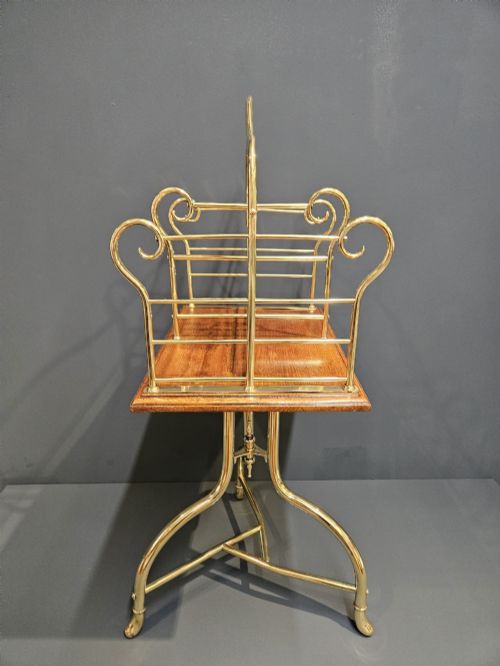


Brass Revolving Rack
A brass revolving rack brings movement and utility to your room, holding your books and magazines within easy reach while showing the polish of Victorian or Edwardian metalwork.
Brass Revolving Rack
A brass revolving rack encompasses revolving book stands, magazine stands, and occasionally fireplace accessories designed to turn smoothly on a base. When you search for a brass revolving rack, you encounter functional furniture built to display volumes or periodicals accessibly.
The versions most likely to meet you on this page are Victorian or Edwardian pieces combining brass with mahogany or oak. These rotating stands range from compact tabletop book tables to floor-standing bookcases and magazine holders.
Makers of the nineteenth and early twentieth centuries also produced revolving fireplace toasters with copper inlay alongside standard book stands. Each piece relies on a central pivot mechanism to allow effortless rotation of the tiered sections.
How they were made
Craftsmen built these rotating pieces using solid hardwoods like mahogany and oak, frequently pairing them with structural brass fittings and turnings. Some tabletops incorporate inset marble slabs, while other stands feature inlaid brass details or copper heart motifs.
The revolving action depends on hidden internal iron or steel swivel mechanisms that support the weight of the timber tiers. Joinery methods of the Victorian and Edwardian periods ensured that the rotating column remained stable under the load of heavy books.
Brass Revolving Rack Retail Price Guide 2026
Typical asking prices for brass revolving rack among the pieces listed under this phrase on Sellingantiques today, from the lower quarter to the upper quarter. They describe what is for sale here now, not the wider market.
Listings on this page span the Victorian, Edwardian, and nineteenth-century periods, utilising brass, mahogany, oak, and marble.
What varies in quality
The distinction between ordinary utility items and superior examples lies in the crispness of the brass casting and the selection of timber grain. Mahogany and oak frames with fine figuring or intricate brass inlay command greater attention than plain, utilitarian versions.
Smoothness of rotation and the heft of the metal components also define the upper tier of quality. A well-balanced stand turns without lateral wobble, reflecting precise alignment of the internal pivot mechanism during manufacture.
The Brass Revolving Rack Glossary
- Revolving book stand
- A rotating piece of furniture designed to hold books upright across multiple sides for easy selection. These stands sit upon stationary bases connected by a central pivot.
- Canterbury
- A low wooden stand traditionally used for holding sheet music or periodicals, often featuring partitioned sections. Some nineteenth-century examples incorporate rotating designs.
- Arts and Crafts
- A design movement of the late nineteenth and early twentieth centuries emphasising handcraftsmanship and simple forms. Pieces from this style often display honest construction and modest metal inlay.
- Regency
- An English architectural and decorative style spanning the early nineteenth century characterised by classical restraint. Furniture from this period frequently utilises dark hardwoods and subtle brass accents.
Brass Revolving Rack: Frequently Asked Questions
What is a brass revolving rack?
A brass revolving rack is a rotating piece of furniture, typically a book or magazine stand, constructed from timber with prominent brass fittings. These stands allow users to access multiple volumes or periodicals from a single seated position by simply spinning the tiers.
Such stands date primarily from the Victorian and Edwardian eras when multi-functional furniture became popular in domestic libraries and sitting rooms. The integration of brass provided both structural reinforcement and decorative contrast against woods like mahogany and oak.
How do you use a revolving book stand?
You place books or magazines vertically between the wooden or brass dividers of the rotating tiers, allowing titles to remain visible from all sides. The central pivot enables you to spin the stand gently to select your reading material without moving around the furniture.
These pieces function well beside armchairs, desks, or in small reading corners where floor space is limited. Their compact footprint maximises storage capacity by utilising vertical height and rotation.
How do I care for brass and mahogany?
Clean the brass components periodically with a dry or very lightly dampened soft cloth to maintain their sheen without stripping patinated surfaces. Avoid harsh chemical polishes that can damage surrounding wood finishes or inlaid details.
Feed the mahogany or oak timber occasionally with appropriate furniture wax to preserve the depth of the grain and prevent the wood from drying out. Keep the revolving mechanism free of dust to ensure smooth, silent rotation over time.
How do I tell Victorian from Edwardian stands?
Victorian stands, dating from the mid to late nineteenth century, often feature heavier carved timber, richer dark mahogany tones, and more ornate brass mountings. Their construction tends toward robust proportions and formal decorative detailing. * * * Edwardian pieces, produced after nineteen hundred, generally present lighter oak frames, cleaner lines, and simpler geometric inlays influenced by later design movements. The overall aesthetic shifts toward brighter, airier domestic interiors.